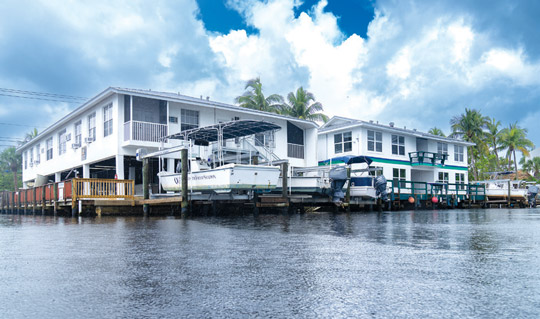
For the first time since Hurricane Ian devastated Southwest Florida in 2022, FGCU’s Vester Field Station in Bonita Springs became fully operational again — a milestone made possible through a combination of significant investments from FGCU and multiple grant partners. A $150,000 grant from the Collier Community Foundation played a crucial role in helping bring the project across the finish line.
Researching Water Issues and Sustainability
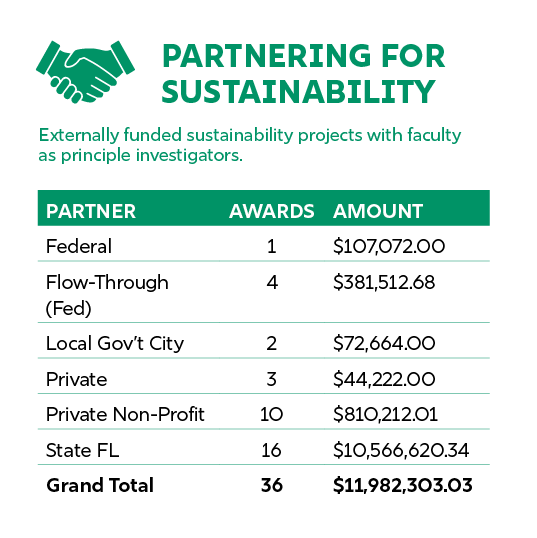
The Water School sustained significant research momentum in 2025-26, securing 24 new grant awards totaling $11.36 million while maintaining 52 continuing grants — a strong performance given that many federal grant programs suspended proposal solicitations during the year. Research expenditures reached $11.78 million, reflecting the capacity of the school’s active grant portfolio.
Funding support came from key state and regional partners including the Florida Department of Environmental Protection, the South Florida Water Management District, the Florida Fish and Wildlife Conservation Commission, and the National Academies of Sciences, underscoring the school’s central role in addressing Florida’s most pressing water quality and environmental challenges.
Scholarly productivity remained robust, with faculty authoring 39 peer-reviewed publications, three books and five book chapters — contributions that extend FGCU’s influence well beyond Southwest Florida. Across these efforts, 24 faculty served as principal investigators, reflecting a broad and engaged research culture within The Water School.
Expanding Education and Outreach
The Taskforce on Regional Sustainability and Resiliency is expanding sustainability and community resilience education, strengthening faculty expertise and establishing a globally recognized interdisciplinary research institute. Current efforts include developing innovative, problem-based graduate programs in sustainability and resilience and exploring additional degree offerings. FGCU also plans to recruit faculty with expertise in sustainability and resilience to support these programs and expand the university’s leadership in these fields, including at the planned institute in Babcock Ranch.
The proposed Institute on Sustainability and Resiliency at Babcock Ranch will integrate research, practice and community partnerships to advance innovative solutions, connect Florida communities with global expertise, train future sustainability leaders and translate research into policy and practice.
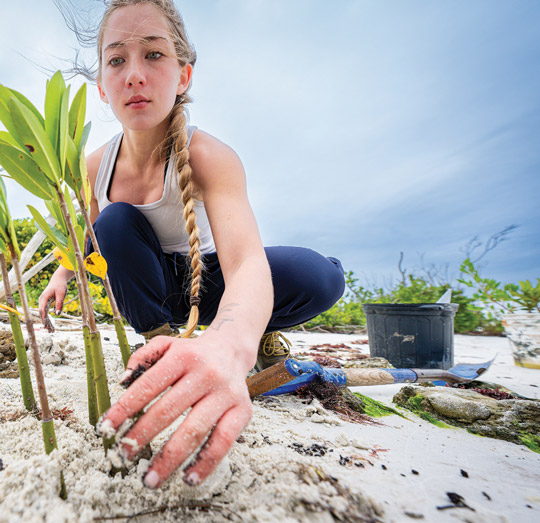
Restoring Our Coastline
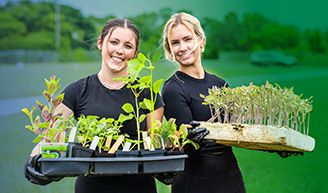
In December, FGCU faculty and students teamed up with Island Coast High School and Lee County to plant hundreds of mangroves at Bowditch Point Park on Fort Myers Beach. They replaced trees wiped out by Hurricane Ian in 2022 — an effort to restore a vital stretch of the San Carlos Bay shoreline.
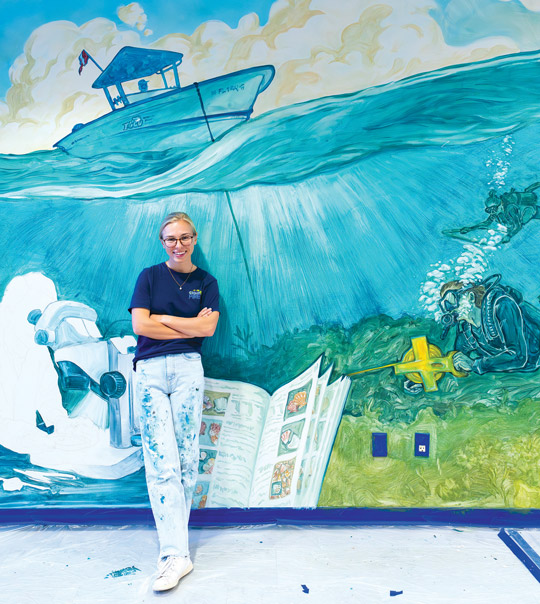
The Art of Experiential Learning
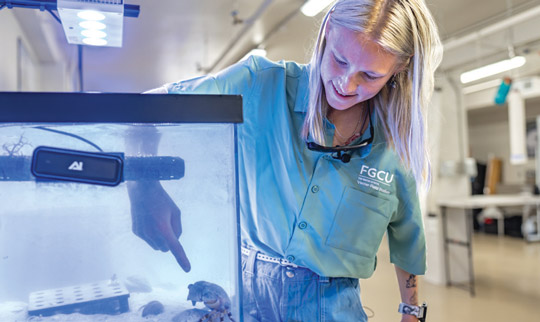
Art and biology major Macy Noll won a commission to paint a mural inside the University Library on the theme of “Knowledge in Motion.” Having spent two years as a research assistant for the Vester Field Station and currently serving as an instructor for scientific diving, Noll based her design on firsthand experience of the impact of this kind of experiential learning.
Integrating Sustainability Across Campus
The University Sustainability and Resiliency Council is charged with an on-campus review of operationalizing the strategic goal to champion sustainable practices and resiliency. The council includes administrators, students, staff and faculty who are reviewing and making recommendations around academics and operations. This includes the creation of an office of sustainability, ongoing training for faculty and staff, the use of Sustainability Tracking and Reporting System (STARS) as a continuous improvement model and new initiatives in academic programming around sustainability and community resilience.