

Your University: The FGCU Podcast
More than Basketball: Raina Harmon on Coaching and Community at FGCU
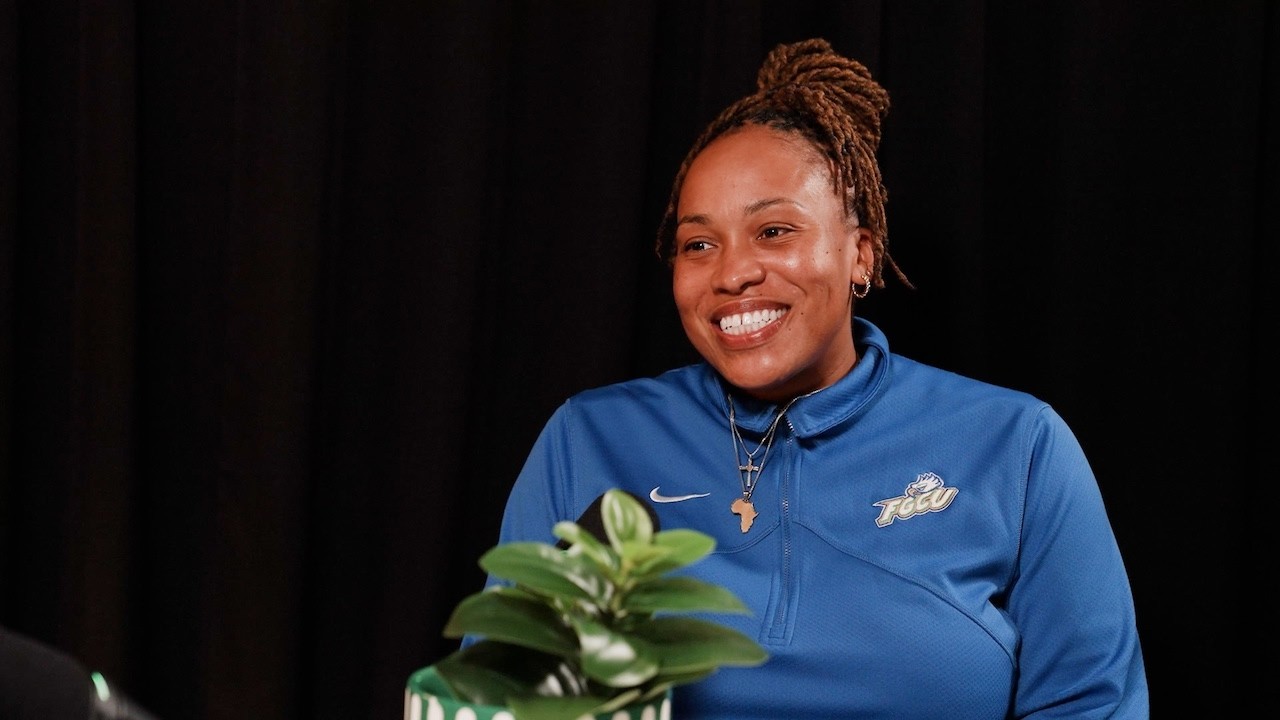
In this episode of Your University: The FGCU Podcast, host Katie Cribbs sits down with Raina Harmon, Head Coach of FGCU Women’s Basketball.
Raina shares her journey from Detroit to leading one of the nation’s most successful mid-major programs. The conversation explores her coaching philosophy, the importance of building strong relationships with student-athletes and how academic excellence, work ethic and community support shape the culture of FGCU Women’s Basketball.
Available on:


Available on:
Episode 2:
More than Basketball: Raina Harmon on Coaching and Community at FGCU
In this episode of Your University: The FGCU Podcast, host Katie Cribbs sits down with Raina Harmon, Head Coach of FGCU Women’s Basketball.
Raina shares her journey from Detroit to leading one of the nation’s most successful mid-major programs. The conversation explores her coaching philosophy, the importance of building strong relationships with student-athletes and how academic excellence, work ethic and community support shape the culture of FGCU Women’s Basketball.
-
Episode Guide
Toggle More Info00:00 Introduction and Midwest Roots
01:54 Journey to Coaching at FGCU
03:37 Finding Passion in Coaching
05:38 Manifesting Success and Building Relationships
08:32 Coaching Philosophy and Team Dynamics
15:14 Academic Focus and Student Support
17:21 Building a Winning Culture at FGCU
18:29 FGCU's Championship Pedigree
21:03 Community Engagement and Support
29:08 Memorable Moments and Fan Support
-
Transcript
Toggle More Info[00:00:00] Raina Harmon: Yeah, but what are you here for? Because basketball’s fleeting. At some point, the ball’s going to stop bouncing. And your degree and your experience here, as you network throughout your major, is going to matter.
[00:00:17] Katie Cribbs: This is Your University, the FGCU podcast, where we talk to the people on campus making a difference in the Southwest Florida community and beyond. From research and the arts, to student success and athletics, we are uncovering the stories impacting you. I'm your host, Katie Cribbs.
It’s hard not to get excited about today’s guest. She’s the type of person who knows how to get you fired up, ready to work hard, and win. That’s one of the reasons why Raina Harmon was chosen as the head coach of FGCU’s women’s basketball team.
Raina, welcome to the show!
[00:00:56] Raina Harmon: Thank you. It’s a pleasure to be here. I’m excited to have this conversation with you.
[00:01:00] Katie Cribbs: Yeah. So, we always like to say that we have a lot of people from the Midwest. I think that’s an understatement. We have a ton of people from the Midwest. And you’re from the Midwest, too?
[00:01:11] Raina Harmon: Yes, I am. Born and raised. Detroit versus everybody, as we like to say.
[00:01:14] Katie Cribbs: Were sports important to you and your family growing up?
[00:01:17] Raina Harmon: Yeah, very much so. So, I’m an only child with a single mom. And so, my mom, she worked at a place called Police Athletic League. And so, you know, I grew up Detroit in the '80s and '90s. And so, for her, she found it very important to get me in a room full of my peers instead of around adults all the time.
And because she worked for an athletic association, she said, ″I’m going to put you in every single sport so that you are going to have sisters and brothers and learn how to share and have teamwork and discipline and time management." And so, early on, sports was very important in my household. I became a cheerleader at the age of six. And from there, through Detroit Police Athletic League, I went to their cheer program, the ski program, the tennis program, the softball program, the track program. And then I fell in love with basketball as my last sport that I tried.
[00:02:04] Katie Cribbs: You’re the third coach at FGCU’s history for the women’s basketball program. What brought you here?
[00:02:10] Raina Harmon: Yeah, a lot of luck and a lot of faith. And so, I’m sure we’ll get to my whole journey. But most recently, I was at the University of Iowa as an assistant coach, where I was for the past eight years. And I would say about two years ago, I started to have the head coaching itch, and people always told me, ″You’ll know when you know." I would always say, ″How did you know you were ready to become a head coach?" And you’re never really ready. But I think if you have that inkling in you to have that next step, you’ll know when.
And so, for me, I knew that I wanted to go to a place that I was going to be replacing someone that had a lot of success, because that’s where I came from. And so, I didn’t necessarily want to be a part of a rebuild or a place that hadn’t won. And I understood that came with some pressure. But I think for my past couple years I’ve been living in pressure. And so, it’s a funny story. We were in Oklahoma for our regional in the NCAA tournament, and I was watching FGCU play Oklahoma. And this was the second time in three years that I had come across FGCU.
So, they had to come to Oklahoma. We played Oklahoma next. We failed to them as well. And on the bus ride to go to the plane, I just happened to be scrolling on social media. Our season was over, and I saw a post that said, “Thank you, Chelsea.” And I realized that Chelsea was going to go join Karl at the Atlanta Dream. And I said, “This is it.”
I had some other places in mind, but they never really felt strong for me, and like just that’s the place where I belong. And so, I didn’t know if FGCU wanted me, but I knew that I wanted it. And so, I texted and called my agent right away, and I said, “I don’t know what they’re looking for. Go.” About four days later, I had an interview.
[00:03:47] Katie Cribbs: You know, we talked a little bit on the phone. Did you find coaching, or did coaching find you?
[00:03:52] Raina Harmon: Yeah, coaching found me. And so, I went to Central Michigan University for undergrad, played basketball there all four years, was on scholarship. But this was before the WNBA, but I wasn’t good enough to play overseas or continue my career. But I did get my degree in sports studies, minor in marketing. And so, when I went back home, I went to Green Bay for a couple months, where I worked for this program called North American Youth Sports.
And I said, “I like it, but not love it.” Green Bay is not necessarily the place for me, so let me go back home. My mom said, “You can come live home for a year. You got to find some work.” And so, I applied to become a long-term substitute teacher. So, I would pick up the phone every day and say, “Where do you need me?” And they’d tell me what school to go to and tell me what class I was filling in for the day. And I end up getting like a three-month stint in a middle school as the health and phys ed substitute teacher.
And what ended up happening is that a lot of times, some of the male youth in the school that were troubled, they really took a liking to me. And so, the dean would say, “Well, can such and such just come sit in your classroom?” Because either I’m going to send them home and they’ll be suspended, or they’ll listen to you. Okay. So, I’m teaching health, but we’re having rap battles, like we’re just having fun. We’re just having fun in the class. And then phys ed too, let them get all their energy out before they go home. And it became a sense where a lot of the troubled youth in the school that were males were also on the basketball team. So, I was asked if I’d be an assistant coach for the boys’ eighth-grade basketball team.
So, I did so, and towards the middle, towards the end of the season, my friend, who was a head coach, he had to step away, and he said, “Hey, I think our team is good enough to win the championship. You just got to get them there.” And lo and behold, we won the eighth-grade championship, and that was my first year. I didn’t know how to move an X or an O, but the one thing that I could find out is I knew how to motivate people. And so, because I cared about them, they cared about me. And so, they wanted to run through a wall for me.
[00:05:35] Katie Cribbs: We talked a little about manifesting. You’re a big believer in putting it out there.
[00:05:40] Raina Harmon: Yeah. My favorite quote is, “Thoughts become things.” If you can think it, then you can do it, right? And sometimes you have to see somebody else do it. Sometimes it takes a little bit of research. But for me, I’ve always walked by “thoughts become things.” And so, even in my career, once I was going… I coached that boys’ basketball team for one year, and then I moved on and coached my former AAU program.
And then I was about six years in, and I realized that I wanted to be a college coach. And so, every college coach that would call my phone to recruit my players, I told them what my dreams were. And then one day, I got a phone call from the University of Michigan. That never happens, that you’d attract just by manifestation the thing that you want.
[00:06:19] Katie Cribbs: Well, was it really manifestation, or was it you doing good marketing?
[00:06:22] Raina Harmon: Well, probably a little of both. That is my minor. But I just agree that the things that you throw out into the world, they’ll come back to you. Now, I will say this. You better be ready for what you asked for, because it’s going to come back to you. So, you work while you wait. But I think my whole career has been that, figuring out what it is I wanted to do. I put it out into the universe. I work really hard while I wait, and it’s all come back to me.
[00:06:41] Katie Cribbs: I was going to say that Midwestern work ethic. We talked a little bit about that, too, before. Not just putting it out to the universe and expecting good things to happen because I’m a good person. It’s working hard. Can you explain a little bit about… Because you were surrounded by hard workers.
[00:06:55] Raina Harmon: I was, yeah. And so, even growing up, like I said, in Michigan in the '80s and '90s, a lot of blue-collar workers as my family members, even a lot of my coaches. And for the most part, I would say most of them either worked for Ford, GM, or Chrysler in Motown, in Motor City. And so, to be able to watch them get up, get their kids off to school, go work in a factory for eight hours a day, sometimes six to seven days a week, that is hard physical labor.
And even my coaches, to be able to do some of that work and then come coach players that are not their own kids for two to three hours after work every day, and to be able to put more than athletics, instill more than athletics into us, but for us to be quality people, for us to take them under their wing. I just, again, when we say Detroit versus everybody, that’s just that hard work mindset. We hustle, hustle hard.
[00:07:40] Katie Cribbs: You had some good coaches growing up?
[00:07:41] Raina Harmon: I had some great coaches, some really good coaches. A lot of them that I’m still in conversation with to this day, and just asking them, ″Well, how were you able to motivate us when we were so young?" And understanding that a lot of the motivation then looked a lot differently. You could be a lot stricter back then. You could use some words back then that you might not be able to use today.
But I think at the end of the day, the fact that I still have really, really good relationships with the people that helped me get started as a child says a lot about the culture that they helped me set for today. Some coaches are transactional. That’s fine. I’m very much relational. And every single student-athlete that I’ve coached in my past, I strive to stay in their lives to this day.
[00:08:21] Katie Cribbs: That seems to be really important to the athlete nowadays, in an age where you can get a lot of money now being a college athlete. The athletes I spoke to at Florida Gulf Coast University said it was the relationship with the coaches and the coaching staff that got them here. And I did talk to a lot of your student-athletes, and they all said that.
[00:08:42] Raina Harmon: Yeah. I think throughout the recruiting process, you could find out a lot about student-athletes, what they want, and they also find out a lot about you. And oftentimes you’re going to attract like things. For me, and I’ve always been this person, whether I’ve been an assistant or a head coach, sometimes you can go after a five-star athlete, but if you don’t really jive with them or you’re not going to enjoy coaching them, or they’re going to be a distraction in your locker room and they’re not people first, people always, it’s not necessarily going to work.
So, for the team that I was able to assemble, I knew going in that they were looking for a relationship out of their head coach. And I’ll say this all the time, and I didn’t invent this, but I’ll coach them for four years, if I’m lucky. They’ll have me for the next 40.
[00:09:18] Katie Cribbs: How many of your former student-athletes do you keep in touch with?
[00:09:22] Raina Harmon: I just had lunch with Kate Martin yesterday, which is really cool. I haven’t coached Kate Martin in two years. But I’d say even some of the eighth-grade boys’ basketball team that I’ve coached, I am probably still in touch with five of them, and that was my very first job as a coach. And so, I’d reckon 80% of the student-athletes. Now, I would say the other 20%, it’s not a bad relationship. We probably didn’t have maybe as much in common, but we may text a few times a year, happy holidays, happy birthday, and things like that.
But I would say for the most part, 80% of the players that I’ve coached in the past, I have really, really good relationships with that we are in communication multiple times a year.
[00:09:58] Katie Cribbs: Your first win at Florida Gulf Coast University. How many of those students blew up your phone?
[00:10:03] Raina Harmon: Oh, it was huge. It was really huge. And I think even bigger when I got the job. Because for me, and not even about wins or losses, but it was like what I love about this. Even maybe players that had entered the transfer portal when I was at the University of Iowa, them texting me saying, “It’s about time. You’re ready. Go kill it. They are lucky.” And that was just like, because that tells you about your relationship with them. Whether they chose to stay where I was coaching or not, they really appreciate me as a person, and I really appreciate them.
And so, it was really fun after the first win, after the Stanford win, after the FAU, just every walk in my journey, those student-athletes have been here for me. And I tell them all the time, if it weren’t for them, I wouldn’t be sitting in this seat.
[00:10:43] Katie Cribbs: Now, one of your student-athletes that you coached back in Iowa, people may recognize the name.
[00:10:49] Raina Harmon: Yeah.
[00:10:49] Katie Cribbs: So, we’re just going to mention it. We’re going to mention it really quickly and move on. Caitlin Clark.
[00:10:54] Raina Harmon: Yeah.
[00:10:54] Katie Cribbs: She still texts you.
[00:10:56] Raina Harmon: Yeah. I would say Caitlin and I probably text every week, multiple times a week, and it depends on what we have going on. She’ll check in with me and say, “Hey, who do we have this week?” She’s with me, trust the process, tell them they need to box out. And so, she’s into what we have going on, and then I’ll shoot her a message. “Hey, how you doing? How’s the injury coming? Hey, I know you’re out at USA trials. How’s it going? You’re ready,” you know. And so, it’s really interesting right now that her and I are both sharing the same type of conversation with each other, where we’re just like pouring into each other essentially. “You got this,” which has been really fun.
[00:11:29] Katie Cribbs: So, what do you tell your students when recruiting them? You had a really interesting phrase.
[00:11:36] Raina Harmon: Yeah. Oh, boy. I got a lot of phrases, so I’m unsure which one we talked about in the past.
[00:11:40] Katie Cribbs: I think a couple of… You know, you made a promise. You like to make a promise. I think you said you may not leave with…
[00:11:47] Raina Harmon: Yeah. So, you may not leave with, like, rings or championships. I can’t promise you all that. I can’t promise you that. But you’re going to leave with your degree, that's number one, and you’re going to leave having a good time, and I’ll be in your life for the rest of your life.
[00:11:57] Katie Cribbs: And most people, they like that.
[00:11:58] Raina Harmon: They do like that. At least in my first year, I think I had a 95% success rate in the transfer portal this year. So, it’s been really fun. But again, I am vulnerable with my student-athletes. I tell them my fears. I tell them my expectations. I tell them my vision. And it’s on them to get on board. But I think more than anything, they just really appreciate my authenticity as we’re talking about the journey.
I don’t lead with what you can do for me on the floor and how many championships we’re going to win. That’s not where I start. It’s ″Tell me about you as a person and how I can help you as a person first." I’ll say this often, ″People first, people always."
[00:12:32] Katie Cribbs: I was going to say, because you’re not building superstars, you’re building… And I think these are your own words. You are building better people.
[00:12:38] Raina Harmon: That’s right. Always. Yeah. Better people make better Eagles.
[00:12:42] Katie Cribbs: So, you get out there, you’re building a team, you’re trying to get everyone to have each other’s back. At the end of the day, do you sometimes have students who are like, ″That person’s just not my cup of tea."?
[00:12:53] Raina Harmon: Oh, yeah.
[00:12:54] Katie Cribbs: How do you get around that?
[00:12:55] Raina Harmon: That’s a team. That’s the definition of a team. And that’s the fun part of coaching, I think, is trying to get every… You already have everybody on the bus. Now you got to get us all pedaling in the same direction. And so, yeah, you’re not going to have everybody that likes everybody as closely as you would like. I would say somebody on our team is going to get married, and they’re not going to have 14 bridesmaids that all came from FGCU. They might have one or two, though. They might have one or two, and I did my job.
But for me, it’s you don’t have to be best friends off the court. I would love it if you were, but you don’t have to be. But what matters is when you are on the court, we’re all together, and we all have to work in harmony. You don’t have to have the same likes. You don’t have to have the same dislikes, same religion, same political belief. All the things that are in the world today, you guys don’t have to agree on those things. But one thing we need to agree on is that we can band together to beat the other team.
[00:13:45] Katie Cribbs: Have you ever had to pull… I don’t know what you would call it, like a parent trap, where you have to stick them in a room together and have them, like, work out?
[00:13:52] Raina Harmon: Yeah.
[00:13:53] Katie Cribbs: Differences.
[00:13:53] Raina Harmon: Oh, yeah. I’ve been there before. I’ve been there before where it’s just two people aren’t seeing eye to eye. And then you get them talking, and then you say, “I don’t know if you guys realize this, but you both want the same thing. Your ego’s just too big to hear the other person.” And so, “What I heard you say was this. What I heard you say was that. Did I get that correctly?” And I said the same thing twice. “Did I get that right?” “Yeah.”
″Well, if you guys can just be there for each other, let’s talk about how you guys can help each other. If you’re the best passer and you’re the best scorer, let’s get an assist record going here, because now you guys need each other in that." And so, getting them to understand how, as humans, even, we’re more alike than we are different. And when you can put those differences aside and just work for one common good. And for us, that’s chasing championships and getting degrees. Then you’ll be stronger than you even imagine once you leave this place.
[00:14:36] Katie Cribbs: So, let’s be clear. Yes. You can’t promise the championships, but you still want them.
[00:14:40] Raina Harmon: Oh, absolutely.
[00:14:40] Katie Cribbs: You still work for it.
[00:14:42] Raina Harmon: Oh, I am a competitor through and through. Oh, yes, absolutely. And you work for it every single day.
[00:14:46] Katie Cribbs: And what are some of the things you do on your team to ensure that your students will leave with that degree, because you take this very seriously?
[00:14:57] Raina Harmon: I will say, so I get academic updates weekly. And I’m not sure… I can’t speak for every head coach on campus. None of my business, really. But that’s one thing that I’ve asked for, is that I need a weekly academic update. I do have an assistant on staff, and she’s the liaison, but I want to see it. And when I see somebody’s grades slip, I’m going to bring them into my office and talk to them. “Hey, what are you here for?” “Oh, I’m playing basketball.” “But yeah, but what are you here for?” Because basketball’s fleeting. At some point, the ball’s going to stop bouncing.
And your degree and your experience here, as you network throughout your major, is going to matter. So, let’s make sure that we can get those grades together. And fortunately, I haven’t had many of those conversations in my short tenure here at all. Conversely, though, when I see a player that may have gone from a B to an A, I’m also going to bring them into my office. “Hey, I’ve seen you’ve been working. I know you’ve been going to a tutor because I see the hours. You’ve been getting all your study table hours, and now you know you’re over a 3.5, so maybe you have study table no more, but keep going. We can’t let them slip.
But now I trust that you’re a self-starter and you’re able to get it done on your own.” And so, that’s one thing that I’m going to promise parents when they come in. I can’t promise a lot of things. You just don’t know. We’ll work hard. I’ll hold them accountable. I’ll be there for them. I’ll do my best to keep them safe, and they’ll leave with a degree.
[00:16:06] Katie Cribbs: So, every week they’re hearing from you in some way, shape, or form…
[00:16:08] Raina Harmon: About academics. Yeah.
[00:16:10] Katie Cribbs: I'd want to make sure I'd stay up on my studies.
[00:16:12] Raina Harmon: Oh, you know what? And a lot of it, I am fortunate enough to have a team that is academically driven. And so, this fall, when we came in as a team, obviously, we practiced together an entire summer, but they were trying to figure each other out with seven newcomers, five returners. We start putting some goals together, and I stepped out of the room and just had them throw a bunch of things on the board.
And then we spent about an hour and a half just figuring out what actually stuck, what they wanted to erase. And we kept coming back to an academic goal. And so, one of their goals is to have a team GPA of over 3.5. That’s their goal. My responsibility is to just keep them academically engaged every single day, but at the end of the day, that’s their goal.
[00:16:49] Katie Cribbs: Yes. Okay, so we’re going to move on a little bit to the program that was started here at FGCU for women’s basketball. Again, we mentioned you are the third coach ever, but the first coach ever, he built this program, stayed for what, about 20 years? And only left when knock, knock, knock came the WNBA?
[00:17:11] Raina Harmon: Yeah. Yep.
[00:17:12] Katie Cribbs: The WNBA saw something in the mid-major Florida Gulf Coast University Division I program, plucked him to go coach pros. That's got to say something-
[00:17:25] Raina Harmon: Oh, absolutely.
[00:17:26] Katie Cribbs: … for FGCU.
[00:17:27] Raina Harmon: One, and I want to give Karl his flowers publicly. He is a wizard with the X's and O's. The amount of championships that he’s got at this program, through the amount of Power Five teams that they’ve been able to get success against, he is a wizard. I heard like they would watch film. He’s got everybody on the same page. His ability to scheme during timeouts, his ability to have so many grads in one year, get so many at the transfer portal the next year, and still be able to not miss a beat, that’s huge.
But I would also say, because of the platform that FGCU has, and I understand that he’s guided him so far, but women’s basketball has been at this for a very long time. Then you go ahead and you add a Dunk City on top of that. You got beach volleyball winning championships. You got baseball winning championships. You got volleyball winning championships. It’s a school for champions. It is a school for champions. And so, I’m not shocked at all that he’s in the WNBA, but I’d be remiss if I didn’t say kudos to Colin Hargis, who’s been hired recently and has made some new hires.
But you just think about the championship pedigree that comes from this university, especially from an athletic standpoint in a mid-major. Every school in the country knows about FGCU.
[00:18:32] Katie Cribbs: Thank you for making that transition super easy for me, because I was going to talk a little bit about the 2013 Dunk City. Put us on the map for the listeners who may have been living under a rock in 2013. FGCU, the men’s basketball team, was the first team in NCAA history to be a 15 seed to move on to the Sweet 16. Huge.
[00:18:54] Raina Harmon: Huge.
[00:18:55] Katie Cribbs: And they did it in a spectacular playing style.
[00:18:58] Raina Harmon: Oh yeah. They were soaring like eagles, if you will.
[00:19:01] Katie Cribbs: Yeah. And it gave us the moniker Dunk City, but we’re not just that.
[00:19:06] Raina Harmon: That's right.
[00:19:06] Katie Cribbs: You mentioned just a few of the teams. I think almost all of our teams, and just recently, for the first time ever this season, women’s cross country a runner made an appearance-
[00:19:16] Raina Harmon: That's right.
[00:19:17] Katie Cribbs: … in the NCAA championship.
[00:19:18] Raina Harmon: That's right.
[00:19:18] Katie Cribbs: We are winners.
[00:19:20] Raina Harmon: And not just winners, champions. Champions. So, when it counts. And the thing is, when you’re around, you know, that type of pedigree, you can’t help but to raise the bar for yourself, because your peers are champions, so you can’t be the one that’s not a champion. And so, even myself and Thais, the volleyball coach, we have conversations all the time because we’re both in our first year, and she ended up going into her tournament number one in the conference. We were ranked preseason number one going into our season.
And so, just to have those conversations about, ″Okay, so you bring so many newcomers in, how do you build culture? All right, so maybe you hit adversity. What do you say?" And so, we’re having high-level conversations about not X’s and O’s, because it’s two different sports. Culture. Because it matters, and it’s always mattered here.
[00:20:01] Katie Cribbs: It’s an expectation.
[00:20:02] Raina Harmon: Absolutely. Expectations. In our community, they let us know what the expectation is. And our fans are finally back down here, a lot of snowbirds. But they come to practice, and they let us know, “Hey, we see where you guys are, obviously in a little bit of a transition, but the fact that you’re able to go beat Stanford and then go on the road and beat an FAU, like, you guys are well on your way.” And we also explained, we know what the standard is here, and the standard is to win championships.
[00:20:24] Katie Cribbs: So, again, for anyone listening out there, I want them to know that we are your hometown team. Whether you’re here for a two-month break, a six-month break, the snowbirds, as we like to call them, come in from up north to escape the winter, or you’re here for 12 months, we got something for you all year long.
[00:20:41] Raina Harmon: Absolutely. Again, you talk about our athletic department, and you won’t find another Division I school for two hours north, south, east. And you’ll be in the middle of the water if you go west. But we have it right, as long as we’re in school. And not even, I mean, because softball and baseball, they’re playing until the spring and the summer. And again, champions in their own right. And so, if you’re looking to see great competition, the ASUN provides that.
I would say kudos to our head coaches for scheduling as tough as we do, to be able to get Indiana and South Carolina this year on our home court in Alico. If you’re a fan of women’s basketball, you want to see those two teams, where else in the country are they going? And so, we’re fortunate enough to have a fan base to support that, to have the weather that supports that, to have administration that also believes in that. But schools of that caliber, they want to play teams like us because they know that it does well for their own schedule to come down here and to play in a sold-out Alico.
That does wonders for teams like Indiana or for South Carolina. Something that, maybe if they go to another ASUN school or a smaller school on the road, they might not have that type of crowd, but we will, and we want to continue to have that. So, I’ll just tell anybody that’s down here, we are your hometown team. No matter what sport you want to support, we’re probably pretty good at it.
[00:21:47] Katie Cribbs: And you can still be a supporter of somewhere up north. It’s not cheating. You can love two teams.
[00:21:53] Raina Harmon: You can love them and cheer for us. Yes.
[00:21:55] Katie Cribbs: And love us, too.
[00:21:56] Raina Harmon: That’s right. Absolutely.
[00:21:57] Katie Cribbs: Because we’re going to give you a good game.
[00:21:58] Raina Harmon: Absolutely. You just think about the Indiana game that we had most recently, what, five-, six-point game going into halftime. We’re playing some good basketball right now. But again, you think about what our baseball team was able to accomplish this year. I’m sure our softball team has a great schedule. Our volleyball team played a ton of Power Five teams, so we’re just bringing P5 talent here. But not only that, you’re going to see us excel in our sport, and we’re some of the best in our conference in our respective sports.
[00:22:21] Katie Cribbs: I like how you said that, we’re going to give you a really good game and get the P5 teams down here. But you’ve also said in the past something different than maybe some other powerhouse schools is that we give you access. Can you explain that a little bit?
[00:22:35] Raina Harmon: Yeah. So, for our fan base, because of the P4, I would say, infrastructure, you don’t necessarily always have access to the student-athletes or even to the head coaches. You are in and out of the arena. You don’t really see them around town because they don’t really have to leave. NIL has gotten itself, they don’t have to necessarily leave the vacuum that they’re in. However, our student-athletes down here, sure, they could also stay in, but one, the weather. Two, like Fort Myers, Naples, Estero, Bonita Springs, like, it’s beautiful. So, our players are out and about in the community.
We have a lot of community events where we’re bringing people to come meet our student-athletes, whether it’s just a meet and greet, whether it’s an autograph session. Us in women’s basketball, we’re getting into camps this year. So, an opportunity to meet with some of the youngsters in the community, to maybe give them the first thought of, “I want to go to college.” And so, you think of our fan base, they’re an older fan base. But we’re out in the streets bringing in the younger fan base as well.
And so, for us, it’s nothing to maybe go to Urban Buzz and see some of our kids getting coffee while they study, or to even go to the beach. And our kids love the sunsets, and so I see a lot of Instagram pictures at the beach. And so, they’re very friendly, and they love having conversations with the community and to be able to share what makes this place so special and then invite them to a game as well.
[00:23:46] Katie Cribbs: Yeah. I mean, I have pictures of my kid from 11, 12 years ago with the volleyball team saying ″Hi″ after the games, getting pictures of how that meant so much to them.
[00:23:55] Raina Harmon: Yeah. And we do that as well. So, after every game at Alico, I’m willing to give seven to 10 minutes before we go back into the locker room. After the game, you go out and you thank everybody for coming, because they didn’t have to. But just an opportunity to get a picture taken, ask them about their major, “I heard you were going into journalism or broadcasting. How can I help?” I think those things go a long way. Just to be able to get out and shake hands with the community is super important. And I know in most sports across FGCU’s campus, we all do that.
[00:24:20] Katie Cribbs: That's, I think, special and unique.
[00:24:22] Raina Harmon: Very, very.
[00:24:23] Katie Cribbs: Because you came from places where you just whisked away.
[00:24:26] Raina Harmon: Yeah. The last five years of my career, it’s been game’s over, security, hound, boom, go. You stop and sign a few autographs, but there’s not much time to be in the public eye. It wasn’t very safe to be out in public, to be honest. But yeah, I think it’s a special place where you do have access to the student-athletes, to be able to pick their brain and find out what makes them unique and what makes this place unique, too.
[00:24:46] Katie Cribbs: That’s awesome. Now, you also said that your students are out and about, student-athletes are out and about. One of the things that’s also special about Florida Gulf Coast University is that we are requiring everyone, when they graduate. If you’re a transfer, you have to get 40 service learning hours in. If you’re a first-time college student, it’s 80 hours. And service learning means you’re giving back to the community. Why is that important to you?
[00:25:10] Raina Harmon: Yeah, I think it’s super important because, again, it could be transactional, and you can always have the community come to Alico and always come to see you, but I think it’s just a little bit different when you put yourself into the community. And then that’s what really separates us as making us your hometown team, is because you see us not only in our spaces, but now you see us in your spaces.
So, whether we’re at the hospital, or whether we’re going to Boys and Girls Club, or whether we’re just out in the community at Kilwins, grabbing ice cream, and signing autographs, I think it’s really important to volunteer, too. Nowadays, student-athletes are getting paid, which I’m in favor of, but I think there’s something unique about volunteering and just giving of your time to a bigger cause, which really says a lot about the program.
But I think that’s when people can really get to appreciate your program, is we didn’t have to be there, but we wanted to see your program succeed, whether that’s a nonprofit or wherever we are in the community. Just to be able to say, “Habitat for Humanity… Hey, we want to help build a house with you guys,” because that’s important for this community here. Or we go to the hospital, let us just say hi to the kids in the hospital, because it’s going to make their day. This isn’t about us, we’re just here to make their day. I think it’s just super important, and it’s super necessary for any program that I’m going to be coaching.
[00:26:20] Katie Cribbs: Have you seen the eyes of some of the student-athletes when you’ve gone and done some of that work in the community, something just clicked?
[00:26:26] Raina Harmon: Absolutely. I would say a month ago, we went out to a school, and as soon as our student-athletes walked in, they were like, “That’s the women’s basketball team.” So, we were there for an hour. We did a Q and A, and then, of course, because they had a hoop out back, we had to go out back and shoot some hoops. And so, our kids are correcting form, but while they’re correcting form, they’re like, “Hey, what do you want to do when you grow up?”
″Oh…″ and then the kids ask, “Well, what’s your major?” “Oh, well, I hadn’t considered that. I’ve never even heard of that. What is that?” So, because of the connection of us putting ourselves in their space, where they feel most confident, and then they’re connecting through the sport of basketball, I think through that now you get to see 30 young females that maybe had not considered basketball or not considered certain majors that our players have. Now their eyes have just opened so big to the world beyond what they can see in high school.
[00:27:11] Katie Cribbs: That’s awesome. All right, you’ve answered this already, but again, before we go, what’s the one thing you want our listeners to take away from this conversation today?
[00:27:21] Raina Harmon: FGCU Athletics, we are your hometown team, and we need you in the stands supporting us.
[00:27:28] Katie Cribbs: It makes a difference.
[00:27:28] Raina Harmon: It makes a huge difference. It makes a huge difference. I think about our conference, and I’m watching film on them, and some of those places, they don’t have many people in their stands. It's always been different, but we want to continue to allow Alico to be different. There’s a reason why Alico Women’s Basketball has been to the NCAA so many times, year after year after year. And it’s because, I say, hostile in a good way, for the home team. It’s a hostile place to play, and that’s because our fans show up. But I appreciate the fans that we have now, but I’m a little greedy. I want more. I want more.
[00:27:56] Katie Cribbs: Me too. I’m a little greedy too. I want everybody out there seeing the amazing things that we do on the court, on the field, everywhere that we play. 15 Division I teams.
[00:28:07] Raina Harmon: That's right.
[00:28:08] Katie Cribbs: We've got something for everybody.
[00:28:09] Raina Harmon: Absolutely.
[00:28:10] Katie Cribbs: You got to start somewhere.
[00:28:11] Raina Harmon: And it’s fun. It’s fun for everybody. I don’t care if you’re seven or you’re 70, you’re going to have a good time.
[00:28:16] Katie Cribbs: Yeah. And you really can’t beat what you’re going to get.
[00:28:18] Raina Harmon: That's right.
[00:28:19] Katie Cribbs: Well, thank you, Raina Harmon, the women’s basketball coach here at Florida Gulf Coast University.
[00:28:25] Raina Harmon: Thank you, Katie. It's been a pleasure. Wings up.
[00:28:30] Katie Cribbs: Thanks for listening to Your University, The FGCU Podcast. We’re proud of our connection with the Southwest Florida community and can’t wait for you to explore all we have to offer. Learn how to engage with us by visiting FGCU.edu/YourUniversity.
-
Show Links
Toggle More Info
Join 100K+ FGCU360 subscribers for monthly campus news, alumni stories & upcoming events.
Thank You for Subscribing