

Your University: The FGCU Podcast
The Art of Diving Deep With Super Student Macy Noll
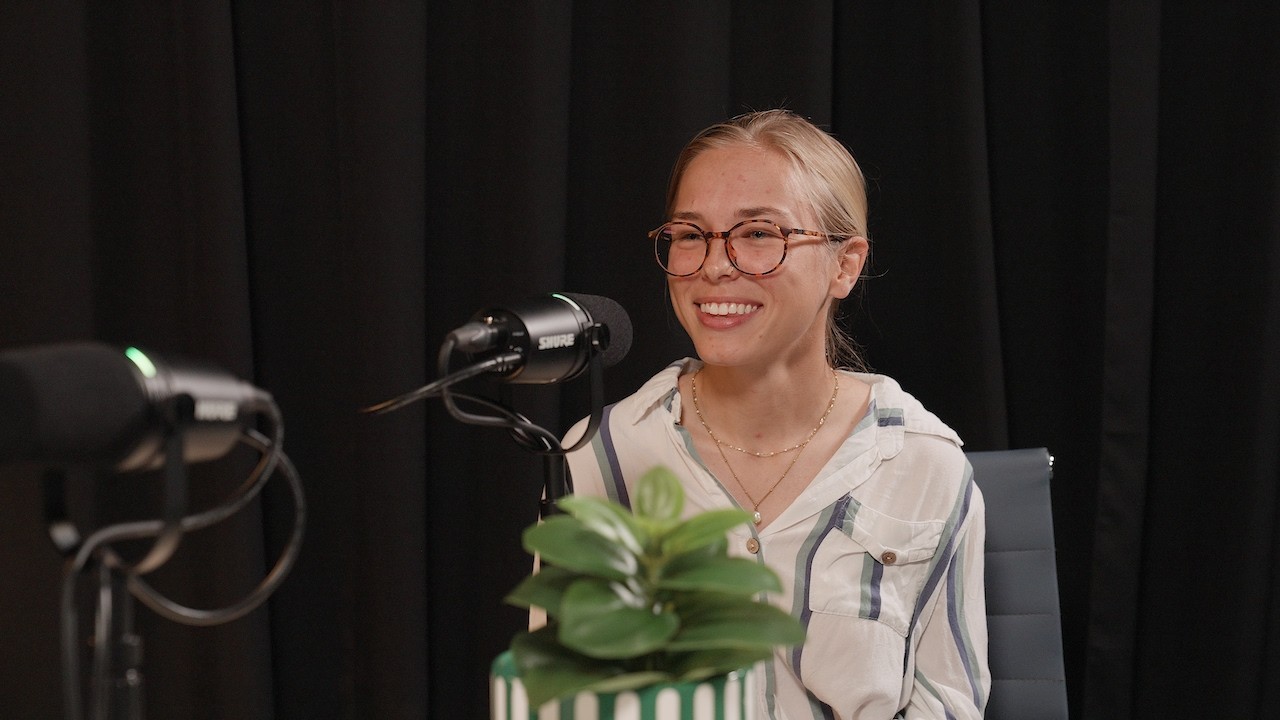
In this episode of Your University: The FGCU Podcast, host Katie Cribbs sits down with Macy Noll, a dual degree Art and Biology student
at FGCU who has spent her college career uniting scientific inquiry with artistic
expression — as a campus naturalist, research assistant, scientific diver and public
artist.
Macy traces the unexpected path from a ceramics class to installing clay sculptures
on Kimberly's Reef and two years of underwater research. The conversation explores
how art and science overlap, why creativity is a powerful environmental education
tool, and the story behind her "Knowledge in Motion" mural in the FGCU library.
Available on:


Available on:
Episode 5:
The Art of Diving Deep With Super Student Macy Noll
In this episode of Your University: The FGCU Podcast, host Katie Cribbs sits down with Macy Noll, a dual degree Art and Biology student
at FGCU who has spent her college career uniting scientific inquiry with artistic
expression — as a campus naturalist, research assistant, scientific diver and public
artist.
Macy traces the unexpected path from a ceramics class to installing clay sculptures
on Kimberly's Reef and two years of underwater research. The conversation explores
how art and science overlap, why creativity is a powerful environmental education
tool, and the story behind her "Knowledge in Motion" mural in the FGCU library.
-
Episode Guide
Toggle More Info01:42 Campus Roles and Diving Life
02:08 Ceramics Leads to Reef Research
02:57 Vester and Kimberly’s Reef
04:52 Benthic Art Project Origins
06:51 Ceramics as Reef Material
09:58 Installing Sculptures Underwater
13:44 First Dives and Coral Discovery
15:29 Art First Then Science
18:41 Art Class Turning Point
21:59 Creating Through Fieldwork
22:46 Library Mural Story
28:28 Why Choose FGCU
30:04 Campus Naturalist Life
32:59 Advice And Community Access
35:05 Closing Thoughts
-
Transcript
Toggle More Info[00:00:00] Macy Noll: Art and science are not as different as they may seem. They're both ways of observing and interpreting natural phenomena.
[00:00:17] Katie Cribbs: This is Your University: The FGCU Podcast, where we talk to the people on campus making a difference in the Southwest Florida community and beyond. From research and the arts to student success and athletics, we're uncovering the stories impacting you. I'm your host, Katie Cribbs.
She's a triple threat: campus collaborator, artist, and scientist. And she's not slowing down anytime soon. Meet FGCU student, Macy Noll.
Macy, welcome![00:00:49] Macy Noll: Hello. Thank you so much.
[00:00:52] Katie Cribbs:Do you know why I call you a super student?
[00:00:53] Macy Noll: I'm doing a lot.
[00:00:54] Katie Cribbs: I think that's an understatement, Macy. So, Macy is a double major. And not only are you a double major, and we'll get into that, but you are involved on campus. It sounds like to me, and it looks like to me, that you just jumped in with both feet and said, “You know what? I'm going to make the most out of my college career.” Why is that?
[00:01:16] Macy Noll: Absolutely. I mean, I love learning, and I have such a passion for it. I think that's part of the reason why I want to be a scientist, so that I can just continue learning for the rest of my life and researching and discovering new things. I was super excited to come to college. I, kind of, never wanted high school to end, but since it had to, I came to college and I've stretched this out for as long as I possibly can as well.
[00:01:41] Katie Cribbs: So, you are a double major. We touched upon that. Art and science, and we'll get to those because I think they're total opposite. You don't agree, so I'm going to have you explain why to everybody. But some of the things you're involved in, and you can add to it or correct me if I'm wrong, but you got involved pretty early on. You're a campus naturalist, public artist on campus and underwater, which is fascinating, research assistant. You do volunteer work in the community and on campus. Master diver and dive instructor. And you've dabbled in some underwater video at some point as well.
[00:02:17] Macy Noll: Yeah. So, I started off as a campus naturalist, and that's kind of how I got involved in the environmental education aspect at FGCU. And then I discovered the scientific diving course. How that happened was really interesting because I actually got introduced to the environmental science side of FGCU through the art side.I was taking a ceramics class, Ceramics I, with Patricia Fay, and she had been asked by Vester Field Station to do a research project creating these biomimetic clay sculptures that could be installed on Kimberly's Reef to help facilitate benthic settlement. So, attracting all those little organisms that help to build the foundation of the reef.
[00:03:01] Katie Cribbs: Okay, we're going to have to back up a little bit-
[00:03:02] Macy Noll: Okay. Yeah. No worries.
[00:03:03] Katie Cribbs: ... because this is fascinating, and this is a great story in itself. So, we're going to back up and explain what Vester is. Just for our listeners, Vester is in Bonita Springs. It's a research laboratory on the water on Estero Bay, and Kimberly's Reef is out in the Gulf, and it is a research reef, correct? What am I missing?
[00:03:25] Macy Noll: Yes, so this is super exciting to me because I did not know when I came to FGCU, even though I was intending on studying marine biology, I didn't know we had a marine field station. And so, I was very excited to figure that out and to go there and experience it and to get involved with everything they're doing there.
Kimberly's Reef is an artificial reef comprised of six villages of three massive cement culverts each, and it's located about eight nautical miles offshore of Bonita Beach. And it's really meant to be this living laboratory and outdoor classroom so that marine science students and biology students like myself, um, anyone doing environmental research or wanting to get involved no matter what their major can actually get out there and get that real-world experience of getting into the field, collecting the samples themselves, taking those back to the laboratory, analyzing the samples, analyzing the data, and getting that big picture of what it looks like to be an environmental scientist.
So, Professor Fay had approached me, and we had done some other, like, assignments in class that were kind of marine-focused because...[00:04:37] Katie Cribbs: In a ceramics class?
[00:04:38] Macy Noll: Yes. We had this project, where it was, kind of, you picked a marine benthic organism and then sculpted it, and the project was three sculptures, and by the end, the third sculpture, the organism had somehow morphed into some kind of vessel.
[00:04:54] Katie Cribbs: Okay, so when you say benthic again and the organisms, would we recognize any of those names?
[00:04:59] Macy Noll: Yes. So, you've got your corals and sponges and crabs. And so, there's like sessile and mobile benthic organisms, basically everything that's, kind of, living on the bottom of the ocean, sometimes on a coral reef, and forming that foundation for life.
[00:05:18] Katie Cribbs: Okay, so you're sculpting and trying to transform these.
[00:05:22] Macy Noll: Yes. And so, that was one project that I think... I mean, I was super excited to do that and really just threw myself into it. And so, I think she noticed that, and she was like, "Wow, she really likes marine biology." And so, when she had been asked to do this research project, she decided to run it as a Seidler Undergraduate Research Project, which typically happens over the summer, and it's a collaboration between a professor and a student. And so, she approached me, not even knowing that I was pursuing a dual degree in art and biology.
[00:05:53] Katie Cribbs: Just by chance?
[00:05:54] Macy Noll: Just by chance. She was like, "This is an art student who really loves biology."
[00:05:57] Katie Cribbs: And what was the object of this research? I want you really to go into it. What was she asked to do? What did you help her with, and what was the outcome, or what was supposed to be the end result?
[00:06:08] Macy Noll: Our main interest was investigating ceramics as an alternative artificial reef material. So, the types of materials that we are using to create artificial reefs can have different effects on what kind of organisms might settle there. At least, that's the hypothesis.So, ceramics is totally natural material. And what's really cool about it is it's very plastic, it's very sculptable, and so you can create all kinds of texture, which marine organisms really love, texture that increases the surface area that they can settle on. It gives them something to grip onto. And ceramics have both kind of macroscopic texture and microscopic texture. So, we worked with two different clay bodies.
[00:06:51] Katie Cribbs: And these are all environmentally safe as well, right?
[00:06:54] Macy Noll: Yes. Absolutely, totally natural materials. So they wouldn't have an adverse effect on the environment. They wouldn't be leaching chemicals of any kind. So, that makes them a really good candidate for an artificial reef material. And then creating these sculptures, we ended up creating 62 in total.
[00:07:11] Katie Cribbs: Wow.
[00:07:12] Macy Noll: And another aspect of them is they were biomimetic, so that means mimicking biology. So, they look like something that you would find on a coral reef. And the idea behind that is, we want to not impose our own human ideas of what the environment might look like or need, but to take from nature what's already working and see if we can recreate that in order to help facilitate new growth.
[00:07:39] Katie Cribbs: So, you spend all this time making the 62 sculptures trying to mimic nature, right, as best you can, and also fit it into research. What kind of material is better? Is it better at all? Does it matter at all? And when it's done, then what happens?
[00:07:55] Macy Noll: So, there would be monitoring over the years. And that's been an important part of Kimberly's Reef, is the main purpose of it is to have an artificial reef that we can monitor from the reef's inception.
[00:08:09] Katie Cribbs: Did you have to go put them underwater?
[00:08:11] Macy Noll: Yes.
[00:08:12] Katie Cribbs: Is that where you got introduced to?
[00:08:14] Macy Noll: Exactly. That was my first time going out with Vester on one of the fleet boats and interacting with scientific divers. So, I met some of the divers who had later become my colleagues and got to watch them take the sculptures. They're in their scuba gear, they're back-rolling off the side of the boat, and they're taking those sculptures down to the reef. So, that was very exciting.
[00:08:36] Katie Cribbs: Was it a bit of FOMO though, for you?
[00:08:38] Macy Noll: A little bit. They told me I wasn't allowed to dive, even though at this point I was open water certified. So, I had that introductory training as a scuba diver, but more recreational. And they told me I could snorkel. So, I had my snorkel gear, and I, like, tried to dive down, which it's about 30 feet deep and I'm not the best freediver. So, I couldn't get down to see the actual reef. But I was there in the water, and I was like, "Oh, I can't wait until I can actually dive with them, so."
[00:09:05] Katie Cribbs: So, it, kind of, lit a fire under you to get that certification. And so, when were you finally able to dive down in there and see your sculptures?
[00:09:13] Macy Noll: Yes. So, the requirement for the scientific diving course is to have your open water certification, and then we say about 10 dives of experience under your belt just to make sure that you're nice and comfortable in the water and that you're going to really be able to be successful and thrive in the scientific diving class.What the course does is help take you from just recreational diving up to the level of a scientific diver. So, it really hones your scuba diving skills to the point where they become instinctual muscle memory, and you can then focus on keeping track of everything that you need to, but also adding other things onto that, like scientific equipment and looking at the environment, and taking notes and things like that.
[00:09:56] Katie Cribbs: Underwater taking notes?
[00:09:57] Macy Noll: Yes.
[00:09:58] Katie Cribbs: How do you do that?
[00:09:59] Macy Noll: You might have a slate or sometimes you can actually have waterproof paper that you can print on. We actually, this past week, just gave our students their underwater midterm, which is not so much...
[00:10:11] Katie Cribbs: That sounds amazing.
[00:10:12] Macy Noll: Yeah, it's super fun. It's the most fun exam you've ever taken in your life. But it's not so much the actual questions on the exam because the questions are like, write down the name of every student in your class, of like, just random things. And then what we're really looking for is, can you be writing underwater and also maintain neutral buoyancy so you're not touching the bottom of the pool, you're not floating up to the top.
[00:10:34] Katie Cribbs: It sounds like a really fun class, but it is not an easy class.
[00:10:38] Macy Noll: Definitely. And I think that's what makes it so fun, partially, is it's a big challenge.
[00:10:44] Katie Cribbs: So, you got your certifications, you got down there, you saw it for the first time. What did you think?
[00:10:50] Macy Noll: Hmm. I mean, I was so excited just to be out in the field. And I don't remember... I might've gotten to see the sculptures that are down there the first time I dove the reef. But there wasn't a whole lot on the reef to begin with because it had just been recently deployed. And so, there was a little bit of fuzzy growth here and there. But I would probably say the most amazing experience I had diving the reef during my research assistantship was the first time that we saw the first coral colonies growing on there.
I was down with Adam Catasus, and he had the underwater camera, and we were taking pictures of the different organisms that had started growing on the reef, and we found the first coral colony.[00:11:31] Katie Cribbs: Congratulations.
[00:11:32] Macy Noll: So exciting. And he had me put my finger next to it and took a picture so that we could tell what the scale of the colony was. And it was just this little golden mound, but very exciting because corals are that foundation of the reef that builds the reef structure that everything else can build off of, so.
[00:11:50] Katie Cribbs: So, you were a little geeked out?
[00:11:51] Macy Noll: Yes, a little geeked.
[00:11:52] Katie Cribbs: You were the first to see it?
[00:11:53] Macy Noll: Yeah.
[00:11:54] Katie Cribbs: With Adam.
[00:11:55] Macy Noll: With Adam. Yeah. Not probably the first to see it, but that was the first time it was documented. Yes.
[00:11:59] Katie Cribbs: It didn't happen unless it was documented.
[00:12:01] Macy Noll: Right, pics or didn't happen.
[00:12:03] Katie Cribbs: We're probably going to mention a few more times, you're a double major, arts and science, a biology major. What came first for you, the love of art or the love of science?
[00:12:15] Macy Noll: I would have to say the love of art. Artists listening to this will relate when I say we get a lot of the same comments when we are creating art, and it's typically something like, "Man, that's amazing. Like, I wish I could draw like that. I can only draw a stick figure," or "I draw like a 5-year-old."
[00:12:33] Katie Cribbs: That's me.
[00:12:33] Macy Noll: Yeah, exactly. And no shame at all. My high school art teacher had this amazing way of putting it, which is the reason you draw like a five-year-old, is because you stopped drawing when you were five. Everyone has the ability to develop that skill. I think people sometimes have this idea that art is based on talent alone, and it's just something that you're, kind of, born with.
But I didn't come out painting and drawing. I was given, you know, a coloring book and a crayon when I was five years old, and I just started coloring, and I just didn't stop. So, I have years of experience now painting and drawing, and that's the reason why I'm an artist today.
Science, on the other hand, was a much longer journey for me. I always loved nature, or at least the idea of nature. I grew up... Let's see, I was born in Florida, but my family spent some time in Alabama, but we would come back down to Florida to visit my grandparents, and that was typically during the summer, during the rainy season. And so, it'd be raining in the afternoon, and I'd be at my grandparents' house, and we couldn't go play outside, so they would put on Planet Earth documentaries.
And those were my favorite movies as a little kid. I would just sit there for hours, like, amazed in wonder and awe at the natural world. But it always seemed inaccessible and unattainable to me, which is part of why I have such a passion for sharing it now, because I think that a lot of the environmental issues we currently face are not causes but symptoms of what I'd call an ecological identity crisis. We don't know how to belong to the ecosystems that sustain us. We don't know how to be a part of our own natural habitat.[00:14:17] Katie Cribbs: When did you think it could be obtainable? At what age and where were you in your life?
[00:14:23] Macy Noll: So, everything, kind of, changed for me. Senior year of high school, I took a class called Florida Natural History. And it wasn't taught by the biology teacher, as you might expect. It was actually taught by the art teacher. And we hand-bound these sketchbooks, and we went out into nature, and we drew the native flora and fauna. And it was those personal encounters with the natural world, interpreted through creativity, that really cemented it for me and helped me to develop that, what I call an ecological identity of the feeling of belonging in the natural world and not being separated from it and being a part of it.So, that was an amazing experience for me and was really the beginning of this idea that creative practices are such a powerful environmental education tool. And I thought, you know, I've always been an artist. I will always be an artist. What if I used art to communicate science? And that, kind of, wasn't articulated as clearly at the beginning. I was just like, "Art and science, that's what I'm going to do.”
[00:15:29] Katie Cribbs: You're going to make them work.
[00:15:29] Macy Noll: Yeah. I was like, "I don't know how it's going to work, but I'm going to do it anyway." And so, then I came to FGCU and started going down that path, and have learned just how many ways that art and science really do overlap and the power of creative practices and environmental education. So that's, kind of, yeah, how it coalesced for me.
[00:15:48] Katie Cribbs: So, tell me a little bit more about that, because I think I said in the beginning, you know, it seems like oil and water, right? Arts and science. But you're, kind of, putting it into perspective how they can intertwine. One of your professors, Patricia Fay, is an example. She did a scientific study as an artist, and she's a certified diver as well.
[00:16:06] Macy Noll: Mm-hmm. Exactly. Yeah. Art and science are not as different as they may seem. They're both ways of observing and interpreting natural phenomena. So, art is more emotional, it's more expansive. Science is more reductive, it's more logical. But they're both two different methodologies of observation and interpretation.
And I come back to this quote over and over again. "You'll only protect what you love, and you'll only love what you know, and you can only know what you've been taught." And so, there's this importance to both knowing and loving in order to inspire meaningful action. And so that's really how art and science fit together and why their collaboration is so powerful.
[00:16:55] Katie Cribbs: Knowing and loving.
[00:16:56] Macy Noll: Mm-hmm.
[00:16:57] Katie Cribbs: I like that. And that's how they fit together?
[00:17:00] Macy Noll: Yes.
[00:17:00] Katie Cribbs: The knowing and the loving. Do you feel that way every time you create a piece of art?
[00:17:05] Macy Noll: Absolutely, and especially because much of my art is inspired by my experiences doing research or being out in nature in the field. I think every artist draws inspiration from somewhere. Sometimes, it's emotional experiences; sometimes it's social experiences. For me, it's experiences out in nature and in science.
So, I definitely draw from those experiences, and then I interpret them through artwork and reflect on them. And that, kind of, solidifies the experience, which is another way that art complements environmental education, is it's active versus passive learning, and it's a way of reflecting on and really internalizing what you've learned.[00:17:50] Katie Cribbs: So, for our listeners or viewers, if they're on YouTube out there, we're not all going to be able to see your artwork and research at the bottom of Kimberly's Reef. But we can all take a journey to the library on campus and see an amazing mural you painted. In fact, you painted it in front of people. For how many weeks were you working on it?
[00:18:13] Macy Noll: Let's see, maybe four or five weeks since the beginning of semester.
[00:18:16] Katie Cribbs: It's right on the first floor of the library. It's beautiful. We have some video of you out there, but you can see some of this artwork. And what inspired you?
[00:18:26] Macy Noll: So, it was an open call for artists that the library sent out because they're, kind of, pioneering this mural project for the library. And the theme that they gave was knowledge in motion. And so, the first thing I thought of was, you know, we have all these amazing science classes where you sit down and you learn the material, but then taking that knowledge out into the field as a scientific diver, as a marine researcher, is knowledge in motion.
So, I thought about all the experiential learning opportunities that I've gotten to engage in and just wanted to reflect on those and also spread the word because it can be so impactful to seek out those opportunities and to engage in them as a student. It can really take your collegiate experience to the next level.[00:19:15] Katie Cribbs: So, inspiration. Knowledge and inspiration.
[00:19:18] Macy Noll: Exactly.
[00:19:19] Katie Cribbs: You also said in a part of the video that we have, and we can link it as well, that every time you go underwater and you dive, it's like a lucid dream. Can you explain that?
[00:19:31] Macy Noll: Absolutely. Diving is unlike any other experience you can have on this earth. And scuba diving, you are just completely weightless and suspended in the water column and surrounded. It's a totally immersive experience, literally and figuratively. And you see the most amazing things. And you can have, at least my experience has been a much closer interaction with wildlife than you can on land. The fish will swim all around you, and you can get really close up to the corals and everything. And so, it's such just an up-close and personal experience. But even besides the amazing wildlife, for me, like, as an artist, it's the colors and, like, the light filtering through the water. And it almost feels like to me swimming in a painting, so.
[00:20:21] Katie Cribbs: Your painting seems to really bring it to life for me. You know, I'm not a diver. I don't do that. I don't know if I'd be good at that. But I feel like I can experience it through your art.
[00:20:33] Macy Noll: That's wonderful. That makes me so happy.
[00:20:34] Katie Cribbs: Yeah, it makes me happy to see it, so thank you. And for everyone listening out there, go check it out.Do you feel like you're blazing a trail to educate people on the arts and science intertwining? I think you gave a presentation about it, right?
[00:20:49] Macy Noll: Yes. Yeah. I was invited to give the keynote speech at the Environmental Education Alliance for Southwest Florida conference. That was this past November. And that was an amazing experience for me, and I was so grateful for it because it really allowed me to synthesize a lot of the things that I had, kind of, nebulously been thinking about over the past five years, studying art and science.
And it was also incredibly impactful for me as well to see people's responses. They were quite emotional, which I was amazed by. There were grad students who asked tearful questions at the end of, you know, "I'm a scientist, but I've always loved art, and I felt like I had to choose," and I got the question of, like, "Where did you get the confidence to just do it, basically, and blaze that trail?"
And so, in some ways, I feel that I might be blazing a trail. It definitely wasn't one that was clearly marked, for sure. I know I'm not the first to have this idea of uniting art and science, and I spoke about some voices in that arena during my speech, but I also just shared that experience for me, that transformative experience of becoming reconnected to the environment through artwork.[00:22:08] Katie Cribbs: What made you decide FGCU, and are you pleased with your choice?
[00:22:13] Macy Noll: Absolutely. This place has really become like home for me, and I love Southwest Florida. And part of the reason that I feel so reconnected to the environment is, I grew up in Orlando, kind of, in the big city, but then coming down here for college, I, kind of, got to know Florida almost for the first time. Sort of, after that first class that I took on Florida Natural History, I got to come down and then really get immersed in it, and that was wonderful.
But, kind of, the choice between... There were a bunch of colleges that I initially was thinking about, but then I narrowed it down to UF and FGCU. And I toured both campuses multiple times and was really struck by the environmental focus of FGCU, which has become, kind of, my favorite thing about FGCU. And I was also told that undergraduates could get experience, firsthand experience, working in the lab, working in the field, doing research. And so, that was very attractive to me because I wanted that experiential learning. So, that was definitely a huge part of the decision in coming here.[00:23:16] Katie Cribbs: And you got that?
[00:23:16] Macy Noll: Yes.
[00:23:17] Katie Cribbs: You were an undergrad research assistant.
[00:23:19] Macy Noll: Yes.
[00:23:20] Katie Cribbs: Did you get to do cool things?
[00:23:21] Macy Noll: Absolutely, yes. So, I spent two years studying benthic settlement on Kimberly's Reef, collecting samples, looking through a microscope at all the little microscopic critters that are in the water column and settling on the reef. So, that was an amazing experience.
[00:23:36] Katie Cribbs: And you got to become a campus naturalist. And so, for people who don't know, this is a really special thing for Florida Gulf Coast University. About half of our 800 acres are preserved. It won't be built on. It's either natural or just preserved wetlands, pinelands. And there are paths all around that you, as a naturalist, can take other classes and professors and help them really get to understand that natural beauty. How did you hear about it, and what was your experience like?
[00:24:09] Macy Noll: Let's see. I think it might have been a Canvas announcement that I saw, and I heard the words "campus naturalist."So, I applied and got the job as a campus naturalist. And I love that you mention all of our protected land on campus because that is another reason why I loved FGCU, it's so beautiful, and you don't have to leave campus to experience natural Florida.
And so, even in the middle of Estero, on campus, you can experience beautifully pristine nature and be surrounded by cypress trees. And sometimes, depending on if it's wet season or dry season, you could be up to your neck in water, or maybe just to your knees and really be immersed in the environment, so.[00:24:56] Katie Cribbs: It is an amazing experience. I've been out there twice. Once, it was just over, you know, my calf, and then another time, you know, almost to my chest. And it's amazing, even in the middle of summer, the water is cool. It did feel like you were in an entirely different world, even though you're in the middle of campus.
[00:25:17] Macy Noll: Exactly.
[00:25:18] Katie Cribbs: Right? Like a spiritual, kind of, feeling.
[00:25:21] Macy Noll: Yeah, which is wonderful because we were made to exist in nature. And so, there's been all this research done of how it can be beneficial for mental health. And I know we have some of our environmental education professors on campus are specifically doing research on that, how it affects the human brain, how it affects our social systems to be out in nature together. So, that's a wonderful resource for FGCU students, even to just be able to take a break from classes real quick and go out into nature and be like, "Oh, take a deep breath."
[00:25:52] Katie Cribbs: Very beneficial. And what would be your advice to students coming to Florida Gulf Coast University for the first time? What would be your advice for them to get the most out of their experience, not just the educational side, but the extras?
[00:26:08] Macy Noll: Right. I would say form relationships with other classmates, upperclassmen and professors who will be able to let you know what opportunities there are.
The reason why I initially got involved is my ceramics professor was doing something, and so she invited me into that. And so, because I had a relationship with her, I was able to take advantage of that opportunity. So, definitely, know that there are endless opportunities out there. There are multiple avenues for getting involved. You could be doing research, you could be doing community service, other experiential learning opportunities. So, the possibilities are endless.[00:26:43] Katie Cribbs: That they are. And then for the listeners out there who may not be as familiar with Florida Gulf Coast University, what would you tell them about how they can experience our university?
[00:26:56] Macy Noll: Well, we have all kinds of educational resources and even volunteer opportunities. If you have young children, Vester has summer camps that you can send them to so that they can get that firsthand experience out in nature.
[00:27:08] Katie Cribbs: They can take a walk.
[00:27:09] Macy Noll: Yes, they can go on campus. We also have conferences like the Environmental Education Conference, where community partners can get together and connect and learn from one another. So, all kinds of opportunities.
[00:27:22] Katie Cribbs: They can see your mural at the library, right? We're a public campus. Come on, park, take a look. They can go to the Food Forest, which is also a very neat opportunity to go and just check out some nature.
[00:27:33] Macy Noll: Yes. It's beautiful there.
[00:27:34] Katie Cribbs: See what kind of food is growing on campus.
Well, Macy, it has been a pleasure talking with you today. The sky's the limit or the depths of the ocean-[00:27:44] Macy Noll: Absolutely.
[00:27:44] Katie Cribbs: ... are the limits for you, and you've really embraced the college experience, and it's just been a pleasure talking with you. Thank you so much.
[00:27:52] Macy Noll: Thank you.
[00:27:53] Katie Cribbs: Thanks for listening to Your University: The FGCU Podcast. We're proud of our connection with the Southwest Florida community and can't wait for you to explore all we have to offer. Learn how to engage with us by visiting fgcu.edu/youruniversity.
-
Show Links
Toggle More Info
Join 100K+ FGCU360 subscribers for monthly campus news, alumni stories & upcoming events.
Thank You for Subscribing