

Your University: The FGCU Podcast
A Symphony of Growth: The Arts at FGCU with Krzysztof Biernacki
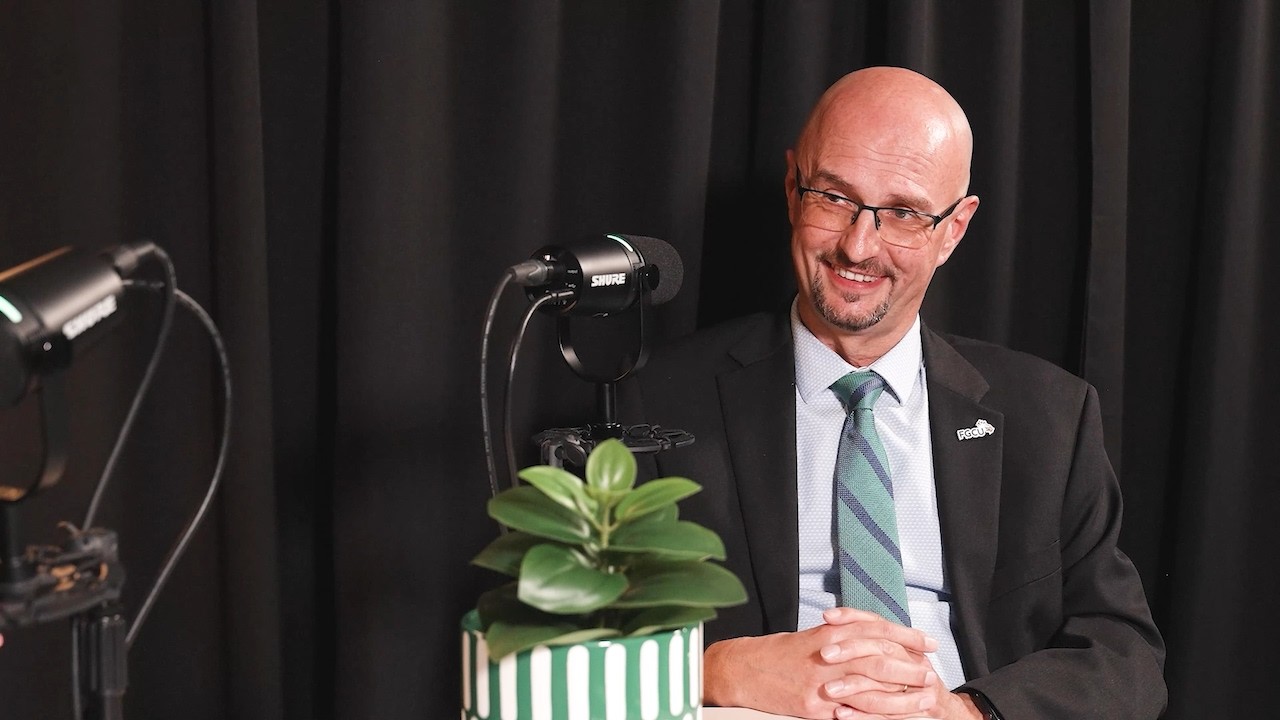
In this episode of Your University: The FGCU Podcast, host Katie Cribbs sits down with Dr. Krzysztof Biernacki, Director of the Bower School of Music & the Arts, to discuss the school's remarkable growth and its deep roots in the Southwest Florida community.
Krzysztof shares his journey from performing on opera stages across the globe to leading one of Southwest Florida's most dynamic schools of music and the arts — and why Southwest Florida's appetite for world-class arts makes FGCU's Bower School unlike any other in the country.
Available on:


Available on:
Episode 8:
A Symphony of Growth: The Arts at FGCU with Krzysztof Biernacki
In this episode of Your University: The FGCU Podcast, host Katie Cribbs sits down with Dr. Krzysztof Biernacki, Director of the Bower School of Music & the Arts, to discuss the school's remarkable growth and its deep roots in the Southwest Florida community.
Krzysztof shares his journey from performing on opera stages across the globe to leading one of Southwest Florida's most dynamic schools of music and the arts — and why Southwest Florida's appetite for world-class arts makes FGCU's Bower School unlike any other in the country.
-
Episode Guide
Toggle More Info01:05 Early Singing Roots
02:21 Poland to Canada Training
03:07 Performing Career and UNF
06:16 Bower School Growth
07:19 Digital Media Design Expansion
09:53 Pavarotti Competition Partnership
15:13 Community Concert Series
18:09 Music Therapy Spotlight
19:44 Summer Camps and Outreach
20:32 America 250 Season Planning
23:06 AI and the Arts Future
24:35 Final Invitation and Wrap Up
-
Transcript
Toggle More Info[00:00:00]Krzysztof Biernacki: That's what's so special about Southwest Florida. This is the arts destination. And, you know, when I moved here in 2019, I couldn't believe that, you know, we're selling out events. You know, other universities across the nation do not have that problem.
[00:00:18]Katie Cribbs: This is Your University: The FGCU Podcast, where we talk to the people on campus making a difference in the Southwest Florida community and beyond. From research in the arts to student success and athletics, we're uncovering the stories impacting you. I'm your host, Katie Cribbs.
He can sing in no fewer than five languages, has taken center stage across the globe, and has helped usher in a revival of an international opera competition, a portion of which is held on FGCU's campus. Meet the director of the Bower School of Music & the Arts at Florida Gulf Coast University, Dr. Krzysztof Biernacki.
Krzysztof, welcome!
[00:01:03]Krzysztof Biernacki: Well, thank you so much for your kind invitation. Delighted to be here.
[00:01:06]Katie Cribbs: Well, thank you so much. And I want to explain to our listeners, you are a trained opera singer, professional.
[00:01:12]Krzysztof Biernacki: That's right. It's been very much, very important part of my life. It started out in my childhood. I was always the little boy that sings. So, when I was about five, six years old, I was still in kindergarten, and my music teacher took me to my first-grade teacher and said, ″This boy is not afraid to be on stage.”
[00:01:31]Katie Cribbs: Was it something that you were drawn to naturally and something that you loved naturally?
[00:01:36]Krzysztof Biernacki: I really have no idea how it started. I just remember performing in a lot of kindergarten plays and performances, and as soon as I started singing in a duo with my friend, that became very real. We had regular voice lessons every week. We learned a new repertoire. We sang in harmony. It wasn't sung unison, it was sung in harmony. Always sang the lower voices, with accompaniment as a cappella performances, and of course, at age eight, I entered elementary school of music. I grew up in Europe. I grew up in Poland. I lived there until I was 18 years of age. So, the European system requires elementary and secondary school of music attendance.
So, I entered elementary school of music when I was eight, and I started playing piano. I was singing at the same time, of course. And then when I was about 14, 15, I entered secondary school of music on trumpet and piano, because at that time my voice broke.
And two years later, I immigrated to Canada. This was a whole family immigration, my parents and my sister, we immigrated to Winnipeg, Canada. And I started continuing my private lessons and singing there, and entered my first university degree, and the next thing you know, you have to figure out how to make a living at this.
So, it was a second degree and a third degree, and performances across Canada and Europe, and it was a very exciting life. I was primarily a recitalist, an opera singer. I sang a lot of concert repertoire, so this was very much part of my life. And then in 2005, I moved to Jacksonville, Florida, for my first university teaching position at the University of North Florida.
[00:03:07]Katie Cribbs: Was that a hard transition?
[00:03:08]Krzysztof Biernacki: No, because I was always teaching. I started teaching as a graduate teaching assistant in grad school, doing my master's degree. And then I did exactly the same thing throughout my doctoral degree at the University of British Columbia in Vancouver, in British Columbia.
So, I was teaching at UBC for five years before I took my first teaching position at UNF. So, I was an experienced teacher by then.
So, I always needed a university position. I knew that I'll build my career out of a university, and that's exactly how it worked out. I finished my DMA at UBC in Vancouver. I was teaching throughout the process, but my doctoral degree took five and a half, almost six years, because I was singing so much. So, I had to defer my comprehensive exams, and I had to take semesters off because I was gigging all across Canada.
And in those days, opera performances were four-to-six-week commitments. So, if I had to go to, you know, to Calgary or Edmonton or Toronto, I usually would be gone for, you know, two months. So, that lengthened my doctoral studies, but it was a huge part of the preparation necessary for what it takes to run an opera program and a university voice program and be a university professor of voice.
[00:04:16]Katie Cribbs: Yeah. Because you've directed productions.
[00:04:19]Krzysztof Biernacki: Yes. That's exactly what I did.
[00:04:19]Katie Cribbs: You've been a vocal professor, now you're running a school.
[00:04:24]Krzysztof Biernacki: That's right. Yeah. It's, you never know where life will take you
[00:04:28]Katie Cribbs: You haven't looked back.
[00:04:29]Krzysztof Biernacki: I have not. No, it was a very well-planned decision, and it was a very fortuitous set of events, you know, that this opportunity presented itself at the time that it did, and that I was very fortunate to get it. So, I'm delighted to be here.
[00:04:43]Katie Cribbs: Well, let's talk about the growth of Bower and the school, because you all have, what, over 100 perform, is it closer to 150 performances, exhibits every year?
[00:04:57]Krzysztof Biernacki: Exactly. We do between 150, 170 events each year. Actually, the event count for this academic year is 178, and this is...
[00:05:05]Katie Cribbs: And it takes a lot of planning.
[00:05:06]Krzysztof Biernacki: Oh, absolutely. We start planning our seasons a year, year and a half in advance. So, we are well into planning our season brochure, our next season, next year. So, it takes a lot of planning, a lot of very careful scheduling.
It takes a lot of effort to make sure that we can do 150 events a year, and that's between music, art, theatre. Of course, next year we're assimilating Digital Media Design, so it'll be that much more, but it's exciting times.
[00:05:31]Katie Cribbs: So, you just touched upon it, but Digital Media Design, that's huge-
[00:05:36]Krzysztof Biernacki: It is.
[00:05:36]Katie Cribbs: ... as well, and you're going to be folding it into your program.
[00:05:39]Krzysztof Biernacki: Absolutely. Yeah. We're delighted to share with everyone that's starting this academic year, 2026-27, and we will be assimilating the Digital Media Design degree back to Bower School of Music & the Arts. It's about 350, 370 students, plus eight full-time faculty, so it'll be a substantial addition to our degree offerings.
[00:05:59]Katie Cribbs: And you'll be able to show off more.
[00:06:00]Krzysztof Biernacki: Absolutely. I mean, digital arts have become such a critical part of creative disciplines right now. It's also a program of strategic emphasis for the state of Florida, so a wonderful thing for our students. They'll have additional opportunities to pursue digital arts at the Bower School of Music & the Arts.
So, we often talk about the front porches of a university, athletics being a very well-known one, but music and the arts being a huge one, especially for Southwest Florida. The people here very much value music and the arts. Can you give us some idea of what they're going to experience when they come to our campus to come to an exhibit or a performance?
[00:06:43]Krzysztof Biernacki: We are delighted to enjoy such a strong community support here at the Bower School of Music & the Arts, and
You know, sure they have steady attendances, but here at FGCU, we sell out most of our events, including student recitals, which is wonderful to see. So, when audiences come to our campus, they can expect a fully comprehensive school of music, school of art, school of theatre, Wasmer Art Gallery. And, of course, from next year we're adding Digital Media Design.
So, it's a very broad offerings of artistic disciplines. It's a very busy schedule. Our offerings right on par with any other comprehensive regional American school of music, art, theatre. We do exactly what all other schools do.
I refer to our school as a smaller school, big school opportunities. You know, when our students start those degree programs, it gives them so many more performance opportunities, engagement opportunities. They get to do everything, you know, they can be engaged in multiple productions and travel internationally and perform for sold-out audiences and take part in all these wonderful curricular offerings, so it's a wonderful place.
[00:07:59]Katie Cribbs: Well, let's talk about that a little bit, because while you have your students in your programs, they're competing nationally, they're competing internationally, and they're winning.
[00:08:08]Krzysztof Biernacki: Correct. Yeah. Very proud of this. Our students are entering international competitions here in the United States and abroad.
For example, one of our piano majors, Quang Vo, who's currently, I believe, a junior, but when he was a sophomore, he placed third in an international piano competition named after Bianca Uribe in Colombia. So, he came third, flew through the night from Colombia to Miami, entered another competition that same day, and won it as well. So, that happens on a regular basis.
Also, our students are competing in the MTNA competitions—Music Teachers National Association competitions. Next one is in Chicago. Students will be entering as finalists of piano duo competitions, voice competitions. Last year our saxophone quartet placed as third nationally in that competition, which was very exciting for the school.
So, those are accolades on par with larger schools in the nation. We're very proud of those.
[00:09:06]Katie Cribbs: The big school opportunities are here.
[00:09:07]Krzysztof Biernacki: Absolutely.
We're still smaller, more accessible with those big opportunities.
[00:09:14]Krzysztof Biernacki: Absolutely. We offer higher scholarships than most schools in the state. So, what our students tell us is when they come here, they feel like they're part of the Bower family, as they call it. You know, they feel seen, they feel recognized. They have the one-on-one connection with their professors. They don't have to study with graduate teaching assistants. They love the fact that they know... for example, they know me by name. They can just knock on my door and see the director of the school. Like, they can have a master class with me at the school or they...
[00:09:39]Katie Cribbs: That's unique.
[00:09:39]Krzysztof Biernacki: Absolutely. And, you know, they're not just a face in the crowd or a name at a school. They really have a one-on-one relationship with their professors.
[00:09:46]Katie Cribbs: That's amazing. I'm glad that we can offer that here and be accessible. Let's talk about another, I think, really big deal. It started last year, and we're continuing it into this year, but you were able to help start off a partnership with the Luciano Pavarotti Foundation Opera Naples International Voice Competition. Did I say that right?
[00:10:10]Krzysztof Biernacki: Yes, it's a mouthful. Absolutely. Yeah. We are just delighted. So it was a very serendipitous set of events. Luciano Pavarotti made his American debut in Florida. Many years ago, he sang his first professional role in the United States in Miami. So, he always had a very, you know, strong fondness for Florida throughout his career, he performed here repeatedly, specifically on Miami Grand.
So, when his widow visited Opera Naples a few years ago, she felt like this was a very natural connection between her home in Modena, in Italy, and Florida.
So, she fell in love with Naples and Naples community and we started a conversation about three years ago about reviving the famous international Luciano Pavarotti Voice Competition that used to take place in Philadelphia throughout '80s and '90s. So, it was just amazing that we were able to come up with a very workable plan to bring those incredible singers from so many different countries, about 460 of them last year was, I think, over 500 this year from worldwide.
[00:11:15]Katie Cribbs: It's grown.
[00:11:15]Krzysztof Biernacki: It's grown certainly, so…
[00:11:18]Katie Cribbs: And you were able to secure the first few rounds on campus.
[00:11:22]Krzysztof Biernacki: Yeah. Last year, we did the whole thing here at FGCU, which was a major development. This year we're doing the first two rounds at FGCU, and the final round will take place at Baker Park as part of the Spring Festival, Opera Naples’ Spring Festival, which takes place at Baker Park. So, it's a little bit different format this year.
However, we have a whole alignment of world-famous judges, international artists, directors, impresarios coming to FGCU to perform and work with our singers and adjudicate these wonderful artists from all over the world.
It's a wonderful format. You know, we're able to offer, you know, the facilities, the practice rooms, the performance spaces, our wonderful recital hall, our judges, Opera Naples colleagues. They love the facilities. They love FGCU.
So, it's great to bring those young singers to us to work with us here at FGCU. It's a very good agreement, very nice workable plan. So, we hope to continue. And of course, Luciano's widow, Nicoletta Pavarotti, just loves our campus, and she was delighted to just, you know, she felt right at home from day one. So, we hope this will continue into the future.
[00:12:27]Katie Cribbs: What an amazing connection, an opportunity for our students. They're hearing these international voices, these famous voices come through here, and perhaps some of them will get an opportunity to compete in this as well, and it's right in our backyard.
[00:12:43]Krzysztof Biernacki: Absolutely. Our voice students get accepted to top graduate programs in the country, including Indiana University, for example, and North Texas. So, it's a fantastic opportunity for them to experience a real-life, world-class voice competition here at FGCU, and just to hear those voices and feel the incredible amount of sound that those young singers are able to produce, it's thrilling to see them experience this.
[00:13:09]Katie Cribbs: So, as a regional comprehensive university, we were built by the community for the community. I think I've said this a million times, but we really have these strong partnerships and relationships with the community that continues to support us. And one of those ways is opening up and having 150 to 170 events every year through Bower.
Another way is sometimes we go out into the community at other locations to bring our music to where the people are as well. One that I'm thinking of has just exploded in popularity, Joyful & Triumphant. And then another one that just started, Rhythm & Blooms. Do you want to talk about those two opportunities?
[00:13:52]Krzysztof Biernacki: So, Joyful & Triumphant has become a flagship event for every academic year, and this is our service to the community every holiday season. We have this ongoing joke at the Bower School of Music that it's not the holidays until we perform Joyful & Triumphant. So, and as classical musicians, we always say it's not the holidays until we perform the Messiah.
So, this is a derivative of that, but it really has become a holiday classic for us. It always takes place on the first Tuesday after Thanksgiving, except next year we have, because we have that very unusual academic year next year. However, it's a beloved event every year. As of last couple of years, we sold out two performances each year.
[00:14:30]Katie Cribbs: And it's only two.
[00:14:31]Krzysztof Biernacki: It's only two. Yes. Because there's just so much that's involved, and we're just so delighted with the partnership with WGCU to be able to do that every year with the recording and then broadcasting the event later. So, it's beloved by our community.
We love performing it at Moorings Presbyterian Church every year. So, that's the big event for December every year. I think it's been 13 or 14 years now, but now there's so many other events that are taking its own root in the community. And, of course, community outreach is such a big part of what do we do as a school, and who we are as a university.
[00:15:05]Katie Cribbs: Because music and art, they touch everybody.
[00:15:07]Krzysztof Biernacki: Absolutely. And community outreach is a huge part of our strategic plan, of course. And we go, we perform in the community, for the community, we sell out performances, bring in these wonderful patrons and donors to support our programs. So, a win-win situation, in a sense.
[00:15:23]Katie Cribbs: And Rhythm & Blooms. So, for listeners who don't understand, we have a great jazz musician on staff, faculty. And then tell us about Rhythm & Blooms and how they can hear some really great jazz in our community.
An idea started by Professor Brandon Robertson, our professor of double bass and jazz studies here at FGCU. Brandon is, I believe, in his seventh year here at FGCU in a full-time position. He's done exceptionally well and is so well and beloved in the community because everybody knows Brandon, has a wonderful following in the community as a jazz musician, and a teacher, and a community organizer.
So, Brandon came up with this idea to set up a partnership with Naples Botanical Garden to present a series of jazz concerts at the garden, at Naples Botanical Garden.
[00:16:12]Katie Cribbs: Which makes sense. You've got these beautiful outdoor settings-
[00:16:15]Krzysztof Biernacki: Exactly.
[00:16:15]Katie Cribbs: ... fragrant, visual, and then you're bringing in top world-class musicians to play beautiful music.
[00:16:22]Krzysztof Biernacki: So, we bring in well-established young emerging world-class jazz artists. So, there's a whole cross-section of guest artists that we invite for those series. And it's a fantastic opportunity for our students to play with these cats, as we call them, because they can swing, you know, to use a-
[00:16:39]Katie Cribbs: Cool cats.
[00:16:39]Krzysztof Biernacki: ... you know, it's cool cats, the jazz vernacular here.
So, it's a great opportunity for the students to perform with seasoned, established professional jazz musicians. It's a wonderful partnership with Naples Botanical Garden. We share resources on this. It's been wonderfully publicized. It's very well attended, and of course, the ambiance in the setting is world-class. So, it looks like it's becoming a classic already, so we look forward to many more of those.
[00:17:04]Katie Cribbs: I hope so. I think Southwest Florida craves that, right?
[00:17:08]Krzysztof Biernacki: Absolutely.
[00:17:08]Katie Cribbs: Like I said, we have a lot of supporters of music and the arts down here. We're very lucky in that people like to go and support.
[00:17:18]Krzysztof Biernacki: This is what's so special about this community. This community is used to consuming arts throughout their lives, and they expect to have access to wonderful performing arts in the community. You know,
[00:17:51]Katie Cribbs: Especially for the size-
[00:17:52]Krzysztof Biernacki: Absolutely.
[00:17:52]Katie Cribbs: ... of our area, you're going to get an outsized portion of music and the arts.
[00:17:57]Krzysztof Biernacki: Absolutely. This also directly affects our fundraising for scholarships and student support opportunities for the students, engagement opportunities, gigging, ensembles. It has an impact on literally everything we do.
[00:18:10]Katie Cribbs: One other program I do want to bring up is music therapy, which people may not think about when they think music and the arts. And they just celebrated their 10-year anniversary.
[00:18:21]Krzysztof Biernacki: Correct.It's a fully accredited program through National Association of Schools of Music, as well as American Music Therapy Association. So, it's a Bachelor of Arts in Music Therapy. It's a clinically based degree program. Our students, upon graduation, they are ready to take the board certification exam in music therapy. They all get employed immediately. It's a wonderful new addition to our degree programs.
We're only one of three in the state of Florida offering music therapy. It's only FGCU, University of Miami, which is private, of course, and Florida State. There are a couple other ones that are coming on board right now, but they're still in very, very preliminary stages. So, it's also one of the strategic degree programs for our school where we're putting a lot of attention into that degree program as a future growth.
[00:19:07]Katie Cribbs: It's in high demand here. Our students are getting hands-on experiential learning in this program within the community.
[00:19:15]Krzysztof Biernacki: Absolutely. Every year, we sign new affiliation agreements with new organizations and agencies to facilitate our students' internships and practicums. So, it'swonderful to see. It's a very successful program.
[00:19:26]Katie Cribbs: So, along with the performances that you can see on campus, because we do have a beautiful facility for you to come and experience our performances or our exhibits in art, right, in our gallery. Beyond that and beyond seeing us when we're out in the community, how else can the community engage with us? I know you started summer camps as well.
[00:19:47]Krzysztof Biernacki: Yes. Mm-hmm. Yeah. Thank you for bringing that up. So, we did some summer camps before 2020, before the pandemic. And then, of course, everything changed through COVID. But the last couple of years, you know, last year we revived our restarted inaugural summer voice camp, which was very successful.
We had 39 students participating, which was a good number as a first start. We are restarting it again this year, possibly adding more, hoping for a larger enrollment. So, it's going great. There's a lot of interest from the community to do summer camps of various types. We would love to do more in art, to do a summer camp in theatre. Of course, who knows what we can do in Digital Media Design; it’s definitely possible. So, there is a lot of interest from the community about summer student engagement opportunities for high school students
[00:20:33]Katie Cribbs: I want to go back to your planning of your years. We are celebrating America 250-
[00:20:39]Krzysztof Biernacki: Yes.
[00:20:40]Katie Cribbs: ... this year, we turned 250 years old. And you and your faculty and staff, you look at major milestones when you plan your seasons, and this one was no exception. You were able to plan a very great season celebrating America history.
[00:20:57]Krzysztof Biernacki: We did. The bi-quincentennial, I believe that's the word.
[00:21:01]Katie Cribbs: Yeah, I'm not going to say it.
[00:21:01]Krzysztof Biernacki: Yeah, 250th. We were throwing that idea around two, three years ago already. We knew this is coming, of course. So it's very exciting. It's, of course, it’s a milestone for our nation, but in our programs, we're just delighted to offer all-American programming throughout the programs.
So, the art gallery represents a history of the United States art exhibit featuring artworks andmusic history lectures in the Wasmer Art Gallery. Our theatre program is presenting a whole season of American playwrights only. So, it's just Americana.
Music program will program all kinds of American composers on each concert. So, there is a very strong representation of American content, and this is something we kept in mind as we were planning the anniversaries, that there should be a strong focus on wonderful American repertoire content art. We've been planning this for a while.
[00:21:56]Katie Cribbs: Can you give us a preview of what's coming up for next season?
[00:21:59]Krzysztof Biernacki: Yes, well, this is the 20th anniversary of the Bower School of Music.
[00:22:03]Katie Cribbs: Congratulations.
[00:22:03]Krzysztof Biernacki: And yes, thank you. It's a milestone. So, we are taking the approach of from, you know, from the past into the future, celebrating the accomplishments of last two decades and very much looking forward into what's coming next.
So, it'll be a 20th anniversary for the school of music. Our art program is about 25 years old. Same for theatre program as well. So, those are big anniversaries. We're bringing a whole bunch of former students, alumni, to do some presentations and concerts. We're bringing high-profile artists to perform with our students as guest artists as well. So, we're trying to bring a lot more exposure to the music program to celebrate their 20th anniversary. It should be fun. It's very exciting. Also, coincides with everything that we've been advocating for the last 20 years. More degree programs, possibly a graduate program soon. Of course, we're always advocating for expansion of our facilities. We love our current music building. It's a beautiful place. But, of course, we continue to grow and expand and diversify our portfolio of offerings for the students.
So, that always requires additional expansions and more space for students and so forth.
[00:23:06]Katie Cribbs: I mean, music and the arts. This is one area AI is not going to take over.
[00:23:10]Krzysztof Biernacki: Although it continues to be a bit of a headache for all of us because, you know, a couple of three years ago, it was still sort of a cool party trick. However, right now it starts to infiltrate in literally everything that we do, including music.It still doesn't sing, it still doesn't dance, and doesn't play the piano yet.
However, the speed of development in that realm is happening so quickly that we have to respond to it. We have to embrace those technologies, or we run the risk of simply not keeping up with the change.
[00:23:40]Katie Cribbs: But there'll always be this need for, I think, human performance.
[00:23:44]Krzysztof Biernacki: Absolutely. If anything, I think it may work to our advantage, in a sense that It's a major shift and disruptor.
I always think that there is perfection in imperfection, and that will mean that humans are here to stay for the performance side.
[00:24:16]Krzysztof Biernacki: Absolutely. And, you know, we believe that there may be a great benefit in this technological revolution that's happening in front of our eyes, that the human touch, the human content will become of greater value into the future.
[00:24:29]Katie Cribbs: Well, before we leave today, what else do you want our listeners to take away from this conversation?
[00:24:36]Krzysztof Biernacki: I would like the listeners to explore the offerings at the Bower School of Music & the Arts and visit FGCU as often as possible. There's so many wonderful things taking place. We have seasonal brochures and seasonal offerings posted on websites and social media, so please check us out online.
because for many of our residents, you know, it feels like they have to drive to Canada just because they have to drive to, you know, Florida Gulf Coast University. However, we are a wonderful institution. We are truly your university. So, I would like to encourage everyone to really give us a chance, come out and see what's on campus, and embrace our offerings throughout the year and become part of our Bower School of Music & the Arts family.
[00:25:27]Katie Cribbs: I would encourage that as well. We're centrally located. It's an easy drive from wherever you are, and I'm telling you, once you get to campus, you won't regret it. It's a beautiful, beautiful place to be.
[00:25:38]Krzysztof Biernacki: Absolutely. We love it here, and it's a great place for our students, and our faculty and staff. And it truly has a family feeling. You know, when students come here to study in our degree programs or perform in our ensembles in music, or take part in our theatre plays or, you know, take general course education in our art programs, this is a transformational learning experience for everyone involved.
Our students travel internationally. For example, our choir just came back from a tour of south of Europe. They were in Italy, Slovenia and Croatia. They spent the entire spring break traveling through Europe. Our art program just came back from a two-week-long art program in Italy at Lorenzo de' Medici Institute in Florence.
Our music therapy program just came back from Bangkok, Thailand, where they were for six weeks doing music therapy. Our theatre program is going to England and Ireland this summer to study theatre. So, they're fantastic travel opportunities, transformational learning opportunities for our students at any time, and our community can experience this, can experience the sparkle in students' eyes when they study at FGCU, they see the transformative power of education and of FGCU in the community.
[00:26:47]Katie Cribbs: And support that next generation of artists. Well, Dr. Krzysztof Biernacki, director of the Bower School of Music & the Arts here at Florida Gulf Coast University, thank you so much for being here.
[00:26:57]Krzysztof Biernacki: It's been a pleasure. Thank you very much.
[00:27:01]Katie Cribbs: Thanks for listening to Your University: The FGCU Podcast. We're proud of our connection with the Southwest Florida community and can't wait for you to explore all we have to offer. Learn how to engage with us by visiting fgcu.edu/youruniversity.
-
Show Links
Toggle More Info
Join 100K+ FGCU360 subscribers for monthly campus news, alumni stories & upcoming events.
Thank You for Subscribing