
Your University: The FGCU Podcast
The Sound of Restoration With “Science Santa” Win Everham
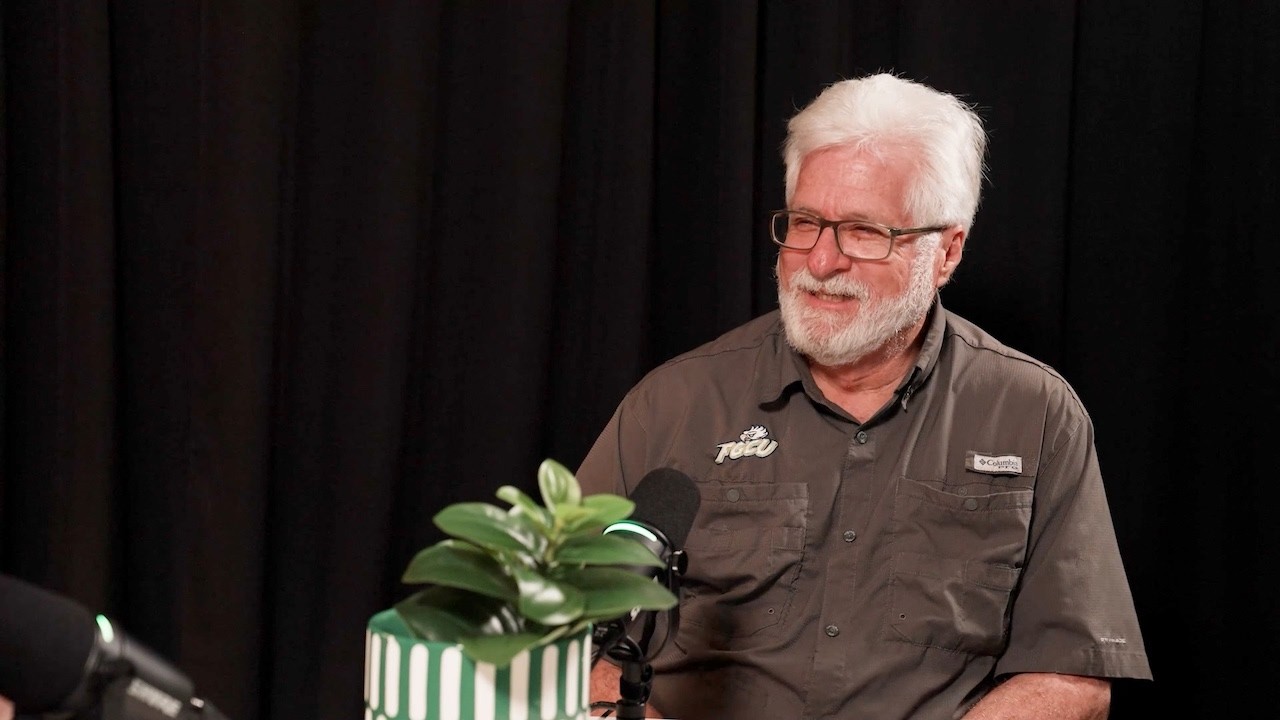
In the first episode of Your University: The FGCU Podcast, host Katie Cribbs sits down with Win Everham, Professor and Program Coordinator for Ecology & Environmental Studies at FGCU.
Win shares how sound is being used to track ecosystem recovery in Southwest Florida — from Frog Watch to the Picayune Strand Restoration Project. The conversation highlights citizen science, environmental stewardship and the vital role our community plays in restoration efforts.
Available on:


Available on:
Episode 1:
The Sound of Restoration With “Science Santa” Win Everham
In the first episode of Your University: The FGCU Podcast, host Katie Cribbs sits down with Win Everham, Professor and Program Coordinator for Ecology & Environmental Studies at FGCU.
Win shares how sound is being used to track ecosystem recovery in Southwest Florida — from Frog Watch to the Picayune Strand Restoration Project. The conversation highlights citizen science, environmental stewardship and the vital role our community plays in restoration efforts.
-
Episode Guide
Toggle More Info00:00 Win’s Background and Expertise
01:00 Defining Ecology and Its Importance
01:34 Restorative Ecology and Sound Measurement
03:02 FrogWatch and Citizen Science
06:18 The Picayune Stand Restoration Project
09:57 Using Pipes to Measure Frogs
12:26 The Number of Species on Campus
17:23 Mangrove Restoration and Community Involvement
21:23 The Joy of Teaching and Science Communication
27:09 Conclusion and Final Thoughts
-
Transcript
Toggle More Info[00:00:00] Win Everham: I like to brag, just because nobody's said I'm wrong, that we've documented more species on this campus than any other campus in the entire universe, not just the United States, in the whole universe.
[00:00:17] Katie Cribbs: This is Your University, the FGCU podcast, where we talk to the people on campus making a difference in the Southwest Florida community and beyond. From research and the arts, to student success and athletics, we are uncovering the stories impacting you. I'm your host, Katie Cribbs.
He’s been called the “Clark Kent of ecology,” “Science Santa,” friend, and all-around good guy, someone you’d want to have a beer with. Win Everham is a professor in the Water School at FGCU and he’s made Southwest Florida his home since 1996, before the university officially opened its door to students.
Win, thanks so much for being here.
[00:01:03] Win Everham: Oh, thanks for asking me, Katie.
[00:01:04] Katie Cribbs: So, some of your expertise includes ecological modeling and restorative ecology. So, before we begin, what is ecology, and what are these specialties that you look into?
[00:01:16] Win Everham: Oh, my goodness. I better have a good definition. I think this was on my final exam. So, broadly defined, we can say ecology is the study of interrelationships among living things in their environment. So, often, people have thought of ecology as when humans separate themselves from nature. It's the going out into the natural world. But really, arguably, ecology is about economics. Ecology is about culture. Ecology is about history, because it's all about interactions among living things in their environment. And turns out humans are living things too.
[00:01:46] Katie Cribbs: So, when we talk about restorative, you've done a couple of projects about restoration and how are we restoring nature or how is nature bouncing back? And one of the cool ways you're measuring that, and I never thought you could do it, but it's through sound. So, two projects I'm thinking of, and maybe you can elaborate on it. FrogWatch, which is national, that you started here, and the Picayune Strand project.
[00:02:12] Win Everham: Yeah. I sometimes call myself a disturbance ecologist. So, what I really got into as an ecologist in the beginning of my career is trying to understand how populations of animals and ecosystems can survive and recover from irregular events like hurricanes.
And I think buried in there was the hope and belief that, if we could understand how non-human systems were recovering from being disrupted, that that might lead us towards a better ability to plan human systems to be more resistant and resilient. I think it was all buried inside there. And I'd say it's only in the last 10 years that I've really tried in my own research to move from not just documenting degradation and natural recovery to a sense that humans are a driving force of so much of the disruption on our planet, that it seems like I wanted to play a role in healing, not just observing. So, I think the idea of restoration came in from there.
But the sound work, you're right, I might not always grab, we call it FrogWatch. It's really FrogListen. And I didn't start it at FGCU. It was a group of students that started it in 2000. So, they set up a route. They graduated. I inherited the route in 2001.
In saying, coming out of the 1990s when people were recognizing that we were discovering frogs that were manifesting these weird mutations morphologically, that if you go online and say ″Weird looking frogs,″ you'll find plenty of pictures from the end of the last century of frogs with eight legs, frogs with all kinds of weird body mutations that were really an indication of something weird was happening.
[00:03:50] Katie Cribbs: All over the world? Or certain…
[00:03:51] Win Everham: All over the world. A lot in North America. And so, the thought was that what's happening, frogs are so intimately tied to water for their lifecycle that, if you're not handling your water well, that then they become a really good indicator. That idea of a canary in the coal mine, that they get changed, they changed quickly.
So, we were offloading pesticides into our water systems. We were offloading other kinds of toxins that are running off our landscape. And the frogs were showing us that. So, USGS started the North American Amphibian Monitoring Program, where people all over North America were setting up routes where they would go out and listen to frogs. It wasn't trying to find frogs that had been impacted, but the idea would be if you go to the same place multiple times every year and just listen, then, through time, you'll be able to tell whether more, less, or the same amount of frogs, in terms of abundance and of species, in terms of species richness are common.
[00:04:51] Katie Cribbs: So, citizen science.
[00:04:53] Win Everham: Citizen science in a really cool way. Yeah. So, that was started in 2000 in Southwest Florida, the FGCU route I picked up in 2001, so we now have been following it for more than a quarter of a century.
[00:05:04] Katie Cribbs: And some of the people, they hadn't done it before, or they didn't know anything about frogs. So, you can really teach them, and they can still be a part of it. You don't have to be an expert.
[00:05:15] Win Everham: Yes. Sorry, I'm just listening and smiling. I'm thinking about how cool it is for people who don't know any frog calls, and by the end of the first night that they go out, they've heard six or eight different species, and they can identify them. There's this West African Forest ecologist, I think he's still alive, Baba Dioum, And I've heard different versions of this from different people, but I always attribute it to him, that ″In the end, we'll preserve only what we love. We'll love only what we understand, and we'll understand only what we've been taught."
And that’s the thing that's beautiful, for all environmental educators, that's part of what we do. But then I added like a footnote to it of you'll never love things you fear. So, if people move down here and they hear noises in their backyard, and they don't know what it is and they're scared, what a shame.
[00:06:01] Katie Cribbs: It's dark.
[00:06:01] Win Everham: It's dark. Yeah.
[00:06:03] Katie Cribbs: You can't see it. You don't know what that sound is.
[00:06:05] Win Everham: And Cuban tree frogs make some weird noises, right? So, I like the idea that people are finding a sense of place in Southwest Florida, in part by knowing what the night sounds are, not being scared of the night.
[00:06:17] Katie Cribbs: Yeah. And the Picayune Strand, it's the same thing, but this is a place, and you can correct me, but this is a place where humans came in, and they started a development project in Collier County, and then at some point, they stopped and let the land reclaim itself and let nature reclaim itself. And you came in with a student and started studying how well nature was reclaiming everything.
[00:06:42] Win Everham: Should I close the loop on the frogs, or should I go with that and…
[00:06:45] Katie Cribbs: Oh, you can close the loop.
[00:06:46] Win Everham: Yeah. So, the frog work is sound, but it's people listening and recording what they are. So, we haven't done much on the FrogWatch side with putting recorders out, which would be a different way of recording data. And those recorders then would allow us to maybe more accurately determine the whole suite of frogs that are in an area. Because we have this saying about the absence of evidence is not evidence of absence.
So, we could go out, and there might be frogs that just aren't calling during the three minutes that we're listening. But we think that, by going multiple times each year over a period of years, we see a trend. Because we're doing exactly the same thing every year.
[00:07:19] Katie Cribbs: And what I heard last May, I didn't hear this May, and we know there wasn't as much rain and…
[00:07:24] Win Everham: Yeah, exactly. But the Picayune Strand Restoration was part of the Golden Gate development that was started by Gulf America Corporation that did Cape Coral. So, they thought they had this good deal of like you come in, you dig canals, so everybody can put a boat in their backyard.
You put in roads. You don't worry about sewage systems. You don't worry about water. You don't even worry about schools, and fire departments, you just sell lots to people and they build their homes. Let's try it again in Collier County.
So, some place in the early stages of the development in Collier, they had already put in the big canals to drain the landscape. Down there, it wasn't so much putting in canals to everybody's backyard. It was a wetter part. And they needed to get the water off the land so you could build homes.
So, they put in the network of roads, they put in the canals, and Gulf America Corporation went out of business. But they had enough sold that, ultimately, Northern Golden Gate became Golden Gate Estates, and Southern Golden Gate, which was south of I-75, got bought back by the state.
So, I think it was 2004, 2005 that they started moving the dirt. And they're literally digging up roads and filling in canals. It's not exactly putting it back to the way it was 50 years ago, but it's a pretty big step.
I think it's a case of going forward to nature, of being able to restore ecological function and habitat on a landscape so that you could maximize biological diversity.
[00:08:50] Katie Cribbs: But you're using sound, and you're listening.
[00:08:52] Win Everham: Yeah. So, that comes later. I got brought in with one of my colleagues who's moved on to the private sector. Dave Sealey had been working on that site before they started the restoration. So, they had established monitoring sites. How could we tell whether this is working? Well, let's look at fish populations. Let's look at aquatic insects, which is a really good measure of health of wetlands, and let's look at frogs.
So, if we're getting the water, we should see aquatic insects, we should see fish, we should see frogs recovering. I'm doing air quotes, ″recovering." Well, what do we compare it to? Dave set up reference sites on the Panther Refuge and in the Fakahatchee Strand. And so, we would go out to the reference sites and measure these taxa and then come back into the Picayune, where the places had been restored, where they hadn't been restored yet.
And through that whole sequence, I forget what the cycle was, two to five years we'd be going back in and resampling those. So, two cycles ago, we weren't picking up anything. We were using pipes to measure frogs.
[00:09:56] Katie Cribbs: They get inside?
[00:09:57] Win Everham: Yeah, they get inside, and they hide. So, you can just walk up to them during the day, and you can look, and see what's in there.
[00:10:01] Katie Cribbs: It doesn't hurt them?
[00:10:02] Win Everham: Doesn't hurt them. It's actually probably good habitat. But we are finding that the native frogs seem to be displaced by these invasive Cuban tree frogs. So, we were picking up only Cuban tree frogs in our pipes, and you really can't compare anything when everything is just this one species. So, we actually dropped frogs out of our sampling because we weren't seeing them. And then we talked about, ″Well, maybe we can switch over to these recorders. We'll set out a recorder, and then we can listen to everything.”
[00:10:28] Katie Cribbs: Is that because maybe they're still there, they're just not in the place.
[00:10:31] Win Everham: That absence of evidence is not evidence of absence. They might be out there, they're just not using our pipes. That whenever you try to measure something in the environment, I guess that's a little like Heisenberg uncertainty principle in physics. The thing you do determines in part what you find and don't find. So, if you're using fish traps, they're going to be probably designed to catch a certain size fish and the ones that are smaller might go through and the ones that bigger won't go in. So, it's always about how we're sampling it.
And partly, that was the thing about FrogWatch is that we could do exactly what was done 25 years ago, in exactly the same places for exactly the same amount of time. And that allowed whatever kind of biases we were getting to be at least consistent through time.
So, got a new graduate student, Charley Vance. He was interested in sound, he's got a background in music. And I thought, ″Well, we could put recorders out there." And as Charley dug into what he wanted to do for his thesis, he taught me about this emerging area of ecology of acoustic ecology.
So, it is a tool. So, I could set out a recorder, just like I could stand and listen. Ornithologists use it, they go out and listen for birds, but they can also put recorders up. We're using it on campus right now to, well, I guess you couldn't-
[00:11:44] Katie Cribbs: Bats, right?
[00:11:45] Win Everham: For bats, yeah. And so, most bats you can't hear. And I can see bats. I can't identify a bat in flight. “That's a bat.” But any sound has a signature to it in terms of the frequency and the amplitude, and so you can record bat calls and see the pattern that tells you what species we are. So, we just documented undergraduate study Allison Goodwin just this semester, Florida bonneted bat on campus, which is a federally protected species.
So, we've got them on campus. We're trying to narrow in and find out exactly where their habitat is. It looks like it's in one of our conservation areas. So, it shouldn't impact whatever else we're doing in terms of developing the campus.
[00:12:24] Katie Cribbs: You know, someone just asked the other day, ″How many species are there on campus of living creatures?"
[00:12:27] Win Everham: But maybe, I don't know, maybe aliens will come, and they'll have a bigger list from one of their colleges. It's just 800 acres, half of which is preserved land. And I think the reason we've got the list is that we're using the campus as a living laboratory. So, our classes are going out, our students are doing projects.
[00:12:54] Katie Cribbs: How could you not? We have this great resource.
[00:12:56] Win Everham: Yeah. So, it's over 1,000 now, probably.
[00:12:59] Katie Cribbs: That you know about.
[00:12:59] Win Everham: That we know about. Yeah. So, Christina Anaya's work on parasites is just so amazing. Okay. So, Charley's discovered this work that’s being done by ecologists all over the world right now of not just using recordings to pick out which species are there. So, like, just a different way of trapping a species, a trap, a camera trap, a recording trap. What birds do you hear? What bats do you hear? But trying to think of the gestalt of sound as a measure itself. So, I think about what a sonogram looks like. It's a weird graph. Is there a shape of that graph for all of the sound that's in an ecosystem that is an indication of a healthy ecosystem?
Is there a shape that emerges when the ecosystem is stressed? Is there a shape between the two when it's going from stressed to healing again? I don't know. I know we won't completely solve that question in just a couple of years that Charley's got, but he's had recorders out before and after fires in the Picayune. He's had recorders on part of the Picayune that has been restored for a decade, and a part that just got finished. And he's just in the process of unraveling all that.
I was just out with him last week when we were picking up recorders, and I said, ″You got that your work is going to ask more questions than answer, right? You're not going to be disappointed?" So, it's the beginning of a different way of thinking about a healthy ecosystem. How does a healthy ecosystem sound? That's a cool question to ask.
[00:14:24] Katie Cribbs: Isn't that the exciting part of science? You're just always learning, building, building, building, and getting new information in so you can keep moving forward.
[00:14:33] Win Everham: I think it is. And I think, the general public who maybe experiences science largely as science in K through 12, which is a foreign language where we ask them to memorize a whole bunch of terms and spit them back on multiple choice exams, I think most people don't get to operate at that edge of knowledge, the fuzzy edge of where we're not sure.
And then I worry that when people see that fuzzy edge, they start to doubt the science. 1980s, 1990s, it was legitimate to talk about doubt about whether the climate was changing. It was legitimate to ask about how much the human footprint was on that change. My sense of the data now is not, it's not. Climate's changing and humans are driving it. That seems really clear.
So, the cool part about the Picayune is that it's being restored as opposed to putting humans on that part of the landscape. And I'm not the kind of ecologist that thinks that humans are a horrible cancer on our planet. It's my species. I actually love my species. I think the challenge for people like me and maybe everybody in southwest Florida is to try to think 20, 30, 50 years ahead of time, as more people move down here, where we're going to put them, and how we're going to put them on the land.
I'm not saying people can't come because they're going to, but I think looking at, for example, FGCU, where 50% of our development is green space, is either created wetlands or protected and restored natural ecosystems. Then, that's the way we should put people on this landscape.
[00:16:22] Katie Cribbs: That would be wonderful. I'm going to take you back.
[00:16:24] Win Everham: Okay.
[00:16:25] Katie Cribbs: So, FGCU is a very young university and it opened its doors in 1997. And you are a founding faculty. So, I'm going to take you back 28 years. What is the biggest surprise or change you've seen over those 28… well, 29 years, because you came a year before?
[00:16:44] Win Everham: So, we came with this sense of everything is possible. We're creating a new university for the 21st century. Things are going to be different. There was a big emphasis. Of course, Dr. McTarnaghan, was the one who said everybody's going to do service learning because he had that vision of, if you give of yourself to your community, you connect to the community in ways we wanted and I feel like needed to in Southwest Florida. But that, also, you get so much back, you know, from the act of helping others. So, that was there on the table.
I resisted at the beginning having my students do research with environmental groups, because I felt like it was weirdly double dipping that my sense was the real gift of community service is for a student to learn that giving is a gift to themselves. How good you feel. So, I'd say, ″No, I don't want you guys planting trees. I want you working at Harry Chapin Food Bank."
I forget who it was in that cycle of people who educated me and said, ″Listen, if we can get your students doing environmental work when they're a senior, then it's value added. They're not just a warm body that has manual labor, that they can bring something to the table for this nonprofit organization, curriculum design, doing some research."
[00:17:54] Katie Cribbs: So, there was that disagreement?
[00:17:56] Win Everham: No, it was my ignorance. And it was really cool to understand the deeper gift that community service can be.
[00:18:04] Katie Cribbs: Yeah. It benefits everybody.
[00:18:06] Win Everham: Yeah.
[00:18:07] Katie Cribbs: I like that. So, speaking of planting trees, you recently called me up and said, ″Katie, I want to do some good. I'm feeling a little down. The year's gotten me down. We don't need to get into it. But feeling down, I just, I need to plant some trees. I need to do some good.″
[00:18:22] Win Everham: Did I really say all that to you?
[00:18:23] Katie Cribbs: Yes. And more. And within a week, you were able to orchestrate with the community, Lee Schools, Lee Countyalso former alumni, and all of these people
[00:18:38] Win Everham: We did it. It wasn't had a deep desire because I felt a need. Planting a tree, if anybody listening hasn't done it, you should before you die. It's a gift to the future, and you can feel it. If you think about it when you're putting that tree in the ground, and often, you won't live long enough to sit in its shade, so, it is something you're doing for the next generation for your kids or your grandkids to be able to sit under that tree.
So, because we're connected to the university, we've got an alum that runs a nursery at Island Coast High School, Joe Mallon, that…
[00:19:14] Katie Cribbs: Also, one of the original students.
[00:19:16] Win Everham: Yeah. I forgot Joe. Yeah. So, Joe, Greg Kosik, Kelton Maystrick, Brian Bovard, and I.
[00:19:25] Katie Cribbs: A colleague in the Water School, Brian.
[00:19:25] Win Everham: Yeah. That we share a lab space with. So, Brian and I do a lot of work on mangroves, and we also connected with the folks who run the company MANG, who grow mangroves. mangroves as part of their…
[00:19:35] Katie Cribbs: Also, alums.
[00:19:36] Win Everham: Also alums, yeah. And we started growing some of our own in preparation for doing more restoration work.
So, we started setting up long-term mangrove plots. We have a one-hectare plot near the Vester Field Station. And the idea was to get the baseline that people could compare to in the future. And then in the last five years, with the frequency of hurricanes getting so tight, it was really obvious that we could see, if we start getting a hurricane every five years, let alone every two years, the mangroves aren't going to have time to recover on their own. So, there has to be some effort, helping hand. And that got us interested. So, we've been growing mangroves.
[00:20:13] Katie Cribbs: Island Coast had been growing…
[00:20:15] Win Everham: Island Coast had been growing mangroves and we just had um, a critical mass of good partners. “Let’s go plant some trees. Oh, we got some. We got some. I'll bring some students. You bring some students."
[00:20:26] Katie Cribbs: But within a week, everyone was able to get on the same page.
[00:20:28] Win Everham: Yeah. I don't know, that's nothing special. The whole world is overworked right now.
[00:20:33] Katie Cribbs: Do you know how hard it is to get a meeting with eight people, let alone…
[00:20:33] Win Everham: Eight, maybe. But the point is that the whole world is behind and so the ability to make something happen this afternoon, we're all getting used to that. So, yeah, it was good. It was beautiful
[00:20:45] Katie Cribbs: Over 400.
[00:20:46] Win Everham: Yeah. We're not exactly sure because we didn't organize accurately to make sure we did a count.
[00:20:51] Katie Cribbs: Well, I checked with Susie from the school district, and she said over 400 mangroves.
[00:20:54] Win Everham: Yeah. I should have mentioned Susie and John, too, from Lee County Environmental Ed. Susie and I both sit on theboard for Calusa Nature Center. So, we're educators who are fulfilling a service to the university that puts us together and allows us to say, "Hey, want to go plant some mangroves?" It is all about connections, isn't it? It's all about taking care of people.
[00:21:17] Katie Cribbs: Yeah, because when you have those connections again, within a week you can plant 400 little baby mangroves on the beach. It's super cool.
[00:21:23] Win Everham: Yes. Felt wonderful. I've had this soundbite of, if you protect mangroves, they'll protect you, which is just true in terms of the way that mangroves become this slowing barrier for storm surge. But I haven't quite got it right that I hit on another of, if you restore mangroves, they'll restore you. Or if you restore mangroves, it will restore you.
I don't know exactly what the right flow of that is, but it's like I said, planting a tree, it's an act of hope for the future. But just like service learning, it's a gift to yourself. That you feel the importance of what you're doing. And lots of people need that right now, I think.
[00:22:02] Katie Cribbs: A lot of us use the word “love.” We throw it around. I loved that muffin. It was great. ″Oh, I love this person. They're so funny." But you say, ″I love FGCU." And you really mean it.
[00:22:12] Win Everham: I do. And if you were going to ask me to define that, I can't. without knowing what it was going to be.
[00:22:23] Katie Cribbs: Yeah, fair disclosure.
[00:22:23] Win Everham: I did get paid. Yeah. Full disclosure, I did get paid. I talked often about not wanting to retire. I'm feeling my age a little bit more now, and I think when I retire, it's not going to be because I don't love the job anymore. It's because I don't feel I can do it to the level that I wish… That because I like it, because I love it, it would make me angry and frustrated to walk out of a classroom and feel like I didn't do the right job today.
So, I don't know exactly what that is. But in the greater sense of going to work, I like the people I work with. I like my students. I like the place I work, I love the campus. Well, I know exactly the shift from like to love in there. I find the job that I've been gifted with here to be incredibly satisfying. I just discovered this poem by Marge Piercy, and I forget the title is something like To Do Work. And she riffs in the middle of it about the idea of a Mayan vase that's in a museum really was built to hold food to do a job. Sometimes, I think about the reference the museum as like us old teachers who end up in the museum.
And her last two lines are the pitcher, a water pitcher. The pitcher cries for water, and the person for work that is real. We do real work here. I feel gifted by that. There are days when I go home that I'm angry about bureaucracy, but when I've done my job, I can go home and say, ″You know, I made a difference today." ″Wow." ″Wow." What if everybody had a job like that world would be different.
[00:24:12] Katie Cribbs: Feel that sense of purpose.
[00:24:12] Win Everham: Yeah. Feel that sense of purpose. The person cries for work that is real. I think that's true.
[00:24:18] Katie Cribbs: Speaking of gift, I ran into somebody that I worked with, an outside partner in the community. We were on campus, and they saw you on campus. ″I got to go say hi. I got to go say hi to Win. I call him Science Santa."
″He brings the joy of science." And I was like, ″Wow. That's a great analogy right there."
[00:24:50] Win Everham: Yeah. The things that you ask me to do in terms of the media are different, but really aligned to what happens in the classroom. The thing I can't… Sometimes I can even do this with a reporter. I don't know why we didn't do this. We should have had people last Tuesday. Well, you come plant one. And then you'll feel what it's like. We should have done that. I'm going to think about that next time.
So, so much of what we do in the classroom these days, I think, is trying to be more active and hands-on, rather than me standing up in front and just talking in sound bites. But if you want to get through to a freshman, or for me, my first career, a high school student, you've got to figure out how to make complex things digestible. And so, I think that particular skillset fits into interacting with the media.
[00:25:33] Katie Cribbs: Yes. I learn something every time I'm around you, which is great. I'm like, ″Oh, they pay me to keep learning." It's wonderful.
[00:25:39] Win Everham: It's my job. And sometimes, you put me in front of a different classroom. Okay.
[00:25:44] Katie Cribbs: That's great.
[00:25:44] Win Everham: I have to switch my pedagogy because it's harder to get the reporter to dig the hole.
[00:25:49] Katie Cribbs: You want me to get dirty?
[00:25:50] Win Everham: Yes, I do. I do.
[00:25:52] Katie Cribbs: So, what is the one message you'd like to leave our listeners with?
[00:25:56] Win Everham: I think that, if you are listening to this and have never been on campus, you should come. Come out to FGCU. See an art show. Listen to some music. Come sit in on a class. If you’re over 65 in Florida, you can audit a state university class for free-
[00:26:12] Katie Cribbs: I think it’s over 60.
[00:26:13] Win Everham: Might be over 60. I didn't even mention sports. Boy, somebody will be mad at me for about that. Always games you can come from that are much more affordable than professional sports are nowThis is the university in your backyard. It is different. It's supposed to be different.
I like to think that our focus is undergraduate instruction, undergraduate education. And so, that changes who's here, who we are and what we do.
[00:27:09] Katie Cribbs: And it's just beautiful.
[00:27:10] Win Everham: And it's just beautiful. And it's diverse. And there are alligators, but we're studying them.
[00:27:17] Katie Cribbs: Find those 1,000 species out there. I don't think we were talking about this. I asked how many species are on campus and can anyone truly, really count them all?
[00:27:25] Win Everham: Yeah. So, we have a list. It's not complete. Can anyone truly count them all? That's a bit philosophical. I'll have to think about the answer to that one.
[00:27:25] Katie Cribbs: How many are you up to now?
[00:27:34] Win Everham: Over 1,000.
[00:27:35] Katie Cribbs: [crosstalk 00:27:36].
[00:27:36] Win Everham: I should know the exact number. Because the students just presented this to me two Fridays ago.
[00:27:36] Katie Cribbs: Should print out those lists for people to come and check them off.
[00:27:43] Win Everham: And check them off. Oh, yeah. That would be a challenge.
[00:27:45] Katie Cribbs: Then you get a prize. That's great. Well, listen Win, you've been an absolute pleasure.
[00:27:51] Win Everham: Thanks.
[00:27:51] Katie Cribbs: And again, this is Your University, the FGCU podcast. Thank you again.
[00:27:56] Win Everham: You're very welcome.
[00:27:59] Katie Cribbs: Thanks for listening to Your University The FGCU Podcast. We’re proud of our connection with the Southwest Florida community and can’t wait for you to explore all we have to offer. Learn how to engage with us by visiting FGCU.edu/YourUniversity. -
Show Links
Toggle More Info
Join 100K+ FGCU360 subscribers for monthly campus news, alumni stories & upcoming events.
Thank You for Subscribing