

Get to know Larry Bender, associate vice president of University Marketing & Communications
February 02, 2026
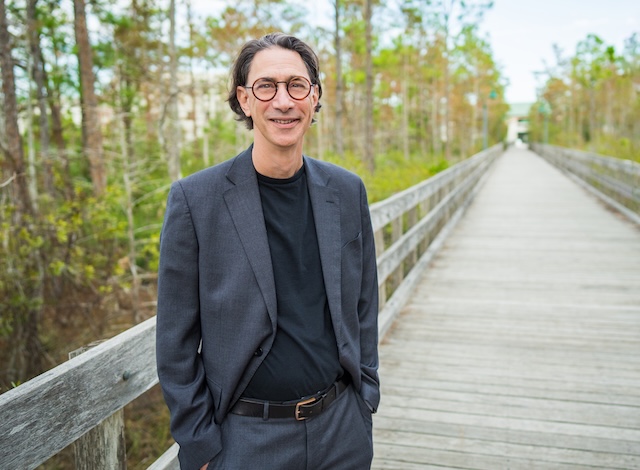
Larry Bender, Associate Vice President of University Marketing & Communications
Larry Bender brings more than 25 years of experience in higher education marketing to FGCU, and he is passionate about telling stories that connect with people.
Curious about how he got his start, how he sees the future of marketing and which job he would swap with on campus, take a peek below.
What inspired you to pursue a career in marketing and communications, and what drew you specifically to higher education?
I didn’t come to marketing and communications in a traditional way. I studied illustration, graphic design and photography and started my career as a graphic designer at a small agency. Even early on, though, I always had a strong interest in the “why” behind the work, not just how something looked, but what problem it was trying to solve.
As my career progressed at Drexel University, I became more involved in strategy, campaign development and messaging, and how creative work and strategy need to work together to truly connect with an audience.
We are telling the story of something that is mission-driven and genuinely life-changing. Higher education has a real impact on people, their families and their communities. Two of my favorite days on a college campus are move-in day and graduation day. You can see the excitement at the beginning and the sense of accomplishment at the end. Those moments are a reminder of why this work matters and why I enjoy being part of it.
How is the shift toward digital and social media changing the way FGCU tells their stories?
The move toward digital and social media has really changed how we tell stories. People scroll quickly, so you only have a few seconds to catch their attention. Because of that, our stories have to get to the point, feel relatable and be authentic right away.
It has also made us think more carefully about who we are talking to. What interests a high school student thinking about college may be very different from what matters to an alumnus, a parent or someone in the community. I always try to remind myself that the story isn’t about us, it’s about the audience. When content feels personal and real, people are much more likely to stop, engage and connect.
If FGCU had a signature marketing campaign theme song, what genre would it be?
I’d probably still start by asking who we’re speaking to and what we’re trying to convey, but if we’re just talking vibe, I’d go with something upbeat alt-rock. Think along the lines of a band like The Killers. Energetic, optimistic and a little anthemic. Music that feels confident, forward moving and makes you want to turn it up, which feels like a good match for FGCU.
If you could swap jobs with anyone on campus for a day, who would it be and why?
That’s a tough one, but I’d probably swap with someone in Student Success & Enrollment Management for a day. Any time I get the chance to work directly with students is really energizing. I’m always impressed by what they’re accomplishing and by the paths they’re carving out for themselves. It would be great to spend a day seeing that work up close.
How do you foresee artificial intelligence (AI) shaping the future of marketing and storytelling in higher education?
I might be dating myself a bit, but I think of AI the same way I think about the introduction of the personal computer or the web. At the time, both felt like big shifts, and over time they simply became tools we rely on every day. I see AI heading in that same direction.
We are already using it in practical ways. For example, with our new brand awareness campaign, we were able to test creative assets through an AI tool to get a sense of how it might perform with different audiences before launch. That kind of insight used to be very hard to get and often required focus groups or long lead times. Being able to do that upfront is a real advantage.
At the same time, AI raises important questions, especially around where information is coming from and what people see as a trusted source. That means we need to be even more intentional about keeping our content accurate, current and easy to find.
What’s the most valuable lesson you carry with you in every marketing decision?
This might sound straightforward, but I always start by asking a few basic questions: who is the audience, what are we trying to communicate and what’s the goal at the end of the day. Once those are clear, the creative, the channels and the tactics all make a lot more sense.
What’s the most creative marketing campaign you’ve ever seen and made you think, “I wish I had created that”?
I have a few, but one that has always stuck with me is Visit Nova Scotia’s “Pomegranate Phone” campaign from 2008. It was built around the rise of the iPhone and the whole “there’s an app for that” moment. The idea was that this fictional phone could do everything and would be the last phone you’d ever need.
What made it so smart was the timing. The iPhone was exploding at the time, and they leaned into the excitement around phone culture in a way that felt authentic and fun. The campaign led to an interactive website and was built around the line, “someday you’ll be able to get everything you want in one device. Today you can get everything you want in one place.” From there, it shifted to telling the story of Nova Scotia through its lifestyle, culture, business and local entrepreneurs.
The concept was simple, the creative was smart and it played directly off what was happening in popular culture at the time. It also went viral before “going viral” was really a thing. It’s one of those campaigns that makes you stop and think, I wish I had thought of that.
What’s one thing on your bucket list you’re determined to check off?
Travel more. There are so many places to see, but the south of France has been at the top of our list for a while. It’s one trip I’m really hoping to check off soon.
What’s your favorite way to spend a free afternoon?
Since moving to Southwest Florida, I’ve really enjoyed just getting out and exploring. One of our favorite things to do is head to Barefoot Beach, grab a beer and sit by the water. It’s a simple way to slow down and relax.
Share Post


