

Weaving together service-learning, sustainability and community
December 01, 2025
Supporting environmental, economic and social sustainability, Patty Krupp, business operations specialist at the Honors College, has been spinning plastic into protective mats for the homeless since 2018.
The process is called “plarn,” a term that combines the words plastic and yarn. It is created by cutting and splicing plastic bags into yarn which can then be crocheted into sleeping mats and pillows for the homeless. In the summer, the mats form a protective barrier from wet concrete and grass. In the winter, it provides insulation and warmth as a blanket or ground cover. Plarn mats can be hosed down and do not need laundering, which is useful for people who do not have access to laundry facilities. “Plarn is about helping the community – touching people’s lives,” says Krupp.
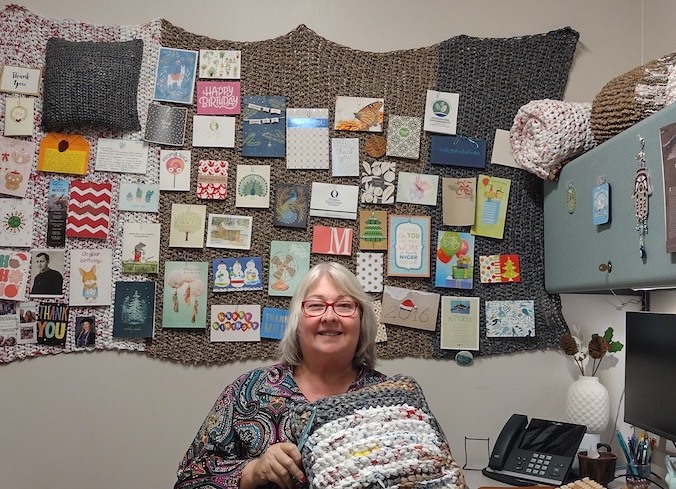
Patty Krupp displays plarn creations in her office space.
Krupp began the plarn project as a “University Colloquium” service-learning opportunity in 2018 with six to eight students. The plarn balls went to local church groups to make mats, and then on to the Lee County Homeless Coalition, which distributed them at health clinics and meal events. During the COVID-19 pandemic, Krupp reimagined the service-learning opportunity as virtual and was inundated with emails from students sharing stories of learning to crochet. Imbued with the spirit of sustainability and inspired by Krupp’s can-do approach, students also began making pillows with the scraps left over.
Today, Krupp’s plarn project continues through “Crochet and Slay” events at the Honors College and through collaboration with FGCU’s Yarn Club. Students crochet mats to express creativity and build community.
Students work 64 hours to process a bag into a ball of plarn, then crochet it into a finished mat. It takes an estimated 400 to 500 bags to make one mat, and Krupp has overseen the creation of 420 mats. These efforts have resulted in 210,000 bags being diverted from landfills and repurposed into woven items by students to serve the community. If you are interested in making plarn, email Krupp at pkrupp@fgcu.edu.
Share Post


