


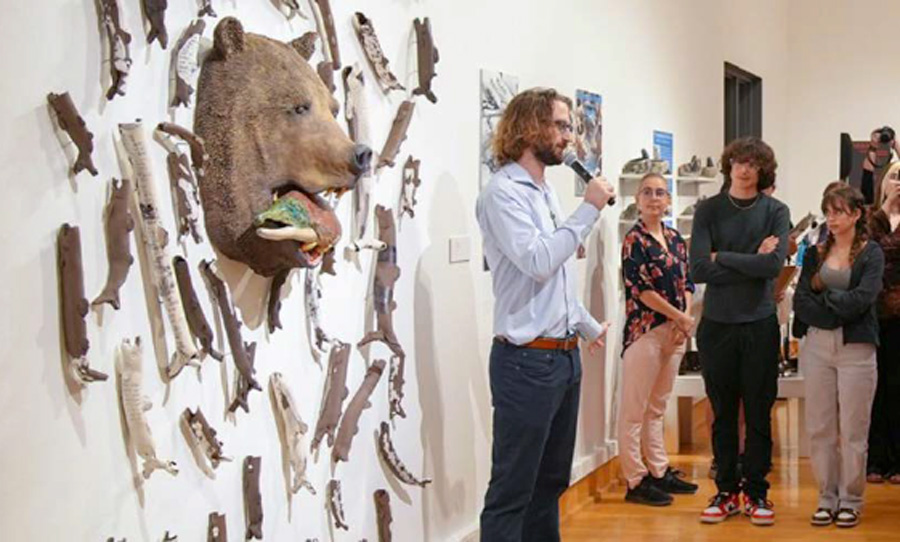
FGCU Art Alum Justin Davis pictured with his Senior Project Rivers Recollection, 2024
Senior Projects - Fall 2026
Location: Wasmer Art Gallery
Dates: November 20–December 4, 2026
Opening Reception and Artists’ Presentation: Thursday, November 19, 5-7pm
At the end of their studies, art majors are required to develop and present a coherent body of self-generated work. This exhibition combines their knowledge of techniques and concepts while drawing on research of historical and contemporary artists. Each senior art major in the exhibition designs and creates a unique installation that combines their technical skills and conceptual vision.
Sponsored by the Layden Family Foundation, the Smith Family Foundation of Estero, and WGCU Public Media.
-
STEPHANIE AGUILAR Lonesome Is A State Of Mind
Toggle More Info
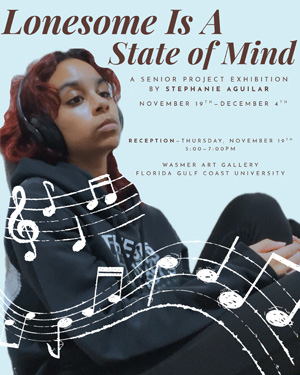
Music has always been a constant in my life. It helps fill the silence, push down my anxiety, and most of all, it helped my loneliness turn into solitude. Being an introvert, I tend to keep to myself and because of this, it’s hard for me to make meaningful connections with people. However, over time, I’ve become comfortable with my own company and learned to find peace in it. Music has helped me embrace that solitude rather than slip back into loneliness. Whenever I lower the needle onto a vinyl or click the play button on Spotify, all those feelings fade away and I’m transported by the surreal sounding melodies that fill my ears.
“Lonesome Is A State of Mind” tells one cohesive story, with each painting having their own. Within three self-portraits, I talk about my experience with loneliness turning into solitude and how music helped me through this journey. Each piece, while corresponding to a time of day, draws inspiration from different songs to help convey the vast feeling of being alone.
The first painting follows the morning, representing the start of a new day. This piece is inspired by Pink Floyd’s “High Hopes,” which talks about nostalgia and how things were simpler when we were young. However, because I have a hard time remembering certain aspects of my childhood, reminiscing only makes me feel lonelier and miss the once-close friendships I’m told I used to have.
The second painting is during the afternoon, representing the hot midday and the rough point of my teenage years, and takes inspiration from America’s “A Horse With No Name.” Though the song is a metaphorical journey about escaping society to find peace out in nature, I interpret it as escaping the noise to find who I truly am in the harsh desert land.
The third painting takes place at night, representing a time to unwind after a long day, and draws inspiration from Earth, Wind, and Fire’s “Boogie Wonderland.” The song is about the dance floor being a temporary sanctuary for those looking to cover up their personal pain. For me, music is my sanctuary. It turns my surroundings into the dance floor, and not only does it cover up my loneliness, it also helps me view it as solitude, allowing me to dance the night away.
-
JACQUELINE BROWN Dearest, Wild Florida
Toggle More Info
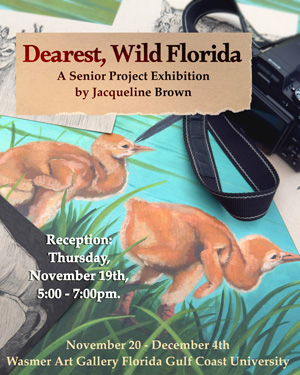
“Dearest, Wild Florida” originated as a sort of love letter from a lifelong admiration of Florida wildlife. As a multimedia artist, my paintings, illustrations, photography, and ceramics reflect my own fascination of the wild Florida creatures I’ve grown alongside. This installation and arrangement provide a glance into the inner world of how I view nature; a quiet, artistic observation in which these beings are my muse.
My entire life I’ve resided on the outskirts of Immokalee. Far outside of town on a lonely, dusty road my life is nestled in the heart of Florida. A trailer carved between palm and oak hammocks, canopied forest, and cascades of greenery that open directly into Florida prairie and cow pasture. These open lands stretch farther than the eye can travel. Each morning is accompanied by bucks, turkeys, panthers, and every southwest Florida creature making their home in the woods beyond our backyard.
My childhood curiosity pulled me into books, documentaries, and taking in all I could about the natural world. Living creatures fascinated me and I spent my time learning, especially of Florida fauna and our native environments. Early on, my connection to animal life was palpable and I’ve been accompanied by a multitude of pets, most notably a crow named Randy and my soul cat, Fletcher. As soon as I could hold a pencil, animals appeared in the margins of my papers and filled my notebooks.
I feel that those who view animals indifferently haven’t been given the chance to experience true animal connections, because to me, these creatures are friends, family, or simply strangers. These beings live their own lives, personalities, and inner worlds that I will never truly understand, but each sketch, paint stroke, and photograph help bridge that gap. This observation fuels curiosity and fosters a desire to learn more of our natives outside.
Underlying my passion is a fear of loss. The importance of these Florida species and the environments in which they reside are groundbreaking. The untouched land used for cattle supports our native wild Florida ecosystems. Each year, habitat loss creeps up and threatens clean water, flood resistance, and many Florida species. Increasing urban scrawl makes it easy to forget the residents who once lived and depended on that land and resources. Through mere exposure to wildlife art and conservation, I hope to communicate the protection of these species through a softer lens. I hope for others to see them through eyes of grace and warmth reflected in my nature journaling and peaceful interactions. Despite the world changing and life passing by, may it always be possible to sit and watch our more peaceful counterparts live slowly beneath the Florida hammock.
-
KAYLEY COLLINS Interchanging Phases
Toggle More Info
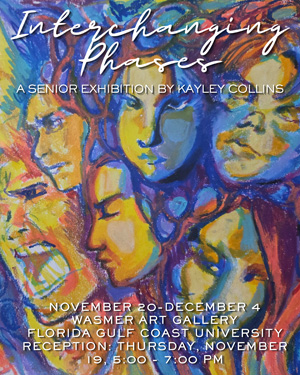
My senior project is a reflection of identity, a depiction of phases of life and experience integrated in both abstract and representational visual forms. My painting Isolation explores inner conflicts such as grief derived from personal experience, using distorted body language and dripping or scratched paint to convey a sense of dread, as well as impressionistic brushstrokes to capture light. Isolation mirrors the grieving process, contrasting with the closeness of the figures in Embrace. These figures portray the importance of connection and the peace that it brings, represented through the blue motif and the gentleness of the embrace.
Meanwhile, Self-Identity examines what is left of us when we lose someone or something important to us. How do we separate these crushing feelings of grief, loss, and mourning from ourselves after losing something so deeply integrated into our lives, to keep on living? I explore human existence on a personal level, questioning the steps of this grieving process: what makes us who we are and gives us individual identities? Through these questions, I also tackle themes of belonging, healing, and reflecting on the sense of self. In Self-Identity, I use warm tones and abstract forms to represent healing, with blue as a motif throughout all of my works to represent calm and the sense of heaviness that follows me throughout life.
My work Boundaries of Reality is based on the uncertainty of the unknown due to societal implementations of doubt when pursuing your passions towards a career that leaves ambiguity for the future. This is shown by the anonymous figures running towards in a mysterious environment, their past selves trailing behind. The Unconscious Mind portrays interconnections throughout the subconscious world, drawing from inner perceptions. In these artworks particularly, I am influenced by Cubism and the concept of simultaneity, showing multiple views of ghostly figures phasing in and out of the picture plane in an unknown world. I portray doubts, fears, and anguish to connect to the inner turmoil that many others share, while also portraying connection and a reflection of the soul. My work is contemplative and allows the viewer to confront vulnerable parts within themselves, exploring our complex, multifaceted existence and allowing the viewer to connect to my visions of existence. The divide between two truths within: passion versus a voice of reason.
-
BEN COOPER Literally Life
Toggle More Info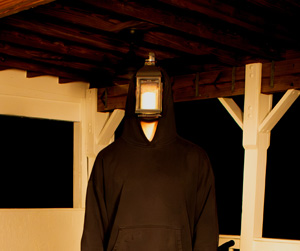

Whimsy is something that the brain tunes out. Lives are too busy, work is too stressful and life can feel too heavy. But as a kid, we create worlds from our imagination. My project, Literally Life, explores this topic of consciousness – allowing ourselves to experience a new perspective where there are no wrong moves or answers. The subjects in these pieces do not know they are in an imaginary upside down reality.
My work is not a reflection of self. It is a statement that is designed to not do anything more than what it is - a purposeful break from reality.
This body of work examines the relationship between familiarity, language, and perception through constructed photographic scenes. I am interested in how a small shift in context can change the way an ordinary object, activity, or phrase is understood - how rituals of homelife and recreational life can be altered to find new meaning. I use photography to explore this suspended space.
The work moves between humor and visual contradiction. I am interested in images that can be understood quickly while still containing something unexpected. Simplicity allows the objects, gestures, and relationships within each image to carry the concept.
Let’s question the expected together.
-
JD GEE Catachresis
Toggle More Info
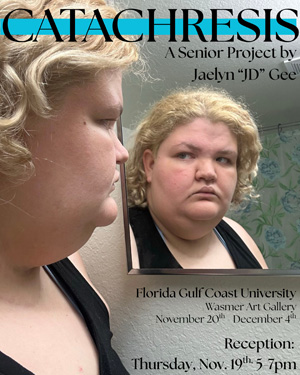
I've always struggled with depicting myself in my art. There has been a persistent gap between my self-perception and how the world perceives me. All attempts to render my own image have fallen short. It feels not unlike writer’s block, grasping for words that can describe my identity yet always landing on the wrong ones. ‘CATACHRESIS’ is the culmination of these efforts, named for this struggle: this is the closest I've gotten to depicting myself, but the “words” I’m using still aren’t the right ones. The style I’ve developed over the past year succeeds in capturing my physicality, while also allowing me to tap into deeper self-reflection without limitations. I use bold, controlled strokes of acrylic paint to express all aspects of myself. ‘CATACHRESIS’ showcases my experiences growing up Queer in Southwest Florida, my struggles with self-esteem and body image, and the isolation that comes with being "different.”
In these pieces, deer represent masculinity and internal perception, while hyenas represent femininity and the physical body. I create a sense of unease by making it unclear whether the viewer is being observed with caution or aggression. The hyenas never face the viewer head-on; hyenas are scavengers, and my physical presentation has always made me feel disconnected from my community. By contrast, the deer are always looking straight at the viewer, forcing the audience to confront my internal identity directly. The typical associations for these animals are subverted to drive home the sense of “other” that comes with the expression of my Queerness.
My work consists of conceptual self-portraits arranged in a gallery-wall style. The paintings are organized so that the viewer sees them first as individual pieces, and only realizes that the works are all parts of a whole after stepping back. The work begins with an intensive digital process to achieve the desired aesthetic. Abstraction takes several rounds: first recreating the silhouette, then breaking each figure into basic forms, before eventually arriving at a series of long, colorful lines implying the desired shapes. Once the initial design is complete, I use a projector to transfer it to canvas, and then meticulously layer acrylic paint to achieve the rich, saturated colors needed. The final step is taking the largest brush in my collection and using it to smear bright red paint over the careful linework. Process has become a major focus of my work in the past year. The physical act of spending days laying my designs on canvas in exacting detail, only to subvert that precision by letting instinct guide me in brushing red paint over it serves as a deeply cathartic method of articulating my own emotional state and experiences.
-
DEMETRIUS MITCHELL Mutant World
Toggle More Info
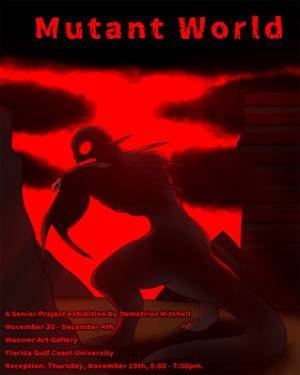
We currently live in an era of irresponsibility. Governments care more for their own pockets and profits than the people that they swore to protect, guide and serve. The average person barely glances around themselves to see what is happening or is already happening in our homes. People are refusing to help each other simply because it’s not their problem, or it doesn’t affect them, and the ones who’ve gotten the worst of it can’t even speak for themselves. Nature is dwindling. Animals are being pushed out of their homes. Species are dying out faster and faster. Eventually, we as a species will have forced their hand, and they will have to move into our neighborhoods and cities just to look for food. Knowing how we are, that means the ignorant and uneducated will rally for their eradication.
So what happens when this goes so far that we humans use nuclear weapons and try to wipe the slate clean? It’s simple, we will all die or; at the very least, our population will drastically fall, while nature finds a way to keep life going. The series of paintings on display are from a horrendous apocalyptic future. One where we let the nukes fall, more focused on eradication than beauty, survival or life. This all takes place from the eyes of a survivor in that hellish world, trying their best not to get eaten alive by the mutated monsters we’ve created with the survivor’s entries documenting their last few months in this post apocalyptic world.
This is an imagined possibility of our world in the future. This is the terrible reality that later generations may have to survive in. All because some people simply couldn’t care less about what happens to the planet that we live on. So let’s fix this mess before it gets to this point, or else our future is running and hiding in a ruined world with these creatures that we tried to dispose of. Only now, they are hunting us down in much more horrific and mutated monstrous forms.
-
MACY NOLL Belonging Is A Choice
Toggle More Info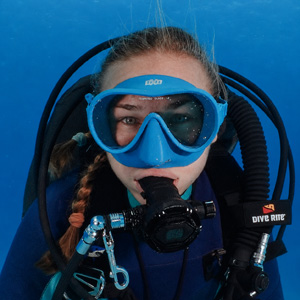
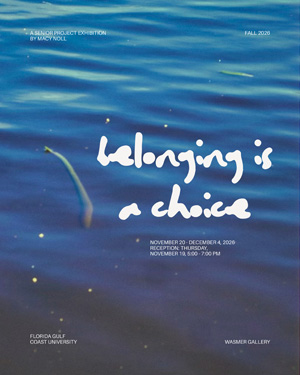
What would it look like to belong not just to the people we love, but to the ecosystems that once flourished on the land we now inhabit? Belonging is a fundamental human need, but we have diminished our ability to belong by relegating its fulfillment to human society alone. Ecology is the study of the interconnectedness of nature, but we make a grave error by leaving ourselves out of the picture. The truth is, we do not know how to exist in our own natural habitat; we cannot even begin to imagine what that would look like! I believe this “ecological identity crisis” is one of the main drivers of both our and the planet’s declining health. We are environmental prodigals, wallowing in the stye of artificial enclosures, entertainment, and intelligence. The good news is, the light is still on. It is not too late to come home.
Through immersive installations featuring off-the-wall acrylic murals, scientific illustrations, community art projects, and environmental education, I promote experiential environmental reconciliation that will change not just the minds but the hearts of the ecologically estranged. Rejecting the climate catastrophism that fuels our generation’s eco-anxiety, I instead embrace visions of reconciliation and restoration, knowing that this positive reframing will take us further than fear-based motivation ever could. “Hope does not deny evil, but is a response to it,” as late activist Jane Goodall proclaimed.
This kind of belonging does not just happen, however. It takes intentionality, persistence, and insatiable curiosity. I was convinced I hated Florida until I got curious enough to get to know her. Now, as a marine biologist, her waters and watersheds are my home, and their inhabitants, well-known neighbors. I want to invite you to make the same choice to belong. Pull up a chair on Florida’s front porch and let her tell you her stories. Let her welcome you home.
-
SARA PHELPS Meditations On Harmony
Toggle More Info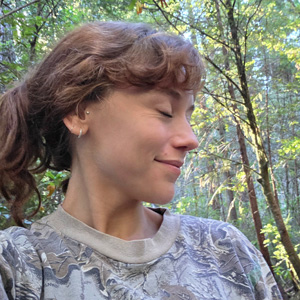
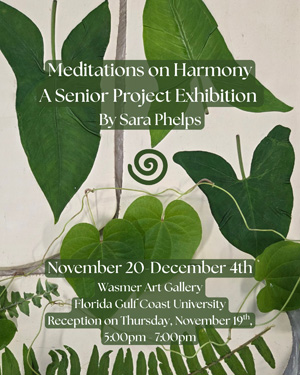
In this exhibition, I invite you to reflect with me upon the connection between us humans and the natural world around us. My most spiritual experiences have always been when connecting deeply to my body and my immediate surroundings in the woods, in the mountains, and in the ocean. Nature reminds us that healing is only a matter of time, and everything we need to grow is already within us. As we connect with nature, we access the parts of us that were never separate from nature in the first place, our primal selves, our raw selves.
Spending time in nature has become an integral part of my life, and I find myself wishing to extend these experiences into my art practice. Inspiration for my ceramic works is taken, mostly, from these sacred moments, where spirituality and physicality merge. Nature reminds me that I am a small, tiny part of a much larger world, and we are all deeply connected.
The spiral pattern your eye follows is a reminder of our non-linear paths in life, how we will always descend and ascend until we return to the earth. While appearing in many cultures throughout history, to me, the spiral symbol ties my work to my ancestry from the United Kingdom. As I honor nature, I also honor those who came before me, and their nature-based spiritual practices. I included real shells, stones and sticks I have found while on my walks outside each day into the design as well. I chose to work with porcelain because I am inspired by the ancient, raw purity of porcelain clay, and the shadows created with the delicate imprints of plants. The glazes I selected were chosen not only to highlight the delicate imprints of the plants, but also the colors we see in nature. The plants pressed into the clay are also harvested from plants around where I live. It is important to me to feature the local landscape because while all nature is important, I find the best nature is the nature we all have access to right outside our front door.
-
AVA SCHIMITSCH In Frammenti
Toggle More Info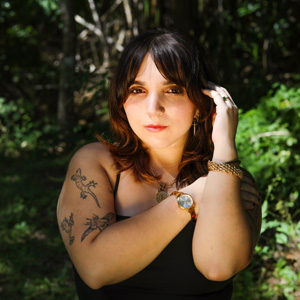
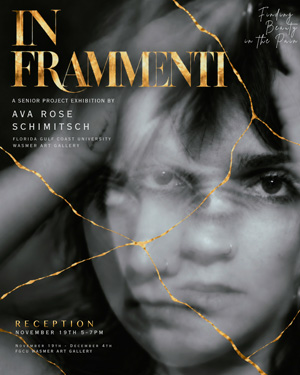
In Frammenti focuses on the experience of living with chronic pain and the ways it changes how I see myself and the world around me. It has affected what I am able to do on a daily basis, and the way I think about my future. There are times when it makes me feel broken, isolated, and disconnected from the person I was before pain became such a large part of my life. Living with the possibility of losing parts of the life I once expected has also made me more aware of how fragile life can be. However, it doesn’t make me any less of a person or less capable of experiencing a meaningful life. This project is about finding beauty within pain and recognizing the value in what is still here.
Pain has changed my baseline and the way I experience life. I often feel trapped inside a body that does not always feel like it belongs to me. At the same time, I think about everything pain has not altered. I still experience love, family, friendship, and all the small moments that make life meaningful. “In Frammenti” holds both the grief and the beauty of what I have lived through.
These ideas take form through photography, ceramics, and poetry. The photographic works combine layered double exposures distorted with writings and paint. The ceramic forms are inspired by the human body but abstracted into organic shapes, with cracks and imperfections intentionally left visible and highlighted with gold gilding paint. Gold serves as a connecting element across the different mediums, representing an acceptance of the marks pain leaves behind while recognizing the beauty that can exist within them. Poetry provides me with another way to question my experiences and express emotions that are difficult to explain visually. Through this work, I process what I have experienced and find meaning within it.
After the heartache, devastation, hospital visits, sleepless nights, and tears, I recognize there is still beauty in being alive. Pain has made me aware that nothing is promised, and that realization can be terrifying. But it has also made every moment feel more precious. I am broken in ways I never wanted to be, and there are days I grieve the person I might have been without the pain. But I am still someone worth knowing. I am still here, and somehow, after everything, I am grateful that there is still something left to lose, something left to love, and a life left to live.
-
BEN SCHNEIDER Ode To Love
Toggle More Info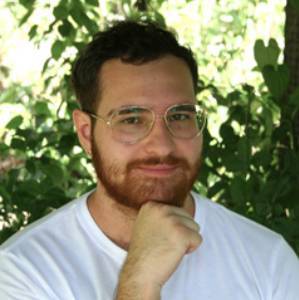
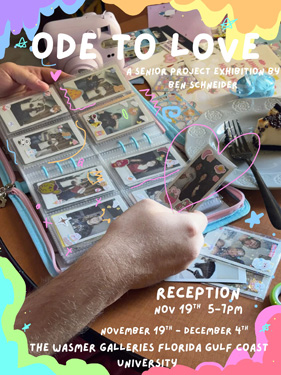
Everyone has their own experience, and each person is unique in how they express it. Luckily, I have an amazing family who helped me before I could ask, and friends who always knew what to say to make me laugh. These works express the connection I have with the people I’ve gotten to know in my life, who have impacted my way of living. In a way, this is like a big thank you for sticking with me through everything.
Through my paintings, I wanted to showcase what it feels like to be me in these scenarios. These works show me experiencing certain emotions, and the added objects add a sense of feeling and an aesthetic. Ode to Love shows 3 paintings along with some ceramic pieces. Each of the paintings showcases a relationship, what it feels like to have my friends, my family, and how my life has been impacted, and the relationship I have with myself. The TV and ceramic pieces are what tie these works all together; they show me growing up with my best friend in my childhood, playing Nintendo games every day. I wanted to recreate where I spent time with her all day, and all the adventures she and I got into. She means the world to me, and I wanted to show everyone the connection we share.
I have experimented a lot with my work over the years at FGCU, trying to figure out how I can put myself on a canvas and not just make it a plain old painting. I like to use a variety of mixtures added to acrylic paint to enhance my art. For Ode to Love, I wanted to take on a cuter concept, and for that I have added a mix of joint compound, or better known as spackle, and formed it in a way to resemble cake frosting. Through my exhibition, Ode to Love, I hope to share with the world the sweet life filled with sunshine and rainbows that the people in my life have gifted me, even through the darkest of thunderstorms.
-
DIANA TALAVERA The Ocean Remembers Her Name
Toggle More Info

My series explores getting to know oneself and accepting the perceived good and bad within. I use Sigmund Freud’s theory of the ego to depict this concept, while relating it to the depth of the ocean. The psyche is symbolized by the ocean as a representation of the unknown. A place that holds mystery, beauty, and is forever changing.
The first painting represents the Superego. This is the part of us that wishes and dreams for success and recognition. The superego follows strict ideals, rules, and moral values. In this painting, the moral compass is the light coming off the shell lighthouse. Across the sea, we can see her goals shining brightly, representative of an idealist future. At her feet, a wise sea turtle will guide her way.
The second painting is the Ego, a combination of both good and bad, innate and learned. Here is a city of fish dancing through corals. They hold routines, they make relationships, and they have jobs. Some of these creatures are harmless, while some have a dangerous beauty. This painting represents society, embracing the balanced dance we create with our surroundings. A reminder of everyday life where we decipher what is right, wrong, and possible.
The final painting in this series is an ode to the Id. Sigmund Freud states we are all born with survival instincts. It is what tells us to eat, sleep, and cry. It is what relentlessly strives for our survival or innate pleasures. In the depths of the ocean, the Anglerfish represents the Id. Blind creatures that survive purely on instinct but have an aggressive lure. Here the darkest of our desires reside, hidden deep beneath the waves.
This series asks us: what are our wildest dreams? How much of ourselves do we know and are willing to accept? Can we sleep next to our demons at night? Freud’s work is important because it confronts us with deeper questions about ourselves and the reasons behind our actions. Although his ideas are still debated to this day, his theories influenced medicine and artists alike. Together, the three paintings tell a story of self-discovery and finally acceptance.
-
SOFIA TEACHEY Two Halves Of My Whole
Toggle More Info

Growing up, I spent most of my summers in a little town in Eastern North Carolina called Goldsboro where my father is from. I got to see where my dad grew up and spent a lot of time exploring the town. This past summer, I was finally able to visit El Salvador, specifically San Salvador, where my mother is from. It has been a dream of mine to visit and put places to names. My mother and father are two very important figures in my life so being able to visit the places they grew up in is a surreal experience. I am dedicating this series to my parents because I want to show my appreciation for all they have done for me.
This series is about those two places that hold a lot of memories for both me and my parents. I am blending personal experiences and memories that I have had and painting them directly onto canvas. Each painting is from my point of view. The landscapes and other places that I chose to paint are from the photos I took that best showcased the beauty. They are places that my parents spent a lot of time at while growing up, and I got to visit them. Places that will probably never mean anything to the viewer, mean everything to me.
This series consists of nine different paintings each being a place that I have visited from both Goldsboro and San Salvador. On one side, there are four paintings about El Salvador, and on the other side there are four paintings about Goldsboro. For example, I painted one of the locations, El Tunco in El Salvador. I chose El Tunco as one of my subjects because it is very beautiful and one of the landmarks in El Salvador. The painting placed in the middle is a transition painting going from one place to the other. Each painting was directly inspired from photographs I took. I want to show people both Goldsboro and San Salvador through my eyes and get the viewer to see the beauty like I do. Through this series, I am able to reconnect with my parents and further learn more about my heritage.
-
KAILYN GALUE Touching The Surface
Toggle More Info
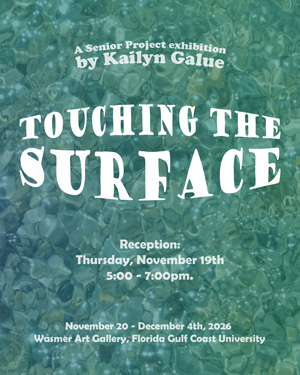
Growing up in Southwest Florida meant going to the Sanibel Causeway almost every week, where it was just my dad, my brother, and me from sunrise to sunset. These days consisted of learning about the fish and other creatures that were reeled in with excitement, shelling when the tide was low and the water reflected the painted sky, and frustrations from the casting net or fishing line getting caught between the rocks. My time was dedicated to chasing crabs and fish before they were out of sight, paddling into the gulf with the kayak to get a closer look at the dolphins and manatees passing by, and standing our ground while the storm would pass by with the wind prickling our skin with the sand. Friends were never consistent, but spending time outdoors with my parents and younger brother was the core of our life growing up. It is what started my passion for the gulf and everything it comes with.
These experiences helped shape my connection to the coast and my understanding of what it means to have a sense of place. In Florida, the sea itself is a symbol of natural beauty and is home to countless species. The more time someone spends immersed in its biodiversity, the more they come to value it and develop a deeper appreciation for the seascape. Focusing on environmental stability, such as protecting marine life and its surroundings, helps ensure the ocean stays healthy for the world to continue admiring.
My artwork involves fragments of my own memories, weaved in with documentation and appreciation of the coast we get to witness today. The three-dimensional sculpture spotlights a black-tip shark on its feeding frenzy during a mullet run. The hanging wall art behind shows varying types of admiration for the gulf, brought together by its fragments with bright and bold colors reflecting the way I experience this source of comfort. This includes portraying the environment itself or aspects of it through different mediums. Together, this installation celebrates a beloved part of my childhood, where I have found endless joy throughout different stages of my life, while highlighting how today’s Southwest Florida environment can become such a crucial sense of place for many through connecting with its local nature.
-
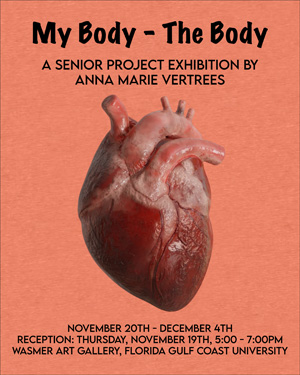
ANNA VERTREES My Body - The Body
Toggle More Info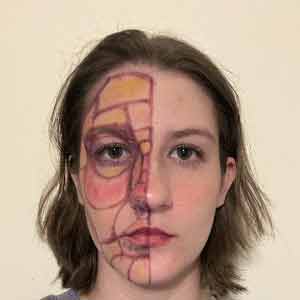
I struggle with human connection. I do not understand or process empathic responses to other people in a typical manner, and I struggle to recognize and reciprocate emotions displayed by other people. This is my experience with autism, and it has changed the way I perceive being a human. I do not quite understand the idea of a body outside of being a purely physical vessel, a machine in which the brain operates to maneuver through the world instead of a sort of being with a soul. As such, I find it far easier to create tangible physical connections rather than emotional, spiritual, or empathic connections.
I have created a life-sized ceramic sculpture of myself that acts as a depiction of the purely physical and mechanical form that I believe a human to be. It is a self-portrait that viewers can physically connect and interact with; it has no soul or emotions to connect to. The sculptures of several vital organs are displayed as sort of machine parts to be assembled into the body. The heart, eyes, and brain are things I see as purely functional and with no deeper meaning behind them. They are parts of the human machine. The tongues showcase one of the most intimate forms of physical connection; exchange of a bodily fluid such as spit, a concept that is much easier for me to understand than that of empathy or reciprocal human interaction.
I create large sculpture pieces with purposeful surface textures because it forces the viewer to interact with the art and make a physical connection with it. I want my viewers to touch, feel, and interact with my art in a physical way because it allows the viewer to experience how I interact with the world and how I view a human physically rather than emotionally.
My art is how I connect with other people, and it is how I express that connection and my view on human experience. I want to explore my own mind, create connections, and express myself in the way that makes the most sense to me and allows the viewer to make sense of and experience my perspective.


