


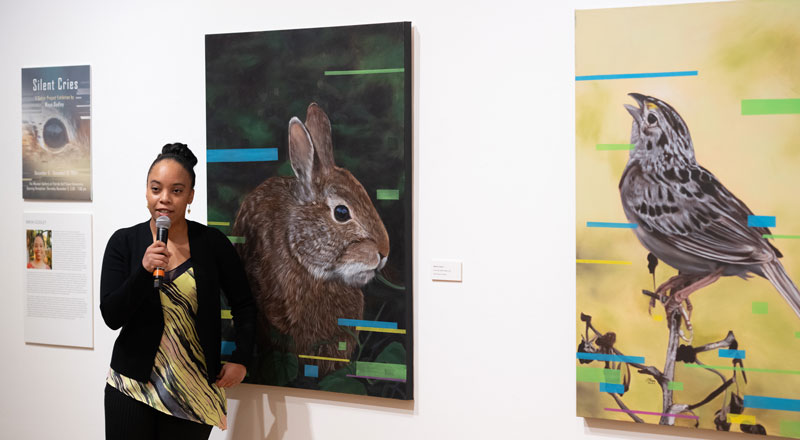
Senior project student, Maya Dudley introducing her series, Silent Cries, during the opening of Senior Projects, Fall 2024. Photo courtesy of Caitlin Rosolen.
Senior Projects – Spring 2026
Location: Wasmer Art Gallery
Dates: April 17 – May 1, 2026
Opening Reception and Artists’ Presentation: Thursday, April 16, 5–7pm
At the end of their studies, art majors are required to develop and present a coherent body of self-generated work. This exhibition combines their knowledge of techniques and concepts while drawing on research of historical and contemporary artists. Each senior art major in the exhibition designs and creates a unique installation that combines their technical skills and conceptual vision.
Sponsored by the Layden Family Foundation, the Smith Family Foundation of Estero, and WGCU Public Media.
-
Anthony Alexander CROWDED LONELINESS
Toggle More Info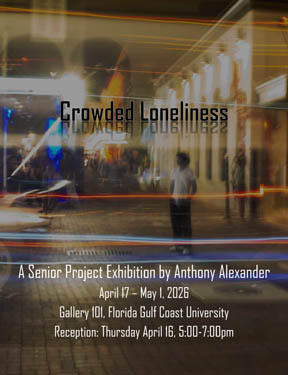
For most of my life, since the foundation of my identity was being constructed and understood, I have felt like I speak, but am often never heard. In social situations, I am physically present, but somehow overlooked. This sensation is familiar to some, but for those who cannot sympathize with it, I have created a world that visually encapsulates the feeling, through cyberpunk-esque landscapes; these dystopian cityscapes were designed for a future of perfection – looming buildings with technological advancements waiting to be gleaned from – yet the emotional connections are missing. The people are there, but also not.
Emotional connections can be difficult to maintain in such a busy and overstimulating world. Take a look at how, since the invention of the smartphone, that most people are incessantly absorbed with their work, video, game, or news, no matter where they are or how beautiful of a day it is outside. Feeding the brain with a constant stimulus is detrimental to the intake of the fragile yet poignant stimuli, such as emotional connection via human interaction. When I was a boy, I used to explore and play outside until it started to get dark, connecting to nature, people (my friends at the time), and physically exerting myself – all human experiences I believe are necessary to healthy human interfaces. Nowadays, we’re “advancing” to a world that makes this all virtually impossible and even stigmatized, when possible.
Some of my drawings were created with an assortment of hardnesses of graphite pencils on drawing paper. Others were started with a base of graphite and finished with layers of colored pencil and/or studio pastel. The photographs were taken using a slow shutter speed at night on a DSLR camera, using a timer. The photos were subsequently edited to reduce saturation in either the background or the self-portrait to exhibit disconnectedness from the masses. The choice of a slow shutter speed and separating the subject crowd was to emphasize the bustling nature of the city life creating a ghostly effect that contrasts with the lonely and stagnant feeling of the subject. The spectral movement of the city also reflects the impermanence of emotional connection. The ceramic work is composed of an ironstone clay body from Highwater Clays in St. Petersburg, Florida, as well as a pure porcelain clay body. Glaze was not used to emphasize the beauty of the true color of the naked clay. These buildings were somewhat abstracted but also connote the overwhelming amount of detail gathered when viewing an architectural landscape.
-
Kaitlyn Brawley DAUGHTERS OF LEDA
Toggle More Info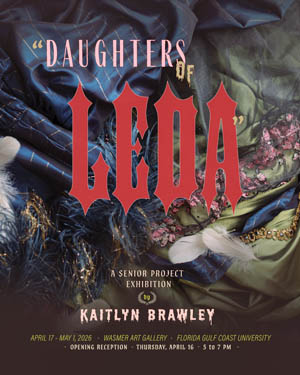
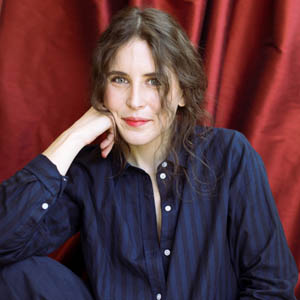
“In truth, cloth for thousands of years was the notebook that recorded the woes and joys, hopes, visions, and aspirations of women” - Elizabeth Wayland Barber
The ancient Greeks viewed one’s lifespan as a thread. Spun by the Fates into existence at birth, measured, and eventually cut at the time of one's death. Though the three spinning sisters controlled the timing of a life, what a person did with their allotted thread was determined by their choices. The Greeks symbolized this shaping of one's own destiny as the act of weaving. At a glance, my anxieties and those of my female peers can seem wide-ranging. Some are fighting to protect our access to birth control and basic healthcare. Others lose sleep over the safety of their daughters or are trying to shake societal pressures and feelings of dread induced by a false, but widely-perpetuated “fertility cliff.” When viewed more critically, a common thread is clear: no matter the stage in life or personal aspirations, none of the destinies we hope to weave are unharmed by the patriarchal system we live in.
This project was inspired by women in mythology, like Penelope, Philomela, and Arachne, who used their skills at the loom to resist or subvert the violent, oppressive systems they lived under. Working in oil on linen, this body of work engages with women’s centuries-old, shared culture of cloth. Recording the anxieties of today, portraits of contemporary women are woven into scenes that recall an archaic past. These incongruent pairings reflect the overwhelming absurdity of a society determined to force women back into the rigid confines of an obsolete world. It’s a place that was neither built for nor by women and where they were granted significantly less autonomy. This regression feels best described as something medieval.
Each composition corresponds to the attributions of one of the Greek Fates: creation, allotment, and endings. Through this framework, the series examines the connection between procreation and control, our individual roles in upholding violent patterns, and whether a better future is possible. Each image is assembled like an allegorical puzzle, with the costumes and settings inspired by the archetypal and formulaic depictions of women in the late Middle Ages, Renaissance, and beyond. Motifs are layered throughout that reference specific women in myth, folklore, or religion who were denied autonomy in life and subsequently objectified throughout the Western art-historical canon and used to perpetuate the same system that harmed them. One of the most egregious examples, and the inspiration for this series’ title, is Leda. Referenced in the first composition, the burden of male violence, symbolized by Zeus in his swan form, hangs from the figure’s neck like an albatross.
-
Chloe Chambo TOUCH ME
Toggle More Info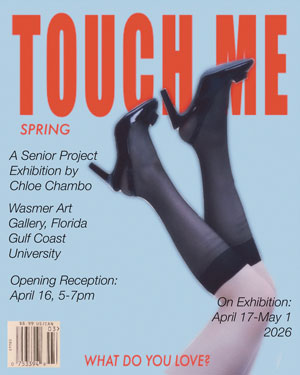
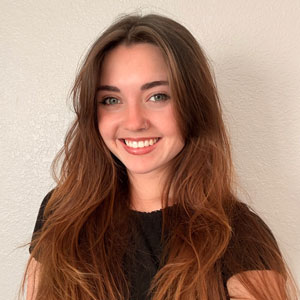
“Touch Me” started as an infatuation with the art of bookbinding, which quickly escalated into an investigation into the intersection between digital media and fine arts. So much of modern life is spent staring at a screen, unable to truly interact with the things we are seeing. I found I had a strong underlying desire to take the media from my screen and put it into my hands. I am fascinated by the tactile qualities of physical art, while preferring the visual aesthetics of digital media, and in this project, I am combining the two. I am spotlighting physical media in the form of books, zines, magazines, and CDs.
The driving theme of this project is the importance of physical touch. By translating digital media into physical works of art, I am not only changing the way the brain digests visual information, but I am also preserving a small portion of my corner of the internet. The digital platforms on which digital media exists are fading into obsolescence as we speak. What will there be to show of our existence when Instagram goes dark? I am choosing to force the content that I obsessively consume into a physical format, which comes from both my desperation to resort to a life I’ve never lived—a life without the internet—and a desire to escape from the toxically misogynistic stereotypes associated with online fan culture.
I was inspired by several artistic practices. Traditional printmaking, painting, and bookbinding disciplines are represented, but I am also drawing influence from graphic design and maximalism. I have incorporated tongue-in-cheek sexual humor as a way to captivate an audience and use this captivation against them to point to the expectations placed upon women. The goal of combining these techniques is to draw the viewer in, then encourage them to physically engage with the piece.
This project was largely inspired by the question “What do you love?” In its most basic form, the contents of the bookshelf will reflect my passions. In a way, they will serve as mirrors to my own love and how I express it. However, I also aim to insert women into spaces where they have been historically shunned or demonized: Sports, literature, music, and art. Even after my extensive exploration, I am still left with questions. How is it that male fandom can be normalized as passion, while female fans are seen as crazy and obsessed? How can I embrace analog art forms when I have never known a life without the internet? What started as a simple idea to create a bookshelf that represented the things I enjoy quickly became a deeper study on how technology impacts modern society. Regardless of what corner of the internet you live in, I implore you to set down your devices and pick up a pencil.
-
Elimar Cuencas HOLDING ALL OF IT AT ONCE
Toggle More Info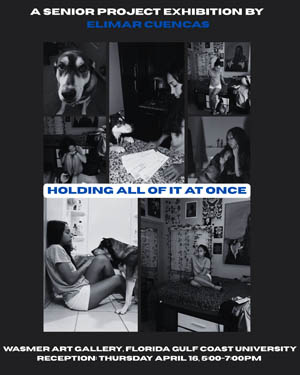
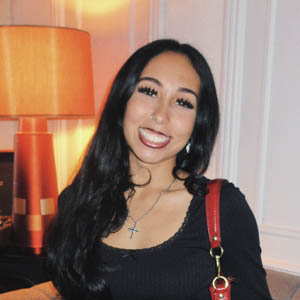
This series of three paintings explores the quiet emotional life of a woman, focusing on the intimate moments that exist beyond productivity and expectation. I am interested in the psychological, emotional, and mental weight of balancing school, work, and personal life, and how fatigue settles into private spaces. Rather than showing a literal struggle, I focus on stillness- the moments after long shifts, late assignments, and being internally overwhelmed. Through these paintings, I aim to make visible the quiet endurance that it takes to navigate these overlapping responsibilities, while valuing the presence of companionship within that exhaustion.
The central relationship within this series is the bond between myself and my dog Kiba. Kiba functions as more than a companion; he becomes an emotional extension of the mind and body. Sort of like a soulmate, within these intimate spaces, Kiba serves as a grounding presence and silent witness to vulnerability, doubt, and fatigue. The physical closeness between the figures reflects a psychological intimacy- a connection built on loyalty and an unspoken understanding. The series shows how companionship can soften emotional strain, offering a sense of stability in the midst of the chaos. Through the posture of my figures, closeness, and shared spaces, I explore how the human figure feels divided between responsibilities, while Kiba represents a witness without judgment.
Each painting starts with photographs that I take myself, documenting my environments rooted in lived experience. These references start the paintings in realism, but the final paintings aren’t a straightforward representation. Influenced by Fauvism, I use bright, non-naturalistic color to express my emotional states rather than physical reality. Saturated reds and warm tones suggest pressure and overstimulation, while cooler blues evoke rest, reflection, or emotional withdrawal. I simplify the forms and reveal brushstrokes to show vulnerability. Through the intentional colors I choose for my figures within the familiar spaces of a bedroom, bathroom, and kitchen, I demonstrate in my work how these spaces feel rather than how they actually appear.
-
Nicole De Los Angeles ENTRE DOS
Toggle More Info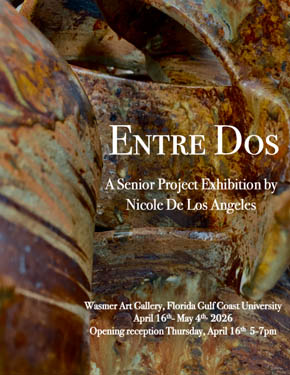

My life in Venezuela exists primarily as memory; one I carry with me a daily yearning for the landscape, my family, language, and culture. When I first moved to the United States, I didn’t understand that I could not return indefinitely, and for many years I held onto the hope of going back. Political instability has made that return feel impossible, transforming my homeland into something emotionally present everyday, yet physically unreachable. In contrast, Florida has been my home for the past ten years. I am grateful for the stability and opportunities it has given me. Even then, I often feel culturally and politically disconnected, unable to fully root myself here. This tension between two geographies of my life inspire both the conceptual and formal qualities of my practice in ceramics.
While studying ceramics, its always classified in two areas: sculptural and functional pottery. I found myself relating to clay as it has it two lives like me. Starting this course I had a vision to showcase these two areas of ceramics relating it to my experience. What emerged was a collaboration with clay that works as a passage for my memories that is automatic and repetitive. In Venezuela, despite political insecurity, there was a profound sense of belonging rooted in the innocence and my family that sheltered me; and while I struggle to fully root myself in Florida, it has given me a sense of home in its outdoors and in ceramics.
Ceramics has become a practice that allows me to feel connected to those memories that shape who I am and that I think about every day. Working with clay brings back those memories making them clearer. Allowing me to understand where I came from, who I am becoming, and where I want to go. In the studio, my hands and my mind becomes one with these separate but intertwined entities. They help me join these worlds together enlightening those lived experiences.
What matters most in my process is not the technical precision but the repetition and intuition that guides it. I begin with similar cylindrical forms, returning to the wheel again and again, allowing my hands to move through motions that feel familiar and grounding. That repetition becomes meditative, almost like revisiting a memory that never truly fades. As I cut, bend, and reassemble sections, the forms shift away from their original structure, much like migration reshapes identity without erasing its origin. The joining of these parts becomes less about construction and more about reconciliation. Each connection reflects an attempt to bridge two geographies and two emotional states that continue to coexist within me. The spaces between sections, the visible joints, and moments of imbalance echo the gaps in my own experience such as missed time, distance, and longing. Yet the act of bringing them together allows me to focus on continuity rather than rupture. Through this intuitive assembly, the work becomes a reflection of my ongoing negotiation between memory and presence, between where I come from and where I am still learning to belong.
-
Olivia de St Pierre IS THIS DESIRE
Toggle More InfoL
What lives within desire? The pretty answer is love. The honest answer is obsession. What primal urge shows itself more ardently? Our obsessions are ourselves. Our identity, our god, our lineage. They drive us to consume, to absorb, and to become. I have always found myself most alive in the throes of obsession. To hyperfixate on something means to absorb its energy as my own. To become this hybrid of myself and whatever is making me feel so good. The dance between intense desire and intense consumption has colored my behavior, my creativity, and my sexuality. Women are often afraid to express their obsessions, especially as they relate to their sexual or romantic interests. Wearing hypersexuality openly as a woman is largely seen as criminal. Removing this shame in the exploration of these themes was integral to the work.
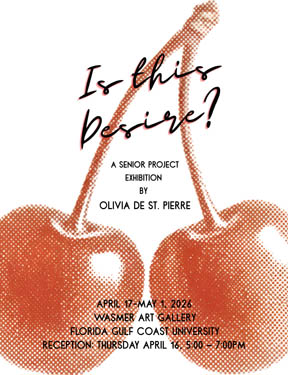
Discussing feminine sexuality can often be alienating. So the accessibility of this work revolved around choosing metaphors that are born of the natural world. The three main motifs are all naturally occurring yet still relate heavily to themes of obsession, consumption, and sexuality. Cherries have a long history of associations with the female body; however, they appear in this work as a symbol of obsessive practice, each little one having to be carefully chewed to avoid a poisonous pit. The mouth: a more direct reference to the act, violence, and beauty of consumption. Something inherently necessary and inherently violent. Finally, the praying mantis. The female praying mantis’s instinct for sexual cannibalism has long made her a symbol for all-consuming desire and rightly placed her within this work.
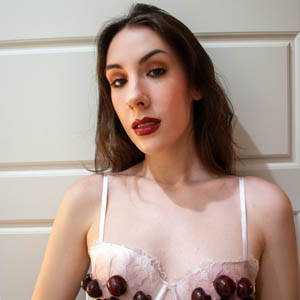
This project combines self-portraiture, printmaking, and clothing design. The large self-portraits made with dry pastels are meant to depict my image and environments in a way that is both realistic and dreamlike, with imagery that evokes the outer and inner experiences surrounding obsession and consumption. The wallpaper was created using stamps made from impressions of my teeth, layered with my kiss prints. The bustier and garter skirt come from my personal wardrobe and were dyed with cherry juice and embellished with clay cherries, religiously sculpted and attached to the fabric. Good enough to eat.
-
Anastasia Filip A LIFE POURED AND SHARED
Toggle More Info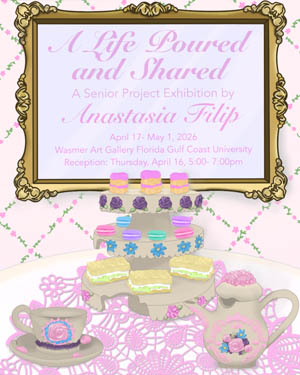

Like many women, I have a difficult relationship with my body. Appearance and weight have played a huge part in how I view myself and my potential. I thought that my outward appearance was often more important than my inner person. I came to focus most on what I was wearing, how good my makeup and hair looked, and most often how my body appeared. While I still struggle I have grown to love my body even though it shows signs of aging, consumption, and activity because it allows me to live my amazing and fulfilling life. My project uses the tea set and desserts as a metaphor for the performance of femininity and the expectation placed on women’s bodies. Tea culture is rooted in presentation, delicacy, control, beauty, and refinement. These objects are made to be displayed and gawked at before they are ever used. This mirrors how women are often first valued based on their outward appearance rather than their inner personhood. Through this project I am exploring how femininity has become staged and maintained. In this project I used hand built and thrown white earthenware ceramics, decorated with colored slips applied using traditional cake decorating techniques.
Unlike the pristine tableware usually seen, my pieces appear handled, worn, and lived with. The crumbs, stains, and surface imperfections become central to the project. Inspired by traditions that value aged and well used objects, I treat the signs of wear not as damage but as evidence of time, experience, and presence. Each crack or break was made intentionally before firing. The aging surface of my pieces parallels the lived body that has been marked, shaped, and changed by history. What is often framed as decline becomes proof of a life well lived. By combining beauty with signs of use the work becomes a critique on the laws of attraction. The delicately decorated surfaces and sweetness of desserts draws viewers in, while the context of use suggests consumption. The table becomes a stage where femininity is performed, but also a site where the performance starts to unravel. Through this work I am reclaiming fragility as strength and again as accumulation rather than loss. This reframes the decorative objects and the female body as something with agency, memory, and value beyond appearance.
-
Julia A. Garcia REMINISCING IN NOSTALGIA
Toggle More Info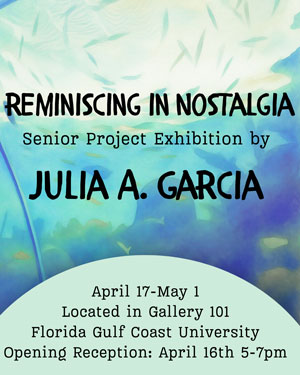

Reminiscing in Nostalgia is a series of marine animal toys that draws inspiration from my childhood in the early 2000s. What brought me fascination, comfort, and joy then still prevails in my adult life.
Looking back, my childhood was magical and amazing for as much as I was able to experience. While I took on responsibilities early in life, I’ve come to realize that the things that brought me happiness then still bring me joy now. At 22, I still love playing with dolls, collecting stuffed animals, watching cartoons, and all things cute; I’ve learned to embrace what genuinely makes me happy.
Growing up, I stumbled over my words a lot. I had a hard time comprehending what I was reading, I misspelled often, and most of all, I struggled to find my own voice. Visuals made better sense to me, and art became a space where I could express myself in ways words could not. When I create, I reconnect with my inner sense of wonder and passion, as well as the need to feel seen.
Over time, these objects made for play became more than just toys. They became reminders of specific moments in my past that brought me delight. Returning to them now reconnects me with those memories and the sense of whimsy they once held. I believe it is important to assert that joy, especially in adulthood, where play and softness are often dismissed as childish or weak.
Because of this, I have always felt a strong responsibility toward objects. I struggle to throw things away, even when they are no longer useful. Instead, I do my best to repair them or save them for a time when they might still serve a purpose. Most of the pieces within Reminiscing in Nostalgia are thrifted items that were given a second chance. They were once broken or misused, then repurposed for parts and transformed into something new and remarkable. I believe objects have souls: the time and attention we give imbues them with meaning. In a way, the objects we care for begin to hold something of us within them.
This is why I create. I want my pieces to be an immersive experience that is soft, whimsical, and heartwarming. The ocean has always felt expansive and calming, and these toys capture that feeling in a small, tangible way. To me, maturing isn’t about letting go of wonder; it’s about carrying that childhood curiosity forward with intention in everything I do today.
-
Callie Grindstaff A HOMETOWN QUILT
Toggle More Info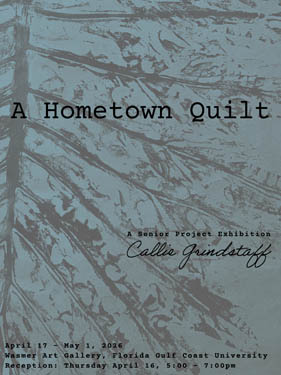
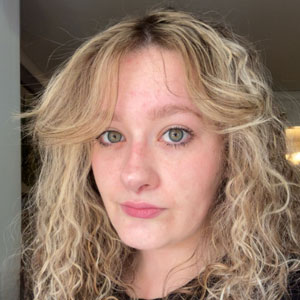
Much of my life has been shaped by the low sloping Smoky Mountains of North Carolina, where I was born. I moved to SouthWest Florida in January of 2023 and have continued my undergraduate education at FGCU. A Hometown Quilt is a visual representation of progress in my personal journey as well as my physical journey outside of Appalachia. The natural world inspires me to create, heal, and continue where I am going, no matter how far from home I end up.
My artwork focuses on the enmeshment of Florida and North Carolina and how these two quite different places have shaped me. The famous hue of the Blue Ridge Mountains frames the background, as my personal background was framed, and the tropical flora of Florida in the foreground, as it frames my present. I focus on the natural elements of life and how nature shaped not only my joy, but also my hardship. The unforgiving harsh climate of the mountains and the social isolation that comes with rural living caused me to channel my artwork into familiar forms once I left home to continue my education. My childhood nickname is “Calico” which is also a floral design commonly used on feed sack bags for dried goods, which would then be made into clothing or patch-worked in traditional Appalachian quilt making. I wanted to honor as many pieces as possible of myself that have been patch-worked into the adult I am today.
My process is shaped by the recycled bedsheets that I chose for fabric. I chose a material that is familiar and comfortable, in patterns that reminded me of myself. The floral print was purchased by my grandmother in the late nineteen sixties. I chose to dye several fabrics, which were also used in folk craft to achieve different hues but keep costs low. The cost effective and strategic cutting of fabric was vital to the patch working of the quilt, as I wanted to reflect the resourcefulness of Appalachian quilters. I assembled the pieces together by using appliqué technique, piecing each fabric on the sheets, and then filling the middle with cotton batting. I wanted the quilt to be decorative but also functional to represent not only the beauty of the natural world, but also the harshness of nature.
-
Taylor Hartman FAMILY FORMS
Toggle More Info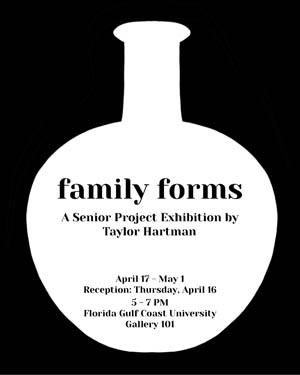

I often struggle to find meaning in creating my art. There are concepts that influence me, topics that I am interested in, but I lack real connection with my works. In searching for the significance of this project, I thought of the people who inspire me every day – my mom and grandma. They have been there for me when I needed them most, supporting me through difficult times and giving me the strength to keep going. This project is dedicated to them, as without them I would not be here today.
My project consists of three grouped together vessels. Each is unique in size, shape, and surface, representing their own energy and emotion. Treating each vessel as a canvas, I play with my glaze application, combining sculpture and painting on the continuous walls of the forms. Together they form a sort of family, establishing an unspoken dialogue between one another that is different to each viewer. A smooth surface might evoke calm; a fractured one might hold movement or resistance. Light plays across these textures, revealing hidden layers of thought.
Constructed of stoneware clay, each vessel was created using hand-rolled coils that were blended together with a dried calabash gourd. To further shape and blend the vessel, I would paddle the exterior using a piece of wood, most often a wooden spoon. Once bisque fired, glaze was applied via splashing, painting, or airbrushing, keeping the forms as well as surfacing non-objective and abstract.
-
Cassian Haynes-Belle OUROBOROS
Toggle More Info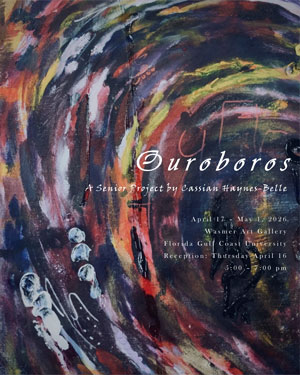
The Ouroboros is the mythical self-eating snake, often used as a symbol for never ending cycles. This perpetual loop is how I view the discipline of philosophy. The pursuit of understanding the concepts that define and often consume us is ultimately unending because each is fundamentally inseparable from one another. You cannot deconstruct them in isolation because they overlap at their edges, spilling into one another until your original inquiry becomes a tangled web of incomprehensibility. This convoluted entanglement, lacking a definitive beginning or end, is the ultimate inspiration for this project.
I chose to center two schools of thought, Epistemology, the philosophical study of knowledge and Existentialism, the philosophical study of self because I find them to be both the most complex and the ones we bump into the most. Taking influence from thinkers like Heidegger, Kierkegaard, and Nietzsche, I posed 13 questions that lie at the center of my own philosophical web. It feels overwhelming to be confronted with the statement that you truly know nothing, especially yourself, and your life innately has no meaning or purpose. It feels even more daunting to be fighting this uphill battle if you choose to challenge these concepts. To emulate this overwhelming feeling, I chose to create these works on a monumental scale, forcing the viewer to feel small under the looming presence of these paintings. The choice to make the titles for each of these paintings the questions that inspired them was to encourage the viewer to not only engage with the questions for themselves, but also to engage with those that are around them, to have that conversation with others and see where the train of thought takes them to next.
The process of building up paint in thin washes, sanding, then building the paint up again in thick piped textures mirrors the push and pull of the mind attempting to understand the vast expanse of philosophy. The overall composition is inspired by natural phenomena like supernovas, river deltas, and neural pathways in the brain. The natural topography, visual line, and motion in these environments mirrors the way I visualize a meandering train of thought and the expressive textures across the surface of the composition. Each canvas exists as more than its aesthetics or the question it represents, to me, it is the essence of the inquiry contemplated during its creation, distilled into a physical visual form. There is no separation between the two in my mind. Ouroboros isn’t just a reflection of its predetermined “meaning”, but also of the mind of the creator as a facilitator of thought.
-
Katie Havener AFTER, STILL
Toggle More Info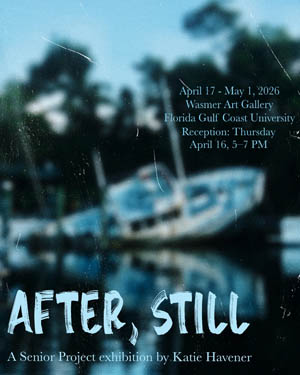
 In the aftermath of Hurricane Ian, I became drawn to places that were never fully salvaged. Throughout Fort Myers, Sanibel, and Pine Island, there are scattered structures that remain suspended in time. For example, a broken dock, an abandoned shack, and a capsized boat all continue to sit where the storm left them. At first glance, much of Southwest Florida appears restored. Businesses reopened, roads cleared, and neighborhoods were rebuilt, creating the idea that the community has recovered. However, these overlooked spaces tell a different story. They exist quietly and often go unnoticed or ignored because they are not considered important enough to fix. It raises the question of what is deemed important for a community to restore and who lives with the consequences of that decision.
My paintings focus on environments where human structures gradually merge back into the natural world. Since the hurricane, the wood has deteriorated, the metal has rusted, and local vegetation has overtaken. Even in the damage, there is still a quiet kind of beauty. Light slips through the structures while nature takes over, softening the spaces and fading everything into pale and weathered tones. Instead of feeling completely destroyed, these places feel calm and still, showing how nature slowly reshapes what was left behind. Each structure holds evidence of human presence and experience. A shack was once someone’s home. A boat served as shelter or possibly a livelihood. A dock functioned as a shared space within the community. By painting these subjects at a large scale, I challenge the idea that they are insignificant. Their size and presence ask viewers to acknowledge their importance and consider the emotional and social weight they carry.
My process begins with photographing these locations myself, capturing sites that feel hidden or forgotten to most. Working from these references, I build my paintings through layered applications of acrylic paint, gradually developing depth and atmosphere. I move between careful observation and a more painterly approach, allowing forms to soften where nature begins to merge with them. Through my work, I want viewers to reconsider what recovery truly means. Even when rebuilding appears complete in high-traffic areas, the effects of Hurricane Ian continue to shape both the landscape and the lives connected to it. I want to bring attention to both the places and people that are neglected. These paintings aim to give recognition to spaces that still hold meaning within the community. -
Savannah Julian EVER RETURNING
Toggle More Info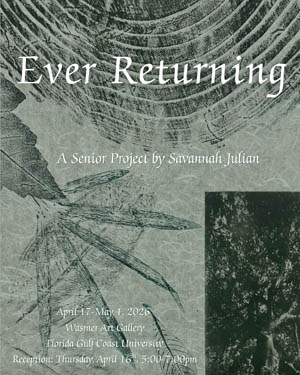
I am drawn to the quiet relationship between the human body and the earth and how both are shaped by time. I don’t see death as something dark and permanent. I see death as return, a release of energy back into soil, air, and living systems that continue long after us. In my work, change is a natural flow. Influenced by Taoist philosophy and Indigenous worldviews that recognize land as living and relational, I believe we are not separate from nature but deeply embedded within it. My practice grows from this belief and asks what it means to surrender to cycles of change rather than try to control them.
These ideas come into form through raku-fired ceramic vessels, anthrotypes weathered by time, and tall mulberry paper scrolls layered with solar plates and botanicals relief prints. The vessels are wheel-thrown and then altered, carved, struck with stones and reshaped so they begin to feel organic and spontaneous. The copper matte and crackle surfaces hold the memory of fire, emphasizing transformation. The mulberry scrolls rise vertically like slender trees, holding impressions of plants and solar-etched photographs of the Florida landscape. An anthrotype rests beside each vessel, made from plant-based pigments and the sun. Where the clay carries the intensity of flame, the anthrotypes hold the slowness of sunlight; their gradual fading reflects the tenderness and fragility of memory. Together, these elements create an installation that feels like a living archive where objects are allowed to age and shift over time.
Process is essential to how I work. Raku firing invites heat, smoke, and reduction to leave unpredictable marks on the clay, allowing the elements to collaborate in the outcome. Solar plate printmaking uses ultraviolet light to expose imagery in sharp detail. I chose mulberry paper for its strength and translucency; its fibers resemble bark and carry a quiet resilience. Anthrotypes, made from natural dyes such as turmeric, spinach, and other botanicals, require patience and acceptance. Their images emerge slowly in the sun and begin to dissapear after they are installed. By working with materials that crack, fade, and soften, I let time complete the work, trusting that transformation itself is part of the meaning.
-
El Levy COLLECTED
Toggle More Info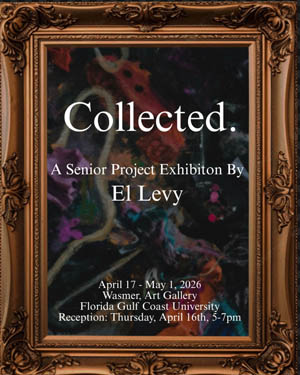
To be invited into a home is to be invited into the mind. Our living spaces reflect our inner thoughts, feelings, and the weight of our daily lives—especially when the world asks so much of us. My project depicts the ways that the mental state effects our physical surroundings. By embracing the vulnerability of the home, I invite my audience into my space and glorify it in an ornate display. My pieces delicately walk the line between what is seen and what is felt, taking the viewer on an emotionally cluttered tour. Leave your shoes at the door and make yourself at home.
My project consists of eight original mixed-media pieces juxtaposed with collected objects in a deliberate “gallery wall” installation. The original pieces were constructed on panels, beginning with a base painting and later collaged and decorated with papers, textiles, plastic, and glitter to create a disoriented and cluttered feel. The three largest pieces are interior portraits of different prominent areas of the house, each connecting to specific experiences or themes within the broader narrative. The Room Where You Sleep deals with the idea of finding comfort within the chaos. You Are the Player, Wake Up explores the topic of avoidance, demonstrating time and dedication wasted on distractions. Finally, Might Need It Someday is a portrayal of the hoarding tendencies of visual artists. In addition to these three, five smaller still-life works fill the empty space to provide a fully-fledged depiction of the home. Ornate, decorative frames and objects surround the original pieces, welcoming and familiarizing the audience to the body of work before becoming fully immersed into the content.
The theme of collection is at the heart of each element. The handcrafted displays of cluttered objects and materials in a home setting an exploration of the compulsion to collect. Throughout history, especially pertaining to the artist archetype, there has been a consistently blurred line between collecting and hoarding. My intention is not to define this for the viewer but rather immerse them into a mental and emotional experience. The carefully crafted nature of the installation furthers the theme of collection, as traditional gallery walls historically align with the narrative of the “collector”. By embracing the open-endedness of collection, my project aims to blend these interpretations into a raw, distorted, yet beautiful display.
-
Sara Miller SECRETS OF INDIGO
Toggle More Info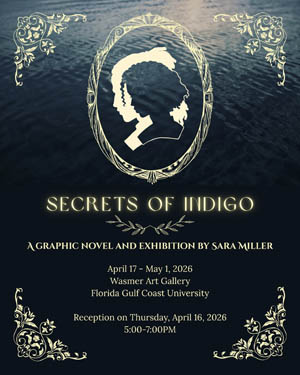
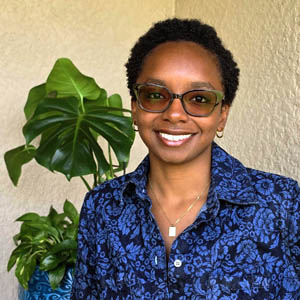
For this project, I sought to challenge myself by making something that is deeply personal to the skin I’m in. In 2025, I discovered that I am a descendant from a lineage of North Carolina black Americans known culturally as the Gullah Geechee Tribe. This is a demographic that emerged from enslaved Africans forcibly brought over via the Transatlantic Slave Trade. For years, I went through life not knowing why I had so many distant cousins along the coastal lands of southeastern states. It wasn’t something the family talked about, aside from brief and vague conversations at reunions. I used to think my familial history was simply lost to time. It wasn’t until I took an ancestry DNA test that I was able to confirm that my maternal great-great grandfather’s roots are seated in the Gullah heritage. What I learned beyond that is the beautiful and tragic world that runs through my family tree.
To cope with this gap in my personal history, I researched, made art, and created Secrets of Indigo to better understand my origins and heritage. Graphic novels and comic books have always been an interest to me since I was young and knew I always wanted to be the one creating them someday. This is a tale chronicling the journey of Olivia Jones, a high school student that is suddenly thrust into the secret, magical world of the Gullah Geechee after years of trying so hard to be normal and fit in. She is, for all intents and purposes, an idealized self-insert character from a time where I recalled being young, often struggling to fit in at predominantly white schools or trying to understand myself without having any heritage to fall back on like most of my peers. The one place I could always find comfort and a sense of self was within literature and art. It was certainly challenging, trying to piece together a history that I don’t have personal access to beyond a few academic resources. Regardless, I’m grateful for the opportunity to know my forebears' history a little better and give them some more time in the light by telling a story from their world. This book is for the black and brown girls, quiet kids, gifted kids, or anyone who ever tried to fit in and failed spectacularly.
-
Eva Petrovski SAINTS OF THE EARTHEN SPIRIT
Toggle More Info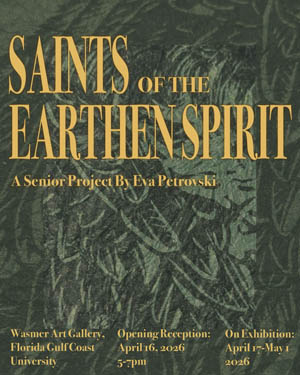
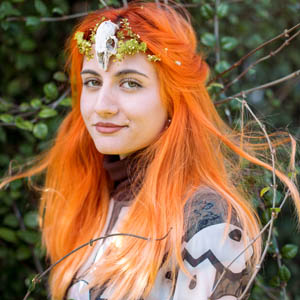
Animals, since childhood, have been my guiding inspiration that connect me to nature and spirituality. I believe nature and animals hold wisdoms that are often overlooked, offering insight into empathy, weakness, strength, and inner peace. This connection to Earth and the natural world influences my work as I explore the relationship between established iconography and individualistic spirituality.
Catholic iconography–the visual system used to depict important Catholic figures and teachings– is one of the most recognizable visual styles and has remained influential with its identity as a branch of a major world religion. In contrast, spiritual beliefs such as my own do not have as strongly identifiable visuals, leaving them to be overshadowed by religious institutions that prescribe artwork. I resonate with a particular spiritual practice called Druidry, and my work serves as a personal interpretation of some important components of this spirituality. My work aims to bridge this gap between the easily recognizable visual language of Catholicism and the lesser illustrated beliefs of nature-based spirituality. Altarpieces are recognizable iconographic objects; this made them an intuitive choice to convey the connection between the religious structure and spiritual content.
I wanted to branch off from the existing visuals of Catholic altarpieces and combine their structure with natural materials and imagery to elevate the natural world the same way Catholic ideals have been revered for centuries. I used clay, wood, and paper— naturally derived materials that connect the medium to the images. The altarpieces combine the silhouette, gold leaf, and halo motifs of Catholic imagery with the natural materials to create a new visual language. The altarpiece with a sculptural bust took inspiration from historic works with a saint sculpture attached to the base. The animal imagery created with printmaking embraces the ability to reproduce the artwork. The ability to print multiples of the images will allow me to share this iconography with more people. The wheel-thrown and hand poured ceramic candles serve as a parallel to prayer candles that embrace the artist’s hand and earthen aesthetics.
The animals I depict become more than just imagery; to me, they become representations of harmony with the natural world. The strangely omniscient face of the hare, the unyielding gentleness of the deer, and the quiet intelligence of the crow all stir powerful emotions that resonate with me. By elevating animals in my work, I hope to encourage the viewer to see them as beings that deserve to be revered and learned from, and to reflect on the power they exert over others.
-
Jack Richards NOTHING NEW UNDER THE SUN
Toggle More Info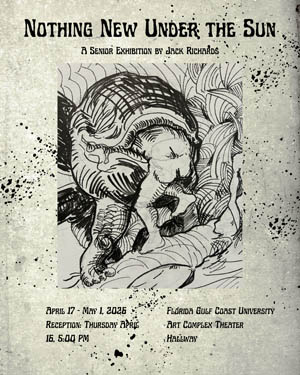
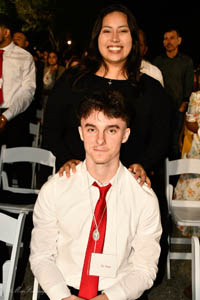
“What does evil look like?”
This is a question that has persisted for centuries among many different cultures and has defined the visual language of several distinct art movements. For this series, I intended to answer this question through an intense analysis of the manifestation and pervasiveness of the many faces of evil in all its unique forms. I owe much of the philosophical portions of my work to the fascinating symbolist language developed through the visual and literary art of the Decadents whose primary artistic playthings typically consisted of profane and occultist subject matter, which ranged anywhere from the mystical subjects found in Gnostic texts like the Book of Enoch to grotesque caricatures of historical figures or events.
Each work within this series attempts to catch all the different masquerades of evil within tiny fragmentary pictures spread out across the breadth of the canvas. An evil impious monk within his cloister whose halo is being snatched by a dancing skeleton; Lady Justice being desecrated by a judge, while soldiers sleep idly by; a horrific massacre of natives by their settler attackers unfolding before your very eyes; – each of these smaller stories work together to communicate the intended effect of evil and its pervasiveness amongst the common man. The subject matter of these vignettes was conceived only after working backwards from this intended effect through a laborious conceptual process before any preliminary sketch.
With the idea of the intended picture in mind, I launch myself directly into linework, using very few initial sketch lines. I find the clarity provided by the ink of pens and the texture provided by the canvases extremely comforting and equally important to the traditional aesthetics that I am trying to achieve in this series. The fracturing of one sprawling landscape into different canvases was itself an unintended consequence of their use, I find that it speaks of the inherent pervasive quality of evil and how the viewer can still comprehend this concept. So, while the media and materials are unorthodox in their uses, it best captures the different artistic visions of the various prints and allegorical paintings that have inspired this work and prove that there is still nothing new under the sun.
-
Aileen Salas BETWEEN GALACTIC WATERS
Toggle More Info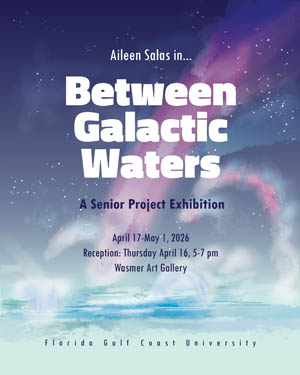
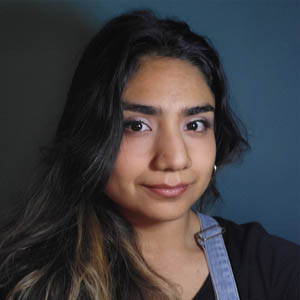
We observe nations of the world as we would with fish tanks in an aquarium. I see the dynamics between people in my home, but the most I can do is simply watch from the other side. Many immigrants and their descendants in the United States face a similar detachment. Even in the most diverse place in the world, positions of power manipulate the environment so that groups are othered—forever in a state of alienation from an identity you have no control over. My senior project attempted that feeling through a fictional fish hybrid species navigating different ecosystems, based on my experiences living as a Mexican American.
These paintings are meant to illustrate three different environments in which this species is moving through. The first painting, Open Ocean, introduces my universe by showing the ways we travel, whether for leisure or for survival. Long, lustrous fish carry souls to waters less traveled; meanwhile, colorful prey flee in droves for safety. The last two paintings, Viva Bio and The Greatest Tank in the World, show the extremes based on my interactions with two sides of America. In Viva Bio, we see a diverse ecosystem united by its bright colors and dynamic movement, based on how I see myself among other Latinos. You can see up close that the inhabitants here are still separated by invisible boundaries, despite the constant exchange between each other. The Greatest Tank in the World, on the other hand, is a world built on assimilation and maintenance operations are held at the sidelines.
Between Galactic Waters stars a single group of fish trying to make their way through each of these environments. These fish do not go through any particular change as they migrate, but it is the contrast of their surrounding environment that separates them from everyone else. My paintings are meant to translate the more abstract factors contributing to displacement. Viewers are encouraged to try to identify what distinguishes a nation from another and who can claim it.
-
Gabrielle Sanchez SGT. GIRL LOSER'S LOSER GIRL NATION!
Toggle More Info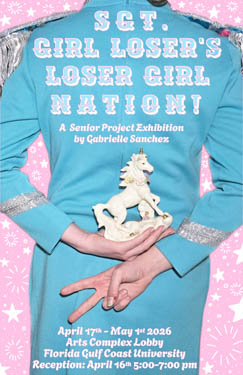
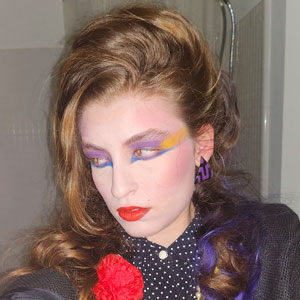
Are people born girl losers? Or is girl loserdom thrusted upon them?
The idea for Sgt. Girl Loser’s Loser Girl Nation! came to me from a previous self-portrait entitled Sgt. Girl Loser (2024). I first saw the term “girl loser” online when young women, girls, and femmes would talk about how they felt like failures or outcasts in some way. At the time, it really resonated with me because, I too, felt like a “girl loser” due to my niche interests and general mental health struggles. To cope, I fashioned myself the leader of a great nation of “girl losers” and painted myself as such. Eventually it grew into something more after I took a course about the Beatles, and I reignited my love for Sgt. Pepper’s Lonely Hearts Club Band. I started to envision the Sgt. Girl Loser persona as having her own version of the famous album cover with all of my personal heroes and interests. Now I call myself a “girl loser” as an act of self-love and celebration, and even if you’re not a girl or a loser, I encourage you to do the same. At first glance, it seems like a rather colorful and inviting scene. The figures stand at various points of the scene, but they also stand before a façade that barely conceals a fiery scene of death and destruction. Mismatched drapes with strange images are on either side of the façade, and the viewer quickly realizes not all is well in Girl Loser Nation. Consumerism, war, and the growing surveillance state are the very things I seek mental refuge from, but they still manage to creep into my celebration. In that way, we’re all girl losers just trying to use what we love to propel ourselves forward every day.
My work has been life-size for the past three years, and there’s always been a level of improvisation to my work. This is true for both the concept and the materials used to make it. When gathering the materials for this project, I left much of it to chance; the chair the rabbit sits on, the drum, the textiles, and even the cardboard mounting the figures were all found by chance at thrift stores and antique markets. The use of secondhand materials was also important conceptually because it reflects the girl loser values of being environmentally conscious, yet unique in personal taste; an unselfish sense of individuality is key to girl loserdom. The rabbit in the corner (aptly named Gabby Jr.) is covered in pins from my personal collection and buttons from my grandmother’s collection, as she greatly shaped my sense of style. Pins and buttons are a reoccurring motif in my project because I wear pins every day, be it political pins or novelty pins. The figures scattered across the composition are made from canvas and are mounted onto carboard to mimic mass-produced cardboard cutouts of celebrities. The figures are a mix of pop stars, political figures, fictional characters, and even non-human manifestations of my interests: Madonna, Lt. Cm. Data, Debbie Harry, Angela Davis, Captain Kirk and Mr. Spock, and myself dressed as Paul McCartney in front. This figure is the evolution of Sgt. Girl Loser as she proudly (and uncannily) stands in the front next to her drum. But, most importantly, the viewer will find a mat on the floor next to Sgt. Girl Loser that invites them to stand beside her.
May you have a pleasant visit to Sgt. Girl Loser’s Loser Girl Nation!
-
Soph Shikes SCARLET SCALES
Toggle More Info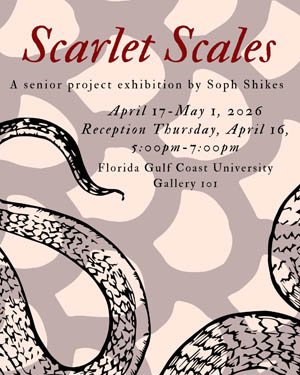
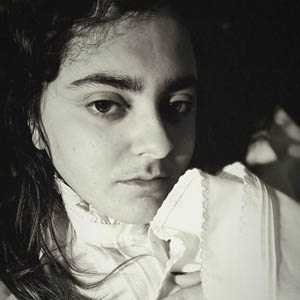
I have always dreamt of flying. There’s freedom in flight as a concept, the power to make yourself go where you please, that isn’t quite achieved through mechanical workarounds. That’s the wonder of dragons, they get to do whatever they want, be whatever they want, and do it unapologetically. In a sense, I wanted to be a dragon more than I wanted to tame one, even though I was sure I would be smart enough to splice up a domestic dragon in the lab. As an adult I know the impossibility of this desire, but I understand it even deeper than I did as a kid. The burning passion to want to express oneself fully, to have that power and control, to go where you want without another person questioning you is a lot to ask for in the society we live in. Individual playtime, child-like wonder, and unconformity don’t have the space to exist in a world where money is everything, you can only survive so long as you prove your worth day after day through completing tasks, unless you get lucky or born into that freedom. There is a culling of the natural, animal instincts in humans to commodify ourselves. To maintain that illusion of control, of us being above animals when we are also animals, society functions on this chastity-like lack of full autonomy. If they were real, humans would absolutely despise having a being more powerful than them, something that could cause massive destruction if it got in the wrong mood. We would most likely stop at nothing to subjugate dragons, drive them to near-extinction, selectively breed them to become more palatable, less threatening, have more health problems and become reliant upon us so they can never survive on their own again.
The absurdity of my project is purposeful. Dragons are supposed to be powerful beings above domestication. This explores the human desire to tame what it finds a threat, subdue it, subjugate it for personal gain, and declare it inferior at all costs. If dragons were real, humans would try to find a way to exploit or weaken them to chase the human dream of control and stability. These dragons, in a sense, represent how I feel as a member of society as well. There’s the need to blend into a human construct, to use one’s uniqueness for a greater purpose, and the overall taming of one’s unpredictable, unbridled nature to make it more palatable.
To make these dragons posable, I started with an aluminum wire base that was threaded together for additional support. On top of this I added a thin layer of quilt batting to be able to map out approximately how large I wanted some pieces of the body to properly proportion them out. Then, on spare pieces of paper I would sketch out the body shapes, laying the aluminum wire base over it to see approximately where it would go. The process itself was unconventional, since I have always struggled with sticking to making a fully fleshed out plan before beginning to work. The pattern would often evolve slowly as the creature started to take form, new pattern pieces being drawn and re-cut when I felt that the anatomy was off-balance. Once the foundational forms were down, like the body, leg shape, and head shape, the rest of the body was easier to map due to it being less proportionally demanding. The harnesses were added to constrain the dragons, muzzle them, mask what their true expressions could be like. Their emotions do not matter, but simply what they can do for their human owners.
-
Abbigail Steward NATURALLY WELL
Toggle More Info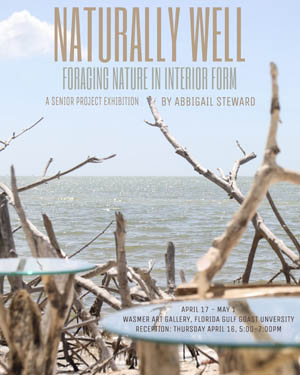

From the earliest narratives of creation, nature is described as both functional and "pleasant to the sight” (Genesis 2:9), suggesting that beauty and wellbeing are intertwined. Biophilia is the human inclination to connect with nature, a tendency that remains essential to physical health, mental wellbeing, and overall quality of life, even in our increasingly urban and artificial environments. Rooted in evolutionary biology, humans spent over 99% of our species history immersed in natural landscapes, developing physical and psychological responses that favor organic, not manufactured, surroundings. Biophilic design concepts are meant to reintroduce these qualities into interior spaces by incorporating natural materials, irregular forms, light, texture, and vegetation to create a direct sensory connection with the environment. Through utilizing the body and the senses, these spaces can reduce stress, improve focus, and promote restoration. In this project, I explore how interiors can move beyond traditional function, to become immersive environments that nurture both mind and body.
This body of work consists of furniture and photographic pieces created from mangrove driftwood collected from local beaches. Guided by biophilic principles, the pieces preserve the raw, untamed character of the material. The furniture remains asymmetrical, irregular, and at times verging on unusable. In doing so, the work challenges conventional expectations of comfort and perfection in interior design. Rather than forcing the wood into standardized forms, I allow its weathered curves, fractures, and unpredictable silhouettes to dictate structure. The final design of each piece balances the practical use between utility and sculpture, while being functional, yet wild. Paired with photography, the exhibition invites viewers to engage visually and physically with the material, encouraging us to reflect on how controlled our built environments have become and how beautiful imperfection can be.
Sustainability and environmental awareness are key elements to the project. The driftwood is reclaimed rather than harvested, honoring the ecological cycles of tide, erosion, and how nature has shaped it. The creation process merges natural and manmade elements. Each piece undergoes a careful bleaching and preparation process before being assembled with wood and lag screws. This tedious process required patience and structural precision, which demonstrates my hands-on approach to being able to balance structural design with the natural integrity of the wood. By preserving the natural state of the wood, the work proposes a vision of being “Naturally Well.” This demonstrates that interior spaces do not tame nature completely, but instead coexist with its unpredictability, reminding us of our enduring connection to the wild.
-
Emma Stockton IN LOVING MEMORY
Toggle More Info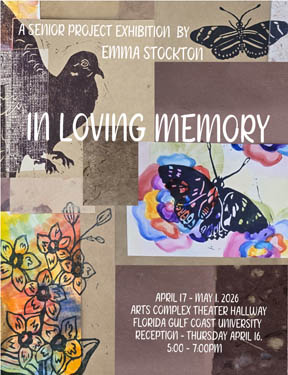
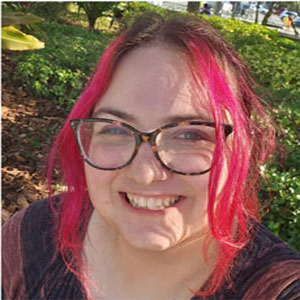
I once heard someone describe grief as a last act of love, and that where there is great grief, there was great love. In this way, I believe that while grief can be painful, it is also a testament to how much love you had for that person or thing. Therefore, the act of grieving is just a way to continue loving them long after they are gone.
My project, In Loving Memory, serves as a representation of grief explored through mediums such as paper, ink, watercolor, and string. These collages not only stand as a way of exploring one's process of grief, but are also a shared celebration of the memories I have with the people I loved. By turning these memories into a physical collection, I am permanently capturing that love through my own personal grief.
Each canvas represents a person that I have lost throughout my life: my grandmother, mother, and grandfather, and consists of prints symbolic of grief and loss as well as depictions that I associate with them. The single string makes up a visual representation of items associated with the thoughts and memories I have with each person. It serves as a way to thread each memory I hold and forms how I choose to remember them. Along with these visuals are personal handwritten explanations, thoughts, and regrets for each imagery.
By using techniques and styles reminiscent of scrapbooking within my collage, I wished to further represent the act of creating memories and preserving them long after they've happened. This style also serves a homage to my mother, who created scrapbooks as a hobby, documenting the childhood of my sister and I so that one day we would be able to look back and reminisce. It is through that act of care that I create this work, which acts not only as my own personal way of grieving, but as just one perspective out of millions of others dealing with grief.
The inspiration for this work came from the most recent passing of my grandfather and stems from the need to portray my grief as something that can still coexist with hope, and tenderness. By framing grief as an act of love, my work encourages viewers to appreciate the importance of preserving relationships through remembrance. And reminds us that while loss does change us, the act of remembering keeps them, and their connection with us, alive.
-
Sami Vila DESPITE EVERYTHING, I'M STILL ME
Toggle More Info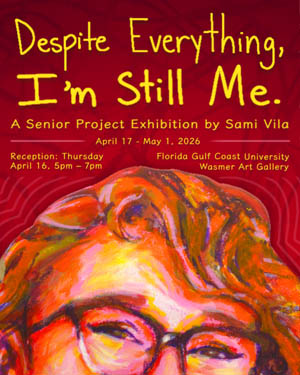
Deeply rooted insecurities lie within everybody and I am no exception. The mere idea of confronting one's own vulnerabilities and fears can be a foreboding concept, yet oftentimes facing intimidating challenges head-on is the most successful first step taken to overcome them. Through my art works, I create a physical portrayal of how I present myself for others, how I perceive my inner-self, and how a life-long worth of art creation unveils that. With my exhibit, the process of creation and development is as important as the finished result if not more so.
Within my works, I’ve explored the internal struggle and external result of long-lasting insecurity. I’ve found myself suppressing these feelings by wearing brightly-colored clothes and portraying myself as an overly light-hearted individual to better fit within social situations and to receive more positive perception from the majority. This is a result of “masking” which I’ve represented in my artwork through the warm, colorful exterior side of my wooden cut-out. It faces the front to represent the mask that I’ve wished to be recognized for; whereas, the opposite side of my cut-out that faces within and uses cool, dark colors reveals the hidden, lingering insecurities that have haunted me ever since my early childhood. My art presents a part of me that has nearly regressed back into my inner child. I have been taught to hide what is deemed “ugly” with what others find “beautiful”; therefore, I’ve translated these abstract feelings into my artwork through my “inner-self” attempting to hide. With the creation of dozens of whimsical, relaxed self-portraiture, I steadily allowed myself to grow accustomed to my own features despite how unflattering many of my photo references were. I had executed a self-induced “systematic desensitization” exposure therapy by confronting the fear of self-observation with each new portrait in a relaxing, low-stakes environment. Though I haven't found a cure for my self-doubt and insecurities quite yet, my journey to self-acceptance will continue past my art. This project was a road that I never thought I would have the courage to travel, and I will walk it for as long as I need to.
I primed and painted a full-sized, 1:1 scale portrait that I had cut from ¾ inch wood to be as close to my height as possible standing at 62 inches. I had also drawn over 52 self-portraits with tempera sticks, 36 of them to be temporarily adhered to a red blanket and many others scaled up the wall as they left the fabric. Using tempera sticks and acrylic paint as my main mediums allowed me to create very saturated and eye-catching visuals that immediately establish the intense emotions presented within my work.
-
Madison Wilcox GRATITUDE AND GROWTH
Toggle More Info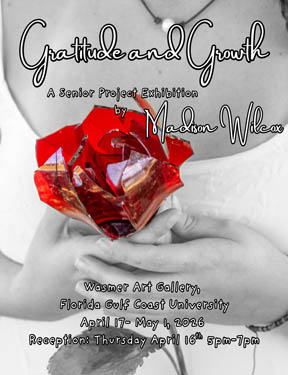
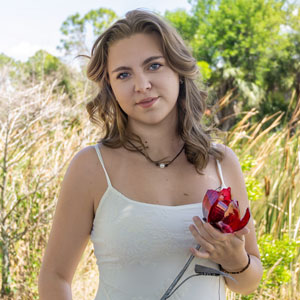
For as long as I can remember, my family has been my strength. To my surprise, the old family photos brought back memories and small moments we often forget or take for granted. The simple, small gestures that made such an impact spoke to my inner being. A huge turnaround in finding myself, acts of kindness, becoming more mindful, intentional, and purposeful in everything, including the planning and intentionality behind surprising someone. Bringing a simple gift, a small gesture to lift their spirits, is exactly what my family thrives on. The part of me that I wouldn’t trade for anything, seeing my sister's face when I show up to see her, or getting my brother that game he wanted, not only brightens my day but theirs too.
In my senior project, I wanted to focus on these small acts of kindness, these gestures of gratitude, and what a simple flower can mean. A relationship can be built from any small number of gestures. Simple thank yous’, holding the door, small gifts. It's proven that a small gesture, a little kindness, can make someone's day even better, and everyone feels good: giver, receiver, and maybe even inspires others who are watching. Flowers themselves, outside of a kind act, have their own meaning. The easiest example, a red rose, is used to say love. Roses and other popular flowers, often have multiple meanings depending on their color—for example, pink signifies happiness. Some of the most prominent meanings across my project are adoration (sunflower), affection (morning glories), faith, trust, wisdom, and valor (iris), gratitude for being understood (hydrangeas), memories of true love (forget-me-nots), and regard or unequalled love (daffodils). These meanings were once used as a way to communicate with those special to you. I use these messages now for the people who have made a huge impact on my life. A call to say thank you, and tell those few your presence hasn’t and will never be lost on me.
My process includes reflection on old family photos, the past, and how I want my life to look after this exhibition. Each piece in my exhibition ties together where I come from and how I want to be remembered. The wood itself is reflecting the progression of the story, a simple gesture of kindness sheading off into the next. The wood, thought to be Magnolia and Poplar, is also a reflection of myself in the work, a journey from New York to Florida. The metal is a strong connection into the glass, keeping the fragments together in one bud, but also telling the viewer what each flower is trying to say. The metal was smithed to get the stems, later leaves and flower base plates were welded before finally adding the glass flower on top. The glass, although pretty, is also sharp, put together to represent fragmented memories that have been glued together during my process. I hope my message is received by my loved ones and leaves a mark of inspiration for a little more kindness.


