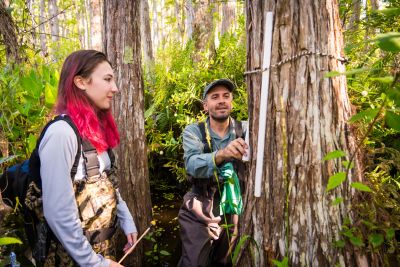
Research experiences built directly into Biology courses help FGCU students engage in authentic scientific work while building skills for senior research, graduate school, professional programs, and careers in science, health, conservation, biotechnology, and related fields.Research Experiences Built Into Biology Course
Biology students at FGCU have opportunities to participate in Course-based Undergraduate Research Experiences, or CUREs, through work already embedded in selected Biology courses. These experiences allow students to ask scientific questions, collect or analyze data, interpret results, and communicate findings. CUREs help students move beyond learning about science to actively doing science. The Department of Biological Sciences is intentionally expanding CURE opportunities across the curriculum, so students encounter research experiences from introductory through upper-division coursework. Why CUREs Matter for Biology StudentsThrough CUREs, students may:
Biology Courses with CURE OpportunitiesSelected Biology courses include research-based experiences that allow students to practice scientific inquiry within the structure of a course. BSC 1010C General Biology I Faculty: Dr. Matt Ware & Prof. Margaret Hood Students collect environmental water samples to investigate species presence and distribution using both observational and molecular techniques. This project introduces foundational research skills, including sampling, data collection, and basic analysis within an introductory biology context. ISC 3120 Scientific Process Faculty: Dr. Scott Michael Students develop a research-oriented grant proposal that includes literature review, hypothesis development, project design, significance, methodology, and expected outcomes. The experience emphasizes scientific writing, research planning, and critical thinking. PCB 3023C Cell Biology Faculty: Dr. Lyndsay Rhodes Students investigate the effects of novel anticancer compounds on human breast cancer cell lines. Using laboratory assays, students assess cell viability, proliferation, and motility while engaging in biomedical research questions related to cancer biology and therapeutic development. PCB 3023C Cell Biology Faculty: Dr. Scott Michael Students conduct bioinformatics-based investigations focused on cellular coding regions. The project involves computational analysis of genetic and molecular data, sequence interpretation, and identification of biological patterns. PCB 3464C Biological Statistics Faculty: Dr. Andrew Durso Students conduct an original analysis of a biological dataset using R and present the results to the class. Students may gather data, obtain data from a research advisor, or re-analyze an open dataset from a published article. They tidy data, calculate summary statistics, create presentation-quality graphs, conduct statistical tests, check assumptions, and explain their conclusions. In many cases, these projects support undergraduate senior theses, honors theses, or EagleX presentations. BSC 4052 Conservation Biology Faculty: Dr. Matt Ware Students design and implement independent research projects focused on conservation-related questions in campus or community settings. Projects incorporate field data collection, conservation principles, and real-world environmental applications. |
|
|
PCB 4674C Reptile & Amphibian Evolution Faculty: Dr. Andrew Durso Students conduct diurnal field surveys of non-native lizard species on campus to map distribution and identify environmental conditions influencing detection. Data contribute to a multi-year dataset and may be shared through public platforms such as iNaturalist, HerpMapper, and EDDMaps. ZOO 4823C General Entomology Faculty: Dr. Joyce Fassbender Students investigate insect diversity in Southwest Florida by collecting, curating, and identifying specimens throughout the semester. Student collections and datasets contribute to the FGCU insect collection and campus biodiversity records. ZOO 4422C Field Herpetology of Southwest Florida Faculty: Dr. Andrew Durso Students conduct diurnal field surveys of non-native lizard species on campus to map distribution and identify environmental conditions influencing detection. Data contribute to a multi-year dataset and may be shared through public platforms such as iNaturalist, HerpMapper, and EDDMaps. MCB 3652C Environmental Microbiology Faculty: Dr. Jan DeJarnette Students participate in a bioprospecting project focused on isolating antibiotic-producing microorganisms from environmental samples such as soil and sediments. The project introduces microbiological research methods and real-world applications in antibiotic discovery. BSC 4910C Senior Project I: Research Faculty: All Faculty that Teach the Course Students conduct a systematic literature review addressing a research question of their choice. The project emphasizes independent inquiry, primary literature synthesis, evidence-based conclusions, scientific writing, and poster-based communication. Expanding Research Across the CurriculumBy embedding research experiences across introductory, mid-level, and upper-division
courses, the Department of Biological Sciences helps students develop progressively
stronger research skills and clearer connections between classroom learning and biological
discovery. For more information about CURE opportunities in Biology, contact the Department of Biological Sciences. |

Access resources to enhance your FGCU experience. Stay informed about campus events through our social media channels and other news sources.
Resources ForShortcuts