

WCE Closes Out the Academic Year with Two 1st Place Wins
May 05, 2026 / Lexi Velte / Tags: environmental engineering, cybersecurity, FWEA, computer science, Software Engineering
While most students were studying for finals and getting their graduation pictures taken, two groups of WCE students were bringing home first place prizes.
FWEA Florida State Champions
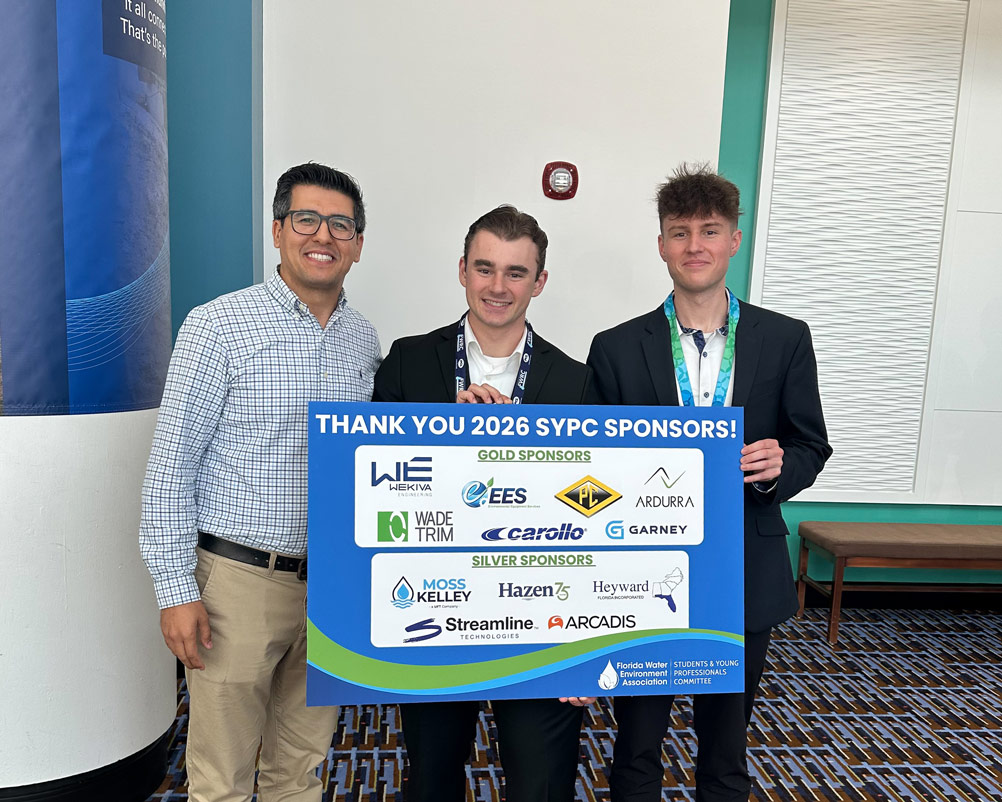
Environmental engineering students Carter Baker and Zach Hudson represented FGCU in the Environmental Engineering section of the Florida Water Environment Association (FWEA) Student Design Competition (SDC) in Daytona Beach, FL.
John Herman, an FGCU alumnus, mentored the group as they worked to design a system to clean polluted soil and groundwater.
“This environmental remediation design project started as a real engineering problem that our firm [AMRC] will be tasked with addressing,” said Herman. “The design of an air sparge and soil vapor extraction system is challenging even on a simple site.”
Herman added that additional project challenges included complex layers of soil and rock, groundwater plumes containing contaminants in difficult-to-reach areas, and a lack of test data to guide decision-making.
“Carter and Zach approached this like professional engineers, developing innovative solutions that any consulting firm would be proud of,” Herman said. “Their first-place finish at FWEA was a credit to their own talent, and as an FGCU alumnus, I’m proud of what that says about the program. It was a privilege to mentor them, and we can’t wait to support them at WEFTEC in September.”
Carter and Zach approached this like professional engineers, developing innovative solutions that any consulting firm would be proud of."
Next, Baker and Hudson will compete at the national competition at the Water Environment Federation’s Technical Exhibition and Conference (WEFTEC), held in New Orleans, LA this September.
Jong-Yeop Kim, the program coordinator and an associate professor for environmental engineering, has been mentoring teams for the FWEA SDC since he first started at FGCU in 2009. Only two other FGCU environmental engineering teams have won the competition at the state level, making this a significant achievement for Baker and Hudson.
"Carter and Zach were willing to meet very high expectations and put in the extra effort needed to compete at this level," Kim said. "Their success reflects their strong work ethic, faculty guidance, and excellent industry mentorship from John Herman. I believe they have strong potential at WEFTEC, and I would not be surprised if they become the first ever FGCU environmental engineering team to win the national competition!"
Hacking, Honeypots, and the Inaugural Champions
This year, the eMerge Americas Global Tech Conference had a new element — the eMerge AI Hackathon: Project SCALPEL, hosted by the USF Institute of Applied Engineering, Inc., and U.S. Army DEVCOM Army Research Laboratory. FGCU students Sean Peppers, Adil Zaben, Jeremy Goldberg, and Katharine Ringo traveled to Miami to compete against 7 teams from other Florida state universities: FIU, USF, FAU, and UF.
The team had to build an edge-intelligent honeypot on a Raspberry Pi for cybersecurity usage on army applications.
Chengyi Qu, an assistant professor in computing and data science, explained the purpose of the project: “There is critical information in a server that a hacker wants to grab. The honeypot is a trap built to look like the real system. The hacker assumes he is successful, but really, he is getting fooled.”
Peppers and Ringo have been working with Qu for over a year in the EagleCyberNest Cybersecurity Experiential Learning Lab, a newly renovated cybersecurity research and learning space designed to provide students with hands-on experience in cutting-edge cybersecurity technologies. They have both published papers in cybersecurity and edge computing.
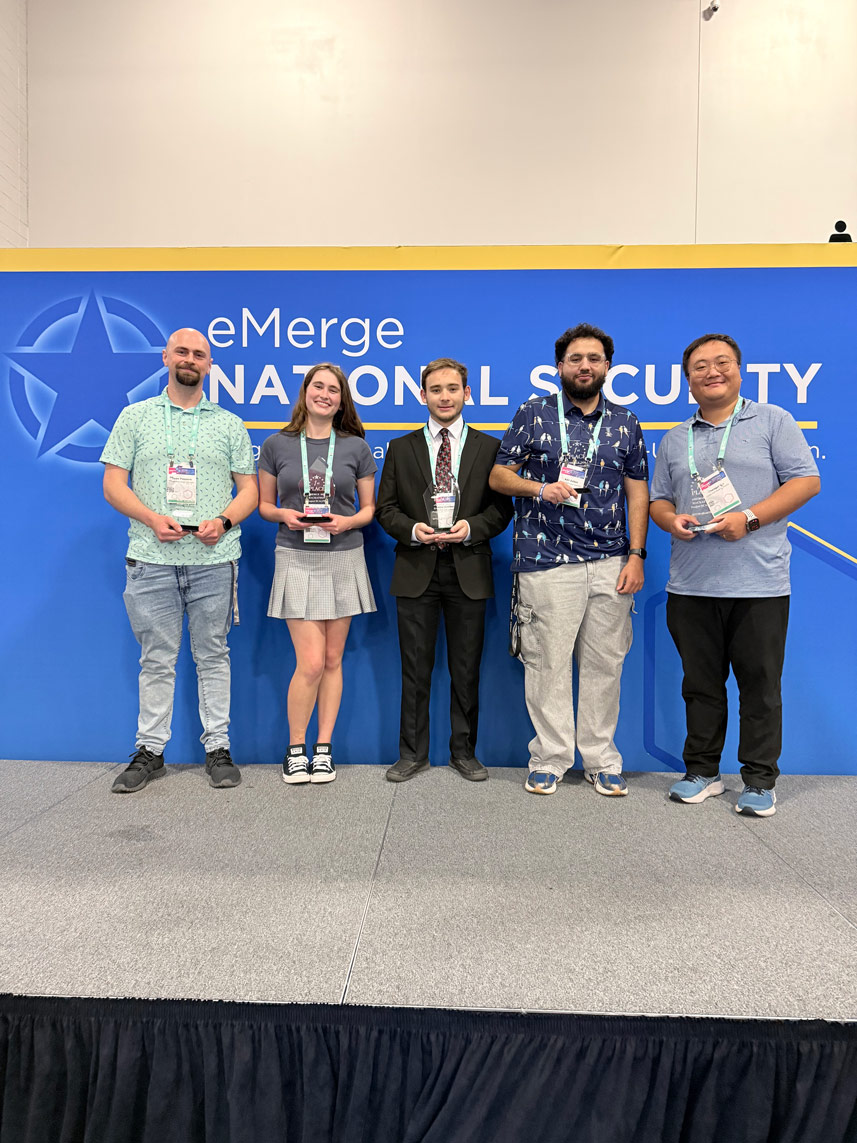
Ahead of the hackathon, the team held cyber meetups to prepare and do research.
Zaben reflected on how their coursework helped them with their eMerge success: "Everything I learned in and out of class came together in that room. Professors here actually care about setting you up for moments like this. Competing against schools that have been around a lot longer and still coming out on top, that tells you something about the quality of education here."
“This project allowed me to take the software development and cybersecurity theories I’ve learned in class and apply them to a complex, real-world application,” Goldberg agreed. “Creating a system that can deceive attackers in real-time perfectly aligns with my career goal of developing advanced security solutions and/or working in the defense sector, and it solidified my passion for collaborative, high-stakes problem-solving."
With these students as our future cybersecurity defenders, we're in good hands.
Share Post


