
From Research to Relationships: Building Networks That Matter
February 11, 2026 / Lexi Velte / Tags: FGCU Day, gulf scholars program, Undergraduate Research, Bioengineering, International Students
While many students from the U.A. Whitaker College of Engineering present their research at conferences, it’s rare that they get the chance to present to politicians. Bioengineering student Juan Cortes recently had that opportunity when he showcased his biomechanics research at FGCU Day in Tallahassee, an annual event where FGCU students head to the capital to share FGCU’s legislative priorities with state representatives and senators.
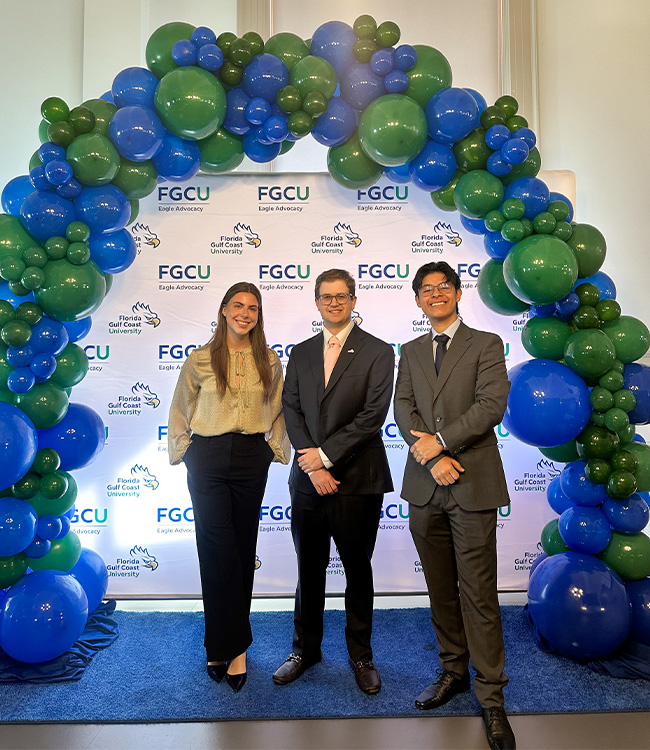
Cortes took part this year to showcase the importance of undergraduate research while representing the Gulf Scholars program.
“It [was] really good exposure not only for my research, but also with exposure for me to engage in all these different activities with all these different people. It’s a whole different target audience. It was a meaningful experience representing research beyond campus and academia,” says Cortes.
It was a meaningful experience representing research beyond campus and academia."
The Gulf Scholars Program
Juan Cortes first heard about the Gulf Scholars Program while in the Dominican Republic with the Dominican Republic Outreach Program (DROP), which provides support to vulnerable children through education, donations, and community service. His advisor Marco Acosta brought up the program and encouraged Cortes to look into it, saying that it’s a good way to get experience, money, and exposure to different resources.
At the time, Cortes was in a “say yes to everything” mentality — he’d joined the DROP trip last minute when his friend, the DROP president, needed more participants after the organization underwent a full restructure — and it turned into a life-changing experience for him.
“It is a really amazing experience because it really gives you perspective on where you are in life. It helps you shape your mentality around, ‘You have a lot of things to appreciate.’ I’m a big advocate of people going,” he says.
Cortes contacted Dr. Heather Acosta, co-director of the Gulf Scholars program, as soon as he got back to the United States. Shortly after, he was a part of the first Gulf Scholars Cohort.
The Gulf Scholars Program, initially funded through the National Academies of Science, Engineering and Medicine, aims to solve problems facing the Gulf and Southwest Florida through creating interdisciplinary collaborations between students, faculty and community partners. Students from all majors are encouraged to join to engage in curricular and co-curricular experiences. Gulf Scholars are required to complete a project with a community partner by the time they graduate.
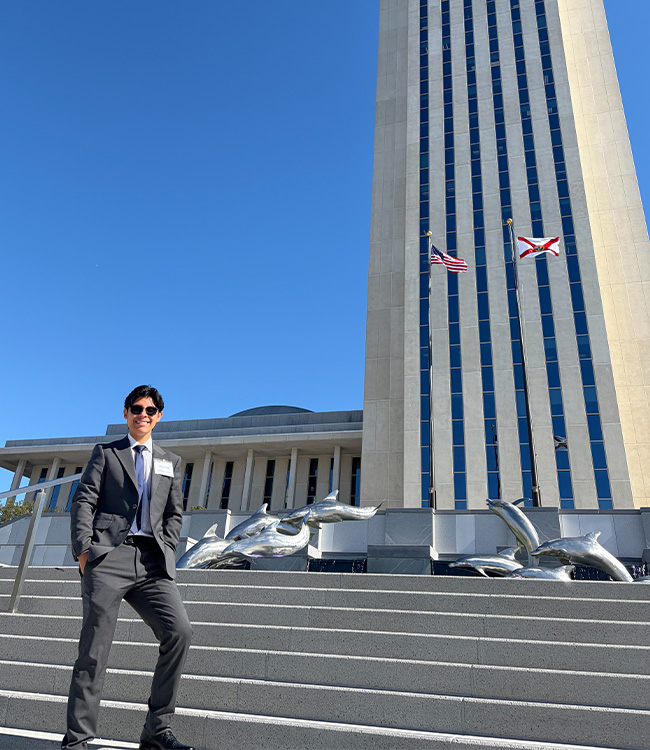
So far, Cortes’s involvement has included working on research and presenting his work to a variety of audiences, including at FGCU Day and the South Florida Life and Science Undergraduate Symposium. His project is in biomechanics, developing and evaluating a wearable arm exoskeleton that is fully controlled by the person wearing it.
“The project focuses on making the device strong, stable and safe to use, as well as aiming to support your movement and help reduce strain while you move naturally,” he says. “The exoskeleton has potential uses in medicine, agriculture, and the military by helping people work longer with less injury.”
Creating a Community of Support
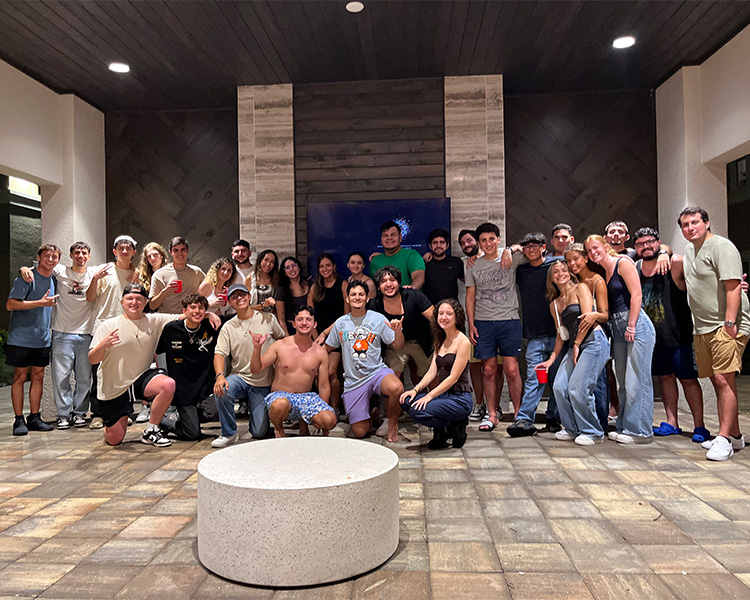
Cortes’s “say yes to everything” mentality seems to be his normal setting. He’s done math tutoring, worked in the SOVI kitchens, and is now a Learning Hub mentor for engineering students. A few semesters ago, he even started Students of All Roots (SOAR), a new registered student organization for helping international students find community.
It started with a conversation between Cortes and his friend Kevin Herrera. “We were thinking – we could have done a lot better for ourselves in the first semesters if we had known [about resources]. We had a lot of bad experiences,” says Cortes.
One of the things he had to navigate early on was getting a driver’s license. How do you get a car to use for the driver’s test when you need a driver’s license to get a car?
“I had to beg this girl I barely knew to let me use her car. But now we don’t need to. There’s a network of support. There’s a network of people [who] have gone through it,” he says.
That’s the beauty of SOAR — international students have a built-in network of resources and community through their peers.
“There are all of these systems in place that’ll help you succeed. You [just] have to know of the systems,” says Cortes.
There are all of these systems in place that'll help you succeed. You just have to know of the systems."
Even before joining SOAR, he would show up at onboarding meetings for incoming international students to help them get connected to these systems of support. Now, SOAR has a reserved spot in the meeting.
Apart from logistical resources, SOAR also prides itself on being a source of community for international students.
“When you come to the U.S. by yourself, you know nobody. [With SOAR], you have a network of friends that you can go to not only to help you but also to hang out, to feel you’re at home. It’s been like that with all of the members [who] have been there,” Cortes says.
Advice for Students
Cortes’s advice for students: “If you’re an international student, join SOAR. If you’re an engineering student, get involved as much as you can. The more involved you are, the less alone you feel, and the bigger your network grows. I know for engineering students, it feels like it’s kind of hard because we have to do a lot of time management. It is hard; I’m not going to lie. But it’s also very important that you do it.”


