Bachelor of Exercise Science Degree
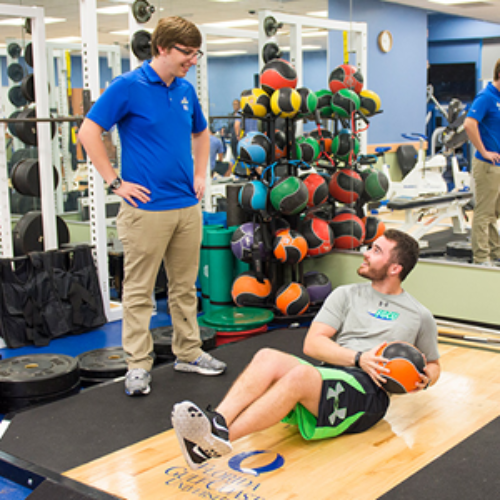
Students in FGCU's Exercise Science program focus on analyzing movement and maximizing performance levels of high-level athletes, fitness-oriented persons, and special populations such as children and older adults.
Exercise Science graduates are eligible to sit for national certification exams through the National Strength and Conditioning Association (NSCA) and the American College of Sports Medicine (ACSM). Graduates of the Exercise Science program will be qualified for graduate programs in the applied sciences and in the health professions such as athletic training, physical therapy, occupational therapy, medicine, sports nutrition, and sports psychology.
The Exercise Science program is 120 credit hours in length. Upper division requirements can be completed in five semesters.
-
Accreditation
Toggle More InfoInstitutional Accreditation
View information on FGCU institutional accreditation
The BS in Exercise Science program at Florida Gulf Coast University (FGCU) is accredited by the Commission on Accreditation of Allied Health Education Programs (CAAHEP), 9355 113th Street N, #7709, Seminole, FL 33775; telephone: 727-210-2350; email: mail@caahep.org; website: http://www.caahep.org. If need to contact the program/institution directly, please call 239-590-7530 or email at rsillevis@fgcu.edu.

Email CAAHEP · Visit CAAHEP WebsiteCAAHEP accreditation offers significant advantages for students, graduates, and employers alike. For students, it ensures a high-quality educational experience that equips them with the knowledge, skills, and professional competencies essential for success in their chosen health profession. Graduates of CAAHEP-accredited programs are highly sought after by employers, opening doors to enhanced job opportunities and career growth. Additionally, many professional certification bodies require graduation from a CAAHEP-accredited program for eligibility to sit for certification exams—an essential step toward licensure and professional practice.
Employers can trust that graduates from CAAHEP-accredited programs are well-prepared to meet the ever-evolving demands of the healthcare field. These graduates bring a strong foundation of knowledge and practical experience, enabling them to deliver high-quality care and contribute meaningfully to their communities.
Dr. Barry S. Eckert, President of CAAHEP, emphasizes the importance of accreditation: “Choosing a CAAHEP-accredited program is crucial for students seeking a career in allied health. It ensures that they receive an education that is both comprehensive and relevant to current industry needs, ultimately benefiting their future employers and people receiving care.”
A Commitment to Excellence in Allied Health Education
At Florida Gulf Coast University, we are dedicated to fostering excellence in allied health education and are preparing the next generation of skilled healthcare professionals. For more information about our accredited Exercise Science program, please visit https://www.fgcu.edu/mariebcollege/rehabilitationsciences/exercisescience/exercisescience-bs .
Program RecognitionThe National Strength and Conditioning Association (NSCA) officially recognizes Florida Gulf Coast University's Exercise Science Program in Strength and Conditioning.
The NSCA Education Recognition Program (ERP) recognizes and distinguishes schools with standardized, approved strength and conditioning or personal training curricula in undergraduate and graduate settings designed to prepare students for the NSCA-Certified Personal Trainer® (NSCA-CPT®) and NSCA Certified Strength and Conditioning Specialist® (CSCS®) certifications.
The American College of Sports Medicine, Exercise is Medicine On Campus has recognized Florida Gulf Coast University as an Exercise is Medicine Gold Level Campus. -
Admissions and Curriculum Information
Toggle More InfoVisit the FGCU Academic Catalog to review specific Admissions information and Program Requirements.
For undergraduate degree programs, also see the Degree Map that can be used as a semester-by-semester guide to timely graduation.
-
Course Description
Toggle More InfoOfficial Course Descriptions
Search for official course descriptions by using the Course Description Search utility.
Go to the Course Descriptions Search Web page, then follow these steps:
- Select an Academic Year from the TERM dropdown (required)
- Select a course prefix from one of the SUBJECT dropdowns (required)
- Enter search words in the TEXT field (optional, but will narrow the search results)
- Press Search
-
Course Schedule
Toggle More InfoGetting started with the Course Schedule Search
Search for program courses by using the Course Schedule Search utility.
Go to the Course Schedule Search Web page, then follow these steps:
- Select an Academic Year from the TERM dropdown (required)
- Select one or more of the search options to narrow your results (for example, CAMPUS, COLLEGE, DEPARTMENT, LEVEL, PREFIX*, COURSE ATTRIBUTE**). For virtual or web courses, select VIRTUAL in the CAMPUS field.
- Press Search.
*A course prefix is a three-letter designator for a major division of an academic discipline (for example, ACG for Accounting , BSC for Biological Science, ENC for English Composition). See the Degree Requirements page for a list of courses (with prefix and number) that can be used to fulfill degree requirements.
**A course attribute identifies specific characteristics of courses that can be used in a Degree Evaluation to satisfy a degree requirement. (Course attribute examples are Humanities courses - GEHM and Social Science courses - GESO.)
-
Learning Outcomes
Toggle More InfoAcademic Learning Compact
In alignment with its mission and guiding principles, the University is dedicated to academic excellence and the ongoing pursuit of quality improvement, grounded in a robust teaching and learning process. This process reflects a shared responsibility between students and instructors, fostering a progression from simple to complex, concrete to abstract, and dependent to independent learning.
The Academic Learning Compact (ALC) initiative reinforces this process by clearly defining core student learning outcomes in three key areas: content knowledge and discipline-specific skills, communication skills, and critical thinking abilities. It ensures that curricula are aligned with these expectations and that assessment results are used to inform and enhance continuous improvement.
Exercise Science Students are able to:
- Demonstrate the knowledge, skills, and abilities of exercise risk stratification, fundamental kinesiology principles, and exercise physiology principles underlying performance of physical activities and exercise.
- Demonstrate the knowledge, skills, and abilities associated with physiological and metabolic responses to exercise, and injury prevention in healthy individuals and in individuals with chronic disease.
- Demonstrate the knowledge, skills, and abilities of selecting and administering appropriate assessment and training modalities according to the functional capacity of the individual.
- Demonstrate an understanding of the key concepts of the nutritional and pharmacological aspects of wellness and human performance.
- Display an understanding of the key concepts of Medical Ethics, Standard of Care, Legal Issues, and Professionalism.
These learning outcomes are assessed through essays, exams, practical application, projects, and other assignments within the following courses:
Student Learning Outcome 1: Demonstrate the knowledge, skills, and abilities of exercise risk stratification, fundamental kinesiology principles, and exercise physiology principles underlying performance of physical activities and exercise.
- Direct Measures from APK 3125, APK 3141C, APK 3142C final course grades.
- Indirect Measures: from APK 4941and APK 4948 Site supervisor Responses to survey, and APK 4930 responses to Student Learning Outcome (SLO) student questionnaire.
Student Learning Outcome 2: Demonstrate the knowledge, skills, and abilities associated with physiological and metabolic responses to exercise, and injury prevention in healthy individuals and in individuals with chronic disease.
- Direct Measures from APK 4137, APK 4137L, PET 3627, APK 4120 final course grades
- Indirect Measures from APK 4941and APK 4948 Site supervisor Responses to survey, and APK 4930 responses to SLO student questionnaire.
Student Learning Outcome 3: Demonstrate the knowledge, skills, and abilities of selecting and administering appropriate assessment and training modalities according to the functional capacity of the individual.
- Direct Measures from APK 3125L, APK 4138, APK 4138L, PET 3627C final course grades
- Indirect Measures from APK 4941and APK 4948 Site supervisor Responses to survey, and APK 4930 responses to Student Learning Outcome student questionnaire.
Student Learning Outcome 4: Demonstrate an understanding of the key concepts of the nutritional and pharmacological aspects of wellness and human performance.
- Direct Measures from APK 3312, APK 4123 final course grades
- Indirect Measures from APK 4930 SLO student questionnaire
Student Learning Outcome 5: Display an understanding of the key concepts of Medical Ethics, Standard of Care, Legal Issues, and Professionalism.
- Direct Measures from APK 3125, PET 3627, APK 4930 final course grades
- Indirect Measures from APK 4930 SLO student questionnaire
-
Tuition, Fees, and Financial Assistance
Toggle More InfoTuition and Fees
Information on Tuition, Fees and estimated total Cost of Attendance is available on the Student Account Services web site.
Financial Aid Opportunities
Visit FGCU's Financial Aid Web site for information about grants, additional scholarships, loans, and student employment.
Additional Expenses
In addition to typical FGCU student costs, the Exercise Science students can anticipate additional costs* related to the following items during their progression through the upper-level Exercise Science curriculum.
*Costs listed are estimates and are subject to change.ITEM ESTIMATED COST Liability Insurance
$15 (annually)
Laboratory and Clinical Uniforms
$0-$50
Immunizations/ Vaccinations
$0-$150
Certifications (CPR/AED and First Aid)
$50
Criminal Record Background Reviews (as required, dependent upon experiential learning site requirements)
Level II Background Review and Fingerprint Screening: $116
Drug Screening: $38
Membership Dues for Professional Organizations
$10-65 (annually)
Professional Certification Exams
$279-$340
Travel to Experiential Learning Sites
Full time Experiential Learning Rotations occur during the upper level curriculum, at several off campus sites.
Distance from FGCU may vary by experiential learning site location.
Scholarship Information
To apply for any of the below scholarships, obtain further information on the below scholarships, or to locate additional opportunities please visit FGCU Foundation/Scholarship.
Theodore Siegel Exercise Science Scholarship Endowed Fund (Exercise Science Students Only):
- Recipients will be full-time, degree seeking students enrolled in the Exercise Science program.
- Recipients will have demonstrated academic merit with a minimum program GPA of 3.0.
- Recipients will be in good standing, as defined by the university.
- Preference will be given to seniors in the Exercise Science program.
- Preference will be given to FGCU student athletes.
- Preference will be given to students receiving limited to no scholarship support.
- This scholarship should be awarded to one student, however, more than one student may be awarded the Theodore Siegel Exercise Science Scholarship in an academic year at the recommendation of the scholarship selection committee.
- Scholarship are to be awarded annually and student who continue to qualify may be awarded in successive years.
-
Events and Activities
Toggle More Info
We’re Here to Answer Your Questions.
Marieb College of Health & Human Services
Department of Rehabilitation Sciences
10501 FGCU Blvd. S.
Fort Myers, FL 33965
239-745-4265