

Doctor of Physical Therapy Degree
Created with a dedication to innovation in the areas of Physical Therapy curriculum and teaching methodologies.
Doctor of Physical Therapy (DPT) entry level degree
The program is a doctoral program leading to the clinical doctor of Physical Therapy degree (DPT). The clinical doctor of Physical Therapy is a three year (115 credits) program that is fully accredited by the Commission on Accreditation in Physical Therapy Education (CAPTE). The program utilizes a variety of instructional methods including traditional lectures, problem-based case studies and computer based instructional material to foster student learning to meet the APTA Vision 2020 of becoming Doctors of Physical Therapy.
The mission of the Physical Therapy Program is to be a transformative, learner-centered program dedicated to educating expectational future physical therapists, promote student and faculty scholarship, actively engage in impactful clinical practice and service.
Graduates of the physical therapy program are mature, critical thinkers prepared for independent practice and leadership, and able to adapt to the changing health care environment. Faculty and students contribute to advancement of evidence-based practice and scholarship of teaching and learning. Excellence in clinical practice and professional service is embedded throughout the curriculum and community-based activities. The mission supports the mission and goals of the University, the Marieb College of Health & Human Services, and the Department of Rehabilitation Sciences.
-
Accreditation
Toggle More InfoInstitutional Accreditation
Information on FGCU institutional accreditation is available at www.fgcu.edu/accreditation
The D.P.T. program at Florida Gulf Coast University (FGCU) is accredited by the commission on Accreditation in Physical Therapy Education (CAPTE), 3030 Potomac Ave., Suite 100, Alexandria, Virginia 22305-3085; telephone: 703-706-3245; email: accreditation@apta.org; website: http://www.capteonline.org. If need to contact the program/institution directly, please call 239-590-7530 or email at rsillevis@fgcu.edu.
3030 Potomac Ave, suite 100, Alexandria, Virginia 22305-3085 · 703-706-3245
CAPTE CompliancePolicy on timely accreditation fee payment and documentation submission: “The department chairperson insures that accreditation fees are paid-in-full once the invoice is received from the Department of Accreditation of APTA and that all required documentation is submitted by any stated deadlines. This documentation includes, but is not limited to, reports of graduation rates, performance on state licensing examinations, and employment rates.”
Policy on notification of CAPTE regarding substantive change: “The department chairperson, or program’s designee, will promptly notify CAPTE of any expected or unexpected substantive change within the program. These changes may include, but are not limited to, change in program or college leadership, significant vacancy of faculty positions, change in institutional accreditation status, or withdrawal of the university’s legal status to provide post-secondary education.”Policy on program compliance with CAPTE criteria: “Florida Gulf Coast University is committed to offering a physical therapy program which meets and exceeds the standards outlined in CAPTE accreditation criteria. Program faculty, and department, college and university administration are aware of the need for the program to be in compliance within two years of written notice of non-compliance and will do all that is necessary to remedy non-compliance. Actions taken to bring the program into compliance include, but are not limited to, hiring additional faculty/staff, securing consultant services, reorganizing faculty assignments, making changes to program policies and procedures, modifying curriculum, and/or securing additional resources.”
Complaint Procedure: A student can provide testimony or file a complaint with the agency responsible for accrediting physical therapy programs (CAPTE). Individuals wishing to make comments about a CAPTE accredited program should see the website: CAPTE - General Information
There are established procedures for filing a formal complaint about a CAPTE accredited program. If the nature of a concern may fall into the possibility of a formal complaint, the individual is urged to contact CAPTE to discuss the nature of the complaint and to determine what procedures should be taken to initiate the formal complaint process. Comments can be mailed to 3030 Potomac Ave, suite 100, Alexandria, Virginia 22305-3085, or call 703-706-3245.
Comments and Concerns
The program welcomes any feedback and/or complaints relating to all aspects of the program. Any comments and complaints can be sent directly to the Program Director at rsillevis@fgcu.edu.- The Program Director will notify the student/ non-student about the decision in 7 days.
- If the student/ non-student is not satisfied with the decision of the Program Director a reconsideration may be requested in writing from the Chair of The Rehabilitation Sciences Department.
- The Chair of the Rehabilitation Sciences Department will notify the student/ non-student about the decision in 7 days.
- Any complaints regarding the Program Director are to be addressed to the Department Chair or the Dean of the Marieb College of Health & Human Services, as deemed necessary by the complainant.
- Students can file concern and complaints at: https://www.fgcu.edu/studentcomplaints/
- Additionally, faculty and students may discuss any concerns with the University Ombuds (htps://www.fgcu.edu/ombuds/)
- All complaints filed with the program/ department will remain confidential (when possible). FGCU prevents any retaliation or probation to anyone filing a complaint. All complaints and/ or comments regarding the program will be answered within 7 days. The program will report all complaints to the Office of the Provost and keep records of all complaints, responses, actions, and outcomes for 5 years.
-
Admissions Application Process
Toggle More Info
HealthGrad.com recognized the Florida Gulf Coast University Doctor of Physical Therapy Among the Best Value CAPTE-Accredited DPT Programs of 2019-2020HealthGrad.com took a look at the tuition rates of every accredited DPT program in the U.S. with a track record for exceptional student outcomes. The goal was simple: identify programs offering the best value available through a combination of uncompromising quality and affordable tuition. We set the bar for quality high, looking only at CAPTE-accredited programs associated with 100% pass rates on the NPTE. When we came to the Florida Gulf Coast University Doctor of Physical Therapy we knew we had a winner. With the kind of convenience and scheduling flexibility today’s doctoral students need, NPTE prep courses built right into the curriculum, and a total tuition cost that comes in more than $24,000 below the average cost of CAPTE-accredited programs at public institutions in the state, the Florida Gulf Coast University Doctor of Physical Therapy easily earns its place on our list of the Best Value DPT Degree Programs of 2019-2020.
Program Admission RequirementsStudents are admitted to the Doctor of Physical Therapy Program in the fall of each year. For priority consideration, all application materials must be received by November 15th. Application materials received after November 15th will be considered on a space available basis. All applications to the Doctor of Physical Therapy program must be submitted through the Physical Therapist Centralized Application Service.
The Department of Rehabilitation Sciences conducts a competitive admissions process. The following are the minimum requirements for admission to the entry-level physical therapy program. (Please note that meeting the minimum requirements for admission does not guarantee admission to the Physical Therapy program.) All applicants must have:
- A baccalaureate degree from a regionally accredited college or university. Applicants may complete a baccalaureate degree in any field. The following undergraduate majors at FGCU may be the most congruent with the required physical therapy prerequisite courses: BS in Athletic Training; BS in Exercise Science; BS in Health Science.
- Achieved a GPA calculated for all prerequisite courses (for courses completed at the time of application) of at least 3.20 (on a 0 to 4 scale).
- Achieved a GPA for all upper division coursework (for courses completed at the time of application) of at least 3.00 (on a 0 to 4 scale).
- A minimum score of 4.0 on the Analytical portion of the Graduate Record Examination(GRE).
- A minimum percentile rank of 35% on both the Quantitative and Verbal portions of the GRE.
- Submitted all program specific application materials using PTCAS.
Completion of the following prerequisite courses or the equivalent with a grade of C or better (a grade of C- or less is not acceptable).
- BSC 2010C General Biology I w/Lab (4)
- BSC 1085C Anatomy & Physiology I w/Lab (4) or BSC 2011C General Biology II w/Lab (4)
- BSC 1086C Anatomy & Physiology II w/Lab (4) or PCB 2XXX Human Physiology (3)
- CHM 1045C General Chemistry I w/Lab (4)
- CHM 1046C General Chemistry II w/Lab (4)
- PHY 2053C College Physics I w/Lab (4)
- PHY 2054C College Physics II w/Lab (4)
- PSY 2012 General Psychology (3)
- DEP 2004 Principles of Development (3)
- STA 2023 Statistical Methods (3) or STA 2037 Statistics with Calculus (3)
The program requires a minimum of 10 hours of documented shadowing. A minimum of 5 hours in the inpatient setting and a minimum of 5 hours in the outpatient is required. Documentation of the observation hours is not required to submit an application. The expectation that all observation hours must be completed by the program start if accepted.
The Department of Rehabilitation Sciences/Physical Therapy Program has a mandatory orientation that occurs usually the two days prior to the start of the entering semester for classes. The information is sent out with the acceptance letters. Students that do not attend the mandatory orientation will not be accepted into the program.Criminal Background Check
All students admitted to the DPT program must complete a criminal background check. A student may encounter potential problems with clinical education placement and/or licensure as a physical therapist if he or she has a criminal record. For specific information, contact the Florida Board of Physical Therapy Practice through its website. If a student has a criminal record, it is the responsibility of the student to inquire with the Florida Board of Physical Therapy Practice as to whether a criminal record may limit the student's ability to obtain licensure as a physical therapist or practice in certain settings.
Essential Functions
Students must be able to perform, with or without reasonable accommodations, each of these essential functions in order to fully participate in the program and successfully complete the requirements of the program in which they are enrolled. Visit Essential Functions.
Admissions Decision Appeals
A student may appeal admissions decisions by contacting the Office of the Dean in The Marieb College of Health & Human Services at 239-590-7451. Through the Dean's Office, the student brings an appeal to the MCHHS Student Appeals Committee. If the student is not satisfied with the outcome of this process, he or she may bring the appeal to the University Ombudsman (www.fgcu.edu/ombudsman).
The Physical Therapy Program at Florida Gulf Coast University participates in the Physical Therapist Centralized Application Service, known as PTCAS. Applicants applying to the Doctor of Physical Therapy Program, apply online using the PTCAS application. To learn more about the PTCAS application process, visit PTCAS.
Welcome Letter - Includes GPA Calculation Form, Course Substitution Equivalency Request Form and Essential Functions Information
Student Profile
The student profile provides the interquartile ranges (25th - 75th percentiles) of the entrance exam scores for students admitted to the program. The information is intended to assist applicants in determining opportunities for admission.
Graduate Record Exam:
GRE taken prior to August 1, 2011
Verbal: 410 - 500
Quantitative: 590 - 670
Revised GRE taken after August 1, 2011
Verbal: 147 - 162
Quantitative: 147- 161 -
Admissions and Curriculum Information
Toggle More InfoVisit the FGCU Academic Catalog to review specific Admissions information and Program Requirements.
-
Course Descriptions
Toggle More InfoOfficial Course Descriptions
Search for official course descriptions by using the Course Description Search utility.
Go to the Course Descriptions Search Web page, then follow these steps:
- Select an Academic Year from the TERM dropdown (required)
- Select a course prefix from one of the SUBJECT dropdowns (required)
- Enter search words in the TEXT field (optional, but will narrow the search results)
- Press Search
Supplemental Course Descriptions
The following course descriptions only provide information about the focus that an individual professor chooses to take for their course. These descriptions are not a replacement for the official course description. Use the Course Description Search page to find the official course description.
There are six areas (tracks) that make up DPT curriculum include:
1) Movement Science Foundations
2) Medical Diagnostics and Pharmacology
3) Physical Therapy Practice
4) Professional Development Seminars
5) Critical Inquiry
6) Clinical Education:
Movement Science Foundations is a comprehensive area of the curriculum that is based on the Movement Science Model (Sahrmann, 1993) and encompasses the six areas of movement science: developmental, anatomical, biochemical, behavioral, biomechanical, and physiological. These six areas are integrated into a series of Movement Science courses. Students investigate the course material in an integrated manner, closely modeling how clinicians must consider information in health care practice today. The foundations of movement science are addressed in an 21-credit hour course sequence offered during the first three semesters.
Medical Diagnostics and Pharmacology track covers the topics of imaging, pharmacology, and medical differential diagnosis throughout the curriculum. The first course offers an introduction to topics of imaging and pharmacology, and is designed to be offered concurrently with Movement Science I. These topics return later in the curriculum as separate courses (MDP IV Diagnostic Imaging and MDP III Pharmacology) to reinforce and enhance content knowledge and application to PT practice. The final course (Diagnostic Testing) in designed to be offered concurrently with Physical Therapy Practice V, and focuses on medical differential diagnosis, screening for disease, and implications to PT practice.
Physical Therapy Practice track encompasses the theory and practice skills that uniquely define the profession of physical therapy. Students enroll in a seven-course series that allows them to explore all aspects of the patient management model including the physical therapy examination, evaluation, diagnosis, prognosis, and treatment intervention. Faculty utilize a modified problem-based learning approach and exploratory clinical laboratory experiences to facilitate student learning. The final course in the series is a two weeklong seminar-style course offered after students successfully complete the clinical education component of the curriculum, comprised of topics identified by the students and preparation for the NPTE.
Professional Development Seminar track defines the area of the curriculum and explores professional, legal and ethical aspects of development as a physical therapist in contemporary practice. The seven-course track includes topics in oral/written communication, including with Spanish speaking clients/patients, leadership/management, ethics, the scope of physical therapy practice, law/regulation, career development, the health care system, education, and psychosocial aspects of health care.
Critical Inquiry Students learn and apply concepts of research design, critical evaluation of research reports, and principles and application of Evidence Based Practice. Each student‘s experience is enriched by his/her participation in either an Independent Research project or intensive Independent Study.Clinical Education Students participate in a total of 36 weeks of Clinical Education experiences: 34 weeks of full-time clinical experiences, and twenty half day clinical education experiences during the second and third semester totaling of 80 hours (2 weeks).
Clinical education is an important part of the physical therapy curriculum. Clinical education is integrated in the academic curriculum with clinical experiences in each year, allowing students to apply and expand the knowledge and skills they have learned in class. Students have exciting opportunities to engage in collaborative clinical experiences in a variety of physical therapy settings.
Students are assigned to a wide range of facilities in order to assure experiences with patients having a variety of diagnoses/disabilities, ages, and practice parameters. Each student will gain experience working with patients with orthopedic, neurological, and medical diagnoses. In addition, each student must participate in the inpatient and outpatient perspectives and have the opportunity to experience patients throughout the lifespan. Management concepts must be a part of the student's clinical experience. Students have the opportunity to examine information about specific clinics prior to submitting a list of top choices. Students will not be assigned more than once to a facility unless the learning experiences are significantly different.Clinical Education Highlights
- Longstanding relationships with many clinics in Florida and across the United States
- Wide range of clinical experiences (geographically, demographically, and settings)
- Specialty clinical experience offerings, in settings such as Pediatrics, Pelvic Health, ICU/Trauma hospitals, Neuro Inpatient and Outpatient Rehab, Manual Therapy, and sports
- Opportunity for students to rank and select their preferences for clinical education placements
Integrated and Full Time Clinical Experiences
First Year
In the Spring and Summer semesters of the first year, students participate in the integrated clinical experience Introduction to Clinical Education.
This course is designed to facilitate the integration of clinical skills taught in the academic setting; to provide early exposure to clinical skills, allowing students to perform clinical skills under supervision; to provide early exposure and practice of professional behavior; and to assist students in developing a better understanding of the roles and responsibilities of the physical therapist in clinical settings.
Students participate in patient care under direct supervision of a licensed physical therapist four hours per week for 10 weeks in an inpatient setting and four hours per week for 10 weeks in an outpatient setting.
By the end of this first full-time clinical experience, students are expected to perform and document results of accurate and effective examinations and interventions for non-complex or familiar patients with close supervision (and minor corrections) of their clinical instructor.
Second Year
In the Fall semester of the second year, students participate in a 7-week full-time clinical experience, and in the Summer semester students participate in two 6-week (or one 12-week) clinical experience(s).
In this clinical experience, students utilize previously learned concepts and skills of patient/client examination, evaluation, diagnosis, prognosis, and intervention for patient management in a continuum of care. Students work under the direct supervision of a clinical instructor who is a licensed physical therapist.
By the end of these summer clinical experiences, students are expected to independently manage familiar patients, at level of a competent clinician with familiar patients.
Third Year
In the Spring semester of the third year, students participate in a 7-week and 8-week full-time clinical experience. In certain circumstances this is combined into one 15-week clinical experience.
These full-time clinical experiences emphasize student demonstration of competency in physical therapy patient/client examination, evaluation, diagnosis, prognosis, and intervention strategies and includes management and peer/patient/family teaching supervised by a licensed physical therapist.
By the end of this terminal clinical experience, students are expected to perform at level of a competent clinician of all patients (entry level performance) in the setting in which the clinical experience is completed.
Clinical Resources
Access to clinical education resources is available through EXXAT.
Resources in Exxat https://apps.exxat.com/public/steps/FloridaGulfCoast-PT/Home
-
Course Schedule
Toggle More InfoGetting started with the Course Schedule Search
Search for program courses by using the Course Schedule Search utility.
Go to the Course Schedule Search Web page, then follow these steps:
- Select an Academic Year from the TERM dropdown (required)
- Select one or more of the search options to narrow your results (for example, CAMPUS, COLLEGE, DEPARTMENT, LEVEL, PREFIX*, COURSE ATTRIBUTE**). For virtual or web courses, select VIRTUAL in the CAMPUS field.
- Press Search.
*A course prefix is a three-letter designator for a major division of an academic discipline (for example, ACG for Accounting , BSC for Biological Science, ENC for English Composition). See the Degree Requirements page for a list of courses (with prefix and number) that can be used to fulfill degree requirements.
**A course attribute identifies specific characteristics of courses that can be used in a Degree Evaluation to satisfy a degree requirement. (Course attribute examples are Humanities courses - GEHM and Social Science courses - GESO.)
Typical Physical Therapy Course Schedule By SemesterYear 1 Year 2 Year 3 Fall 1 Fall 2 Fall 3 Spring 1 Spring 2 Spring 3 Summer 1 Summer 2 -
Learning Outcomes
Toggle More Info- Model professional behaviors that are consistent with professional excellence and the expectations of the profession and the consumer.
- Practice utilizing patient/client management skills consistent with contemporary practice.
- Experience areas of personal growth necessary for the transition into becoming a professional.
- Recognize the importance of and pursue community involvement as part of his/her professional responsibility and civic engagement.
- Appropriately use and modify written, oral and non-verbal communication with clients, families and colleagues.
- Practice effectively and are able to respond to change within a dynamic health care environment.
-
Tuition, Fees, and Financial Assistance
Toggle More InfoTuition and Fees
Information on Tuition, Fees and estimated total Cost of Attendance is available on the Office of the Bursar web site.
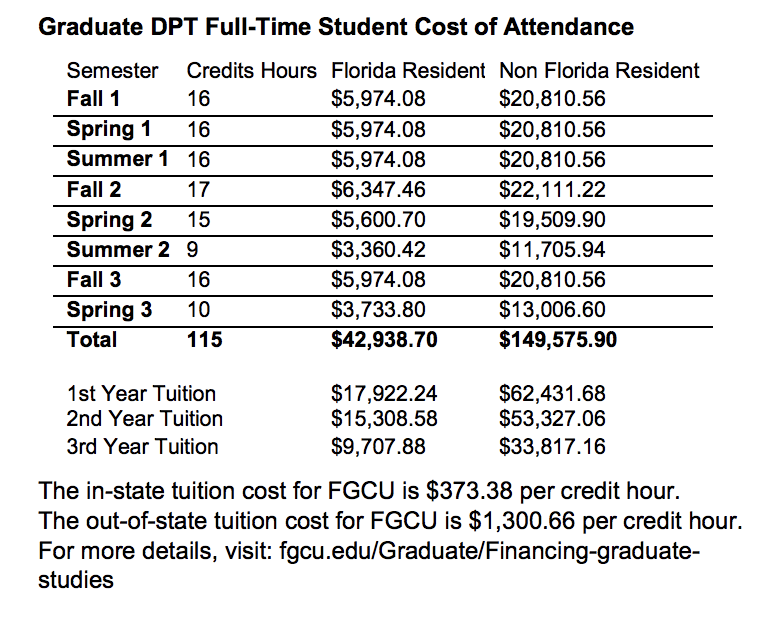
Students who meet the criteria can apply for instate residency status after the first year. See the Registrar's website for more information.
----------------------------------------------------------------------------
DPT students have additional costs, some examples are:
Program Fee $340
Lab Attire and Clinical Attire $150
CPR/First Aid AED training $50x2
Immunizations $ as needed
Criminal record background review and Castle Branch $125
Membership dues for professional organizations $90x3
Professional certification exams, $ based on Independent study or Independent research
Travel to off campus learning experiences and clinical rotations $ as where located
Housing room and board ~$9,700 as identified in Financial Aide or per your selection on campus or off campus
---------------------------------------------------------------------------
Financial Aid Opportunities
Visit Graduate Studies ScholarshipVisit FGCU's Financial Aid Web site for information about grants, additional scholarships, loans, and student employment.
Health Scholarships
Complete one FGCU Foundation Scholarship application to qualify for more than 300 scholarships. Scholarship awards average $1,600.
Examples of scholarships include:- Students who return to complete a degree after taking time off
- Students 23 years or older
- Students from the surrounding five counties: Collier, Lee, Glades, Hendry and Charlotte
- Students interested in pediatrics who plan to stay in SWFL after graduation
- Students living in Lehigh Acres
- and more...
-
Program Outcomes
Toggle More InfoBelow are program outcomes:Class of:
2025 - 2026
Graduation Rate:
93.3%
# grads who took the exam at least once:
54
First time pass rate
100
# grads who passed the exam after all attempts:
54
Licensure Pass Rate:
100%
Employment Rate:
100%
2025 Graduating Cohort - FSBPT Outcome ReportGraduating Class First Time NPTE Pass Rate Mean Score Summary Performance for ALL U.S. Schools 27 Students 100% 723.2 668.3
The DPT Program at Florida Gulf Coast University is accredited by the Commission on Accreditation in Physical Therapy Education (CAPTE), 3030 Potomac Ave., Suite 100, Alexandria, Virginia 22305-3085; telephone: 703-706-3245; email: accreditation@apta.org; website: http://www.capteonline.org. If needing to contact the program/institution directly, please call 239-590-7530 or email DPTadmissions@fgcu.edu .
MEET THE PHYSICAL THERAPY TEAM
Library Resources Continuing Education support our programs File a Complaint
Any Suggestions? Let Us Know How We Can Improve!
Why Choose FGCU's Doctor of Physical Therapy Program
The Doctor of Physical Therapy Program at FGCU is a dynamic, innovative program utilizing a hybrid problem based curriculum model. Students choose FGCU and the DPT program for a variety of reasons ranging from Education to Environmental to Person. While conducting interviews with applicants and admitted students, a wide variety of answers to that question have been received. Here are just a few comments from those two groups:Applicants:
- Sunshine, beaches, great area, it's like paradise
- Small class size
- Excellent student-to-faculty ratio
- State of the art facilities
- NPTE pass rates exceeding state and national averages
Graduates:
- Expert faculty with diverse content expertise and experience
- Faculty and staff availability to students
- Hybrid problem-based learning format, promoting life-long active learning skills
- Opportunity to do an Independent Research project or an Independent Study project, allowing for acquisition of poste-entry level knowledge and skills in a specialty area
- NPTE exam preparation throughout the curriculum
We’re Here to Answer Your Questions.
Marieb College of Health & Human Services
Department of Rehabilitation Sciences
10501 FGCU Blvd. S.
Fort Myers, FL 33965
239-590-7530


