

Behind the Design: Emotion by Design
November 20, 2026 / Digital Learning / Tag: Digital Learning

Sarah's Story
Meet Sarah, a sophomore enrolled in a college writing course.
From the beginning of the semester, Sarah does just enough to get by. Her assignments
meet the requirements but lack depth or originality. She participates in group activities
but rarely contributes beyond what's expected. She doesn't ask questions, attend office
hours, or engage much in class discussions.
By mid-semester, something has changed. Sarah begins missing assignment deadlines,
her attendance becomes inconsistent, and her participation declines even further.
Her professor reaches out several times by email but receives no response.
The Question
How do we get students to engage and persist in their learning?
The Science Behind the Design
Emotion and learning are deeply connected. Consider some of your most memorable learning events (positive and negative). Many of our most memorable learning events come with a strong emotion. Research in neuroscience and educational psychology tells us that emotions influence how students pay attention, process information, remember what they've learned, and decide whether to persist when learning becomes difficult. Emotion isn't something that happens alongside learning. It's part of the learning process itself.
Emotion helps direct attention. Our brains prioritize information that feels interesting, meaningful, or personally relevant. Curiosity can draw students into a learning experience, while boredom can make it difficult to sustain attention.
Emotion influences memory. Emotionally meaningful experiences can strengthen how information is encoded and remembered. When students connect new ideas to their experiences, interests, or goals, learning can become more memorable.
Emotion shapes motivation and persistence. Students' feelings about their ability to succeed and the value of what they're learning influence their willingness to invest effort. Enjoyment, interest, and hope can encourage persistence, while prolonged anxiety, frustration, or feelings of isolation can contribute to withdrawal.
Emotion also influences connection. Students who feel supported by their instructor
and connected to their learning community may be more willing to participate, ask
questions, and work through challenges.
A Word of Caution
Not all emotions associated with learning need to be positive. Frustration, confusion, and uncertainty can be part of meaningful learning, especially when students feel supported as they work through challenges.
It's also important to remember that emotions are personal. What sparks excitement or curiosity for one student may cause discomfort or trigger distress for another. When designing emotionally engaging experiences, consider offering choices, alternative activities, and opportunities to opt out without penalty.
How can we use what we know about emotion to make intentional course design decisions?
In Practice
-
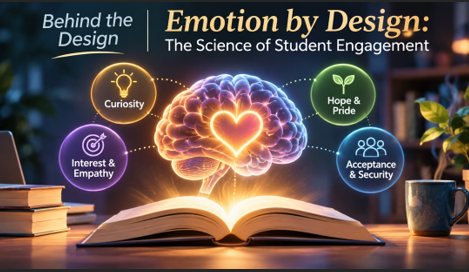
- Curiosity: Capture Attention
Curiosity draws students into learning and motivates them to explore new ideas.
Begin a lesson or module with an intriguing question, surprising fact, compelling image, or real-world dilemma. Give students something to wonder about before introducing the content. - Interest and Empathy: Strengthen Memory
When learning evokes interest or empathy, students are more likely to find the experience meaningful and memorable.
Use stories, authentic problems, and examples that connect course concepts to students' lives, experiences, and interests. - Hope and Pride: Support Motivation and Persistence
Hope encourages students to believe success is possible, while pride in their progress reinforces their willingness to keep trying.
Break complex assignments into manageable stages, provide constructive feedback, and create opportunities for students to recognize their growth. - Acceptance and Security: Foster Connection and Belonging
Feeling accepted and emotionally secure can help students participate, ask questions, take intellectual risks, and seek help when needed.
Create opportunities for meaningful interaction through collaborative activities, supportive communication, and shared reflection.
- Curiosity: Capture Attention
Reflect
Let’s look back at Sarah’s story. Imagine experiencing your course through Sarah's
eyes.
What opportunities are there to feel curious, interested, hopeful, or connected?
Where might those opportunities be missing?
Resources
Cavanagh, S. R. (2016). The spark of learning: Energizing the college classroom with
the science of emotion. West Virginia University Press.
Darby, F. (2020, September 18). Emotions in online teaching: A powerful tool for helping
online students engage, persist, and succeed. Faculty Focus.
https://www.facultyfocus.com/articles/online-education/online-student-engagement/emotions-in-online-teaching-a-powerful-tool-for-helping-online-students-engage-persist-and-succeed/
Darby, F. (2026). The joyful online teacher: Finding our fizz in asynchronous classes.
University of Oklahoma Press.
Miller, M. D. (2014). Minds online: Teaching effectively with technology. Harvard
University Press.
Tag Cloud
Share Post


