

Behind the Design: Designing Clear AI Expectations
August 07, 2026 / Digital Learning
Behind the Design: Designing Clear AI Expectations

Behind the Design
Behind the Design pulls back the curtain on the decisions that shape effective online and technology-enhanced teaching. Each episode begins with a real faculty question, explores the learning science and instructional design thinking behind the answer, and shares practical strategies you can use in your own courses.
The Question(s)
- What do the Simple Syllabus AI Statement options mean?
- How do I clearly communicate that statement to my students?
The Research
Research suggests that using an AI Assessment Scale is a best practice because it moves the conversation beyond simply allowing or banning AI. Instead, it provides a clear framework for communicating expectations, designing valid assessments, and helping students use AI ethically and appropriately in support of learning (https://open-publishing.org/journals/index.php/jutlp/article/view/1707).
Practical Implications
Identifying Your AI Level:
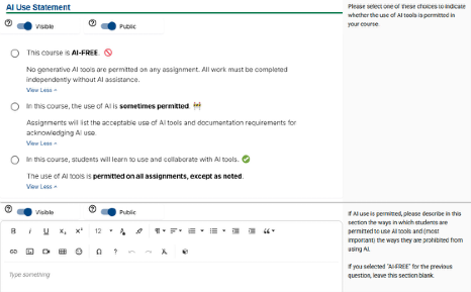
Simple Syllabus offers three options, No AI, Some AI and All AI. This can be confusing to students, so we want to be clear about what each of these levels mean.
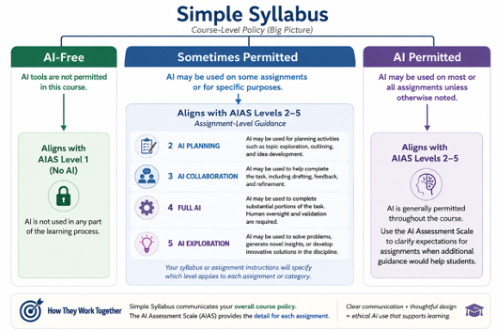
Looking at the revised AI Assessment Scale based on the AI Assessment Scale by Perkins, Furze, Roe & MacVaugh, levels are broken down and detail how AI can be used for each.

How the Two Frameworks Work Together
Simple Syllabus communicates your overall course AI expectations. The AI Assessment Scale provides assignment-level guidance by clarifying how AI may be used for specific learning activities. Together, they help students understand not only whether AI is permitted, but how it should be used to support learning.
Communicating AI expectations to your students in Simple Syllabus and beyond:
Simple Syllabus includes a textbox where you can explain your AI expectations to students. Use this space to communicate more than whether AI is allowed; help students understand how and why AI should be used in your course.
Consider including:
- How AI expectations will be communicated (for example, using the AI Assessment Scale for individual assignments or assignment categories).
- The rationale for the level of AI use you have selected.
- The process that will be followed if unauthorized AI use is suspected.
Although the Simple Syllabus instructions suggest leaving the textbox blank when you select AI-Free, consider briefly explaining why AI is not appropriate for your course or specific learning outcomes.
Beyond the syllabus, continue the conversation throughout the semester. Consider discussing:
- AI literacy and responsible use
- Academic integrity and ethical decision-making
- AI as a thinking partner rather than an answer generator
- Co-created class expectations or honor codes
- Ethical dilemmas involving AI
- How AI expectations may evolve across different assignments
The more students understand the reasoning behind your AI expectations, the more likely they are to use AI appropriately and in ways that support their learning.
Reflect
There is no single "correct" AI policy. The most effective policy is the one that aligns with what you want students to learn, how you will assess that learning, and the role AI plays in your discipline. As you develop or revise your AI statement, consider the following questions:
- What specific, foundational skills in my course will be completely lost if a student uses AI to generate the work, and what skills might be enhanced by using it?
- When my students graduate and enter our professional field, how will AI be used as a legitimate tool in their workplaces, and how can my policy model that reality?
- Does my current approach to communicating course rules rely on compliance and fear of penalties, or does it invite students into conversation about academic integrity and shared responsibility?
Resources:
Jarenski, S. (2024, September 5). Conversation as Care: Why Talking to Students About AI is Our Most Essential Task Right Now. The Hub for Teaching and Learning Resources. https://dearbornhub.net/conversation-as-care-why-talking-to-students-about-ai-is-our-most-essential-task-right-now/
Perkins, M., Jasper, R., & Furze, L. (2025). Reimagining the Artificial Intelligence Assessment Scale: A refined framework for educational assessment. Journal of University Teaching and Learning Practice, 22(7). https://doi.org/10.53761/rrm4y757
The Assessment Scale Website https://aiassessmentscale.com/


