

Lutgert Researchers Use Brainwave Technology to Rethink How Students Learn Accounting
February 20, 2026 / Lutgert News / Tags: neuroscience, Research, Accounting
Dr. Kalana Malimage and Dr. Shawn Granitto from the Department of Accounting, along with Graduate Assistant Tabata Del-Fondo, are conducting a groundbreaking research project that integrates cognitive neuroscience with accounting education. Using a neuro-headset to collect real-time brain activity data, their study examines which teaching modality (text-based learning, video-based learning, or AI-assisted learning) is the most efficient and effective for student learning.
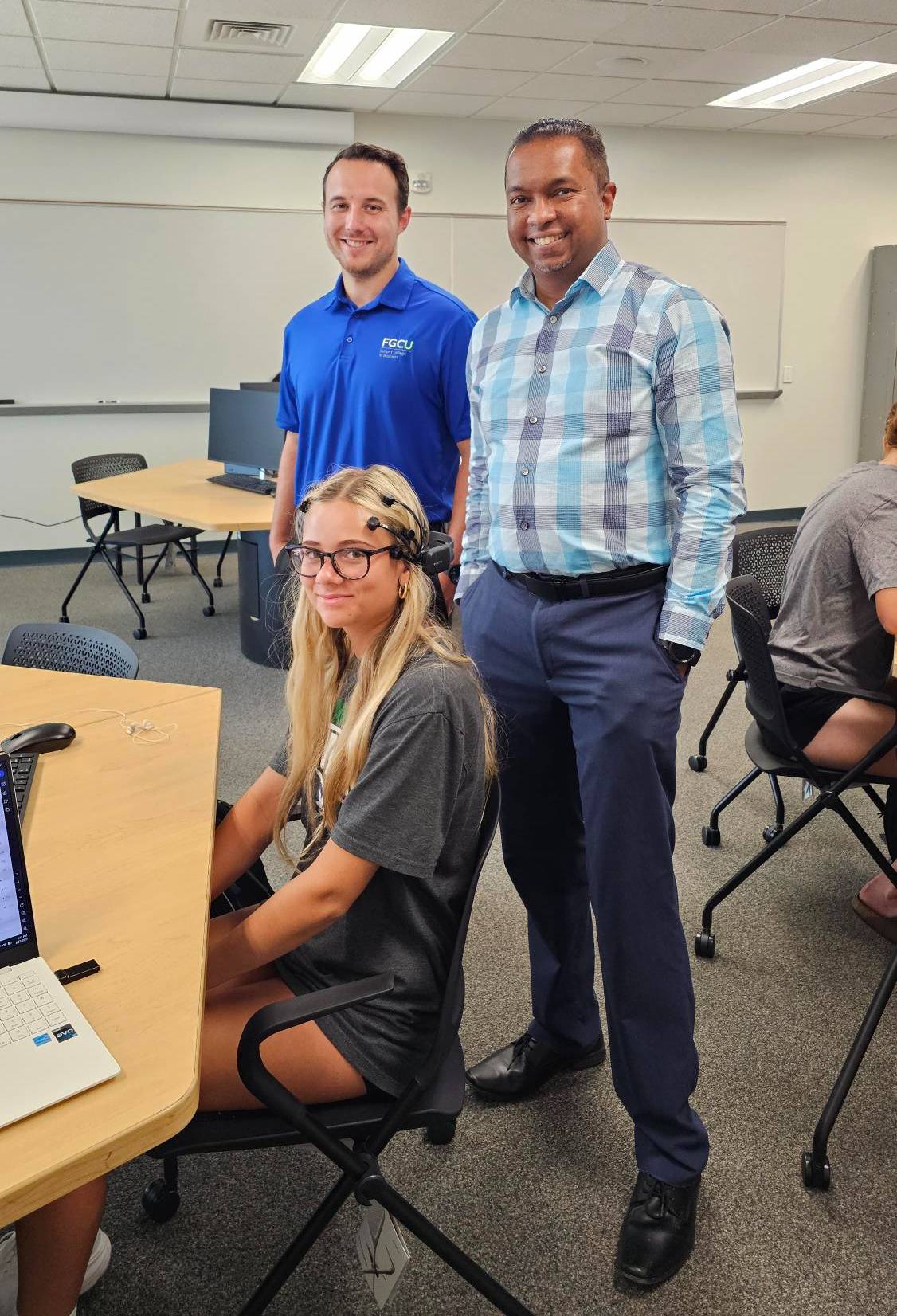
The EMOTIV EPOC+ headset is a wireless, multi-channel EEG device widely used in academic research. It captures real-time brain activity across key frequency bands—delta, theta, alpha, beta, and limited gamma—enabling researchers to examine cognitive load, attention, engagement, and learning processes. With 14 EEG channels, portability, and access to raw EEG data, the device is well-suited for both laboratory and classroom-based behavioral neuroscience research.
Together, Dr. Malimage and Dr. Granitto developed a controlled study involving undergraduate students enrolled in Introduction to Managerial Accounting. Students were asked to learn a topic that had not yet been covered in class and then answer an assessment question related to that topic. Participants were randomly assigned to one of three learning modalities: text-based materials, a recorded video lecture, or independent learning using ChatGPT. While completing the learning task, students wore the neuro-headset, allowing researchers to record brain activity alongside learning performance outcomes. Students received extra credit for participating in the study.
Dr. Malimage and Dr. Granitto have now completed data collection and analysis and are finalizing their manuscript for submission to a premier academic journal. In addition to this study, they are actively engaged in several other research projects exploring topics such as fraud detection and real estate investments, further highlighting FGCU’s growing presence in interdisciplinary, data-driven accounting research.